RED-LINING A BIRTHDAY


So turning 61 is no big deal. The big “six-oh-oh” is now ancient history and I’m beginning to find that I am quietly celebrating the turning of each decade with more gratitude and anxiousness.

This year found us camping on the outskirts of Atlin, British Columbia awaiting the official kick-off of the annual Atlin Music Festival. But we had hours to fill before the first musical notes would emanate from the big tent.

After a skillet of eggy-vegetable breakfast was washed down with copious amounts of Midnight Sun roasted coffee, we laid out our “younger next year” workout for my birthday.

Younger Next Year <www.youngernextyear.com/> is an excellent book for any middle-aged or older persons. Basically it argues that you can dial back our biological clock. It looks at the latest research on aging and then offers a blueprint for men and women 50 or older to live like 50 year olds until you are well into your eighties.   In the book the authors argue that basically your job for the rest of your life is to move your body somewhat vigorously for at least 45 minutes each day.

Nancy and I loaded our two-wheeled “bush ponies” up on the bike rack, next to Hugh and Cheryl’s canoe.  (We love our new Trek mountain bikes. . . with the 29-inch wheels. Thanks CyclovaXC!!  <www.cyclovaxo.com>.

Hugh and Cheryl were going to paddle and explore Surprise Lake, while Nancy and I were going to pedal into the Ruby Creek area. The plan was to bike until mid-afternoon and then either meet them or we would bike the twelve or so miles back to the campground.

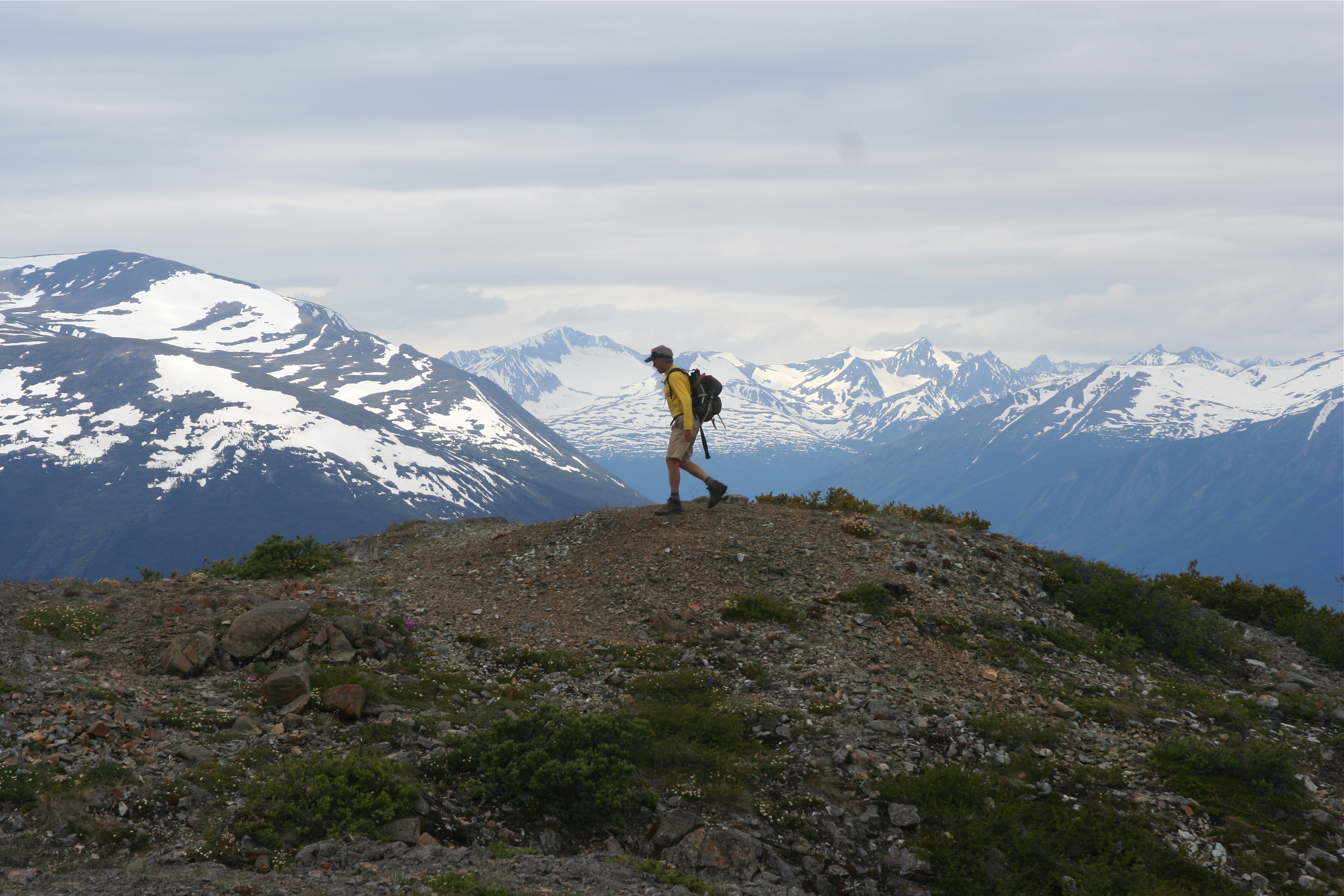
We got on our bikes and headed up and around Surprise Lake with a gradual climb on the gravel road. Then we came to a rugged, single-lane mining road that runs parallel to Ruby Creek. It eventually leads to a molybdenum mine. Almost immediately we began climbing a series of pitches. There were several that had us breathing oh-so-big.

Poet, Walt Whitman would have enthusiastically sang out that we were “inhaling great drafts of space,” . . .in this case, great drafts of oxygen.  While our lungs were mightily inhaling our thighs were on fire as they strained to keep the pedaling cadence that allowed us to purchase the hill. Oh it hurt so good!

The percussion of our accelerated heart rates was drumming loudly in our ears and our breaths were pulling in huge waves of fresh mountain air and releasing equally loud carbon tainted exhalations.

We would face a steep climb only to have a brief respite as we reached what we perceived as level ground. Then we would gasp one or two-word sentences to each other. A hilltop exchange might go as following: “Damn!” Then take in a big gulp of air quickly followed with a gushing exhale “Tough!”

After our fourth steep pitch we paused longer, choking down some water. I was losing my enthusiasm for this idea of getting younger next year but we both decided to push on for one more and see if the road would give us an easier grade to the head of the creek valley. We were now at an elevation that was moving us beyond the tree line. Willow and dwarf birch or “buck brush” was dominating the rough roadside.

We were also encountering more frequent piles of bear shit. On the mining road. Clearly they used this lane for easier access to the high country. Both of us had containers of bear spray in our packs but I couldn’t help wonder if my heart rate wasn’t additionally accelerated.

We both were now in the red-line zone of our heart rate. Red-lining is a zone where car racers know they are flirting with working their race machine too hard. To run too long in this zone is flirting with blowing an engine. I did not want to blow my “engine” on my birthday.

For humans, red-lining your heart zone is making it work at a level that is 90 to 100% of your maximum heart rate. You simply cannot go any higher and it is impossible to stay in this zone for more than a few minutes.  Normally one should consult with a doctor about working your heart at such a high rate.  Not possible for any consultations with the nearest hospital more than a two-hour drive in a car.

Generally, and I use the word loosely, another attribute in aging is an acquired wisdom. And so it was, on the fourth or fifth steep pitch, that my brain overrode all other systems and told me to stop. Now!

Gravity and good bike brakes are a wonderful thing. And in short order, I understood this getting younger idea. The Ruby Creek valley was filled with tandem hoots of unabashed delight as we wove our way down the switchbacks.


Foraging for Twinflower

While the river noise relaxes me, it is the collecting of plants, particularly twinflowers that puts me in a high state of contentment.

I love the little pair of pink blooms that make up this boreal dweller twinflower. Connected by threadlike stolons, or runners, many twinflowers are joined together. And the mat of small green rounded leaves that cluster above the perennial runners are nearly as appealing to me as the flower.

When mats of these delicate flowers emerge, I can’t help but think of Carl Linnaeus, the charismatic Swede of the 18th century who not only was a grand promoter but he had the brainstorm of classifying flora and fauna, giving them a Latin title composed of a genus and species name. This tool, referred to as binomial nomenclature, offered a straightforward way that botanists around the world could understand.

Linnaeus assigned over 8,000 plants and animals with their scientific, or Latin, names. He named one, a favorite, after himself. That was twinflower or Linnea borealis. (Linnea “Linnaeus” and borealis “of the north”)

Some people might consider me greedy, not unlike the red squirrels that frequent these same forests.  The sassy rodent stashes pine and spruce cones for winter sustenance and I collect pressed twinflowers for creative sustenance. I always keep a stash of dried delicate botanical specimens on hand for making wedding, greeting, or birthday cards. I am also partial to small burr oak leaves and the intense blue of alpine forget-me-nots.

However, I am ethical in my collecting. I never take many flowers or leaves from one spot. And if I find only one or even a handful, I will pass them up and wish them well for healthy propagation.

Less than 10 minutes from the Outpost there is an old aboriginal trail that I sometimes hike or pedal with my mountain bike. There is a piece of fairly open forest, composed of lodgepole pine and spruce. There is very little understory here. Hugging the ground are lovely patches of ashen and green-hued lichens interspersed with abundant lingonberries that will warrant my attention in a little over a month when we take to the woods, pails in hand to garner the scarlet, tart fruits.

Most Yukoners and Alaskans call these circumpolar treats “cranberries.” So desirable are these treasure that the local organic bakery will pay pickers $15 per pound to enhance muffins and breads.

But today it is the mats of twinflower and bastard toadflax that hold my attention. You might wonder how something so delicate and freshly pink can keep company with the likes of a plant called “bastard toadflax.”

Surely, the proper Sir Linnaeus frowned at such a degrading common name. So he ignored the back alley name and gave it a more graceful scientific name; Comandra umbellata. Why such a title is fun to sing out! Comandra umbellate! Co. .MAN. .dra   umbel. .LATA!!

Maybe it gets the common name “bastard” because it is a semi-parasitic plant and it is able to absorb water and nutrients from the roots of neighboring plants. Simply put it robs; consequently it must be a bastard. There is no lilting song when you hiss “bastard toadflax!”

Both twinflower and bastard toadflax spread through seeds and vegetatively or through thier roots. A single clone of each species can cover a wide area and flourish for years.

I leaned my “two-wheeled “bush pony” against a pine and carefully sat on the ground so as to minimize flattening any twinflowers. And I began to excise flowers from the hordes. At one point I lay my head on the ground to get the perspective of the red squirrel that was clearly and loudly upset with my presence.  Each twinflower’s threadlike stem is “y-shaped.” From each branch of the “y” dangles a small pink flower that looks like a tiny tapered Victorian lampshade.  I was spellbound peering through the wee forest of tiny pink delicacies.

After a half hour of moving from patch to patch of twinflower, I carefully filled each of my blotter pages in my small plant press with tiny flowers. I carefully packed the press into my daypack next to the bear spray, retrieved my bike.

As I pedaled through the pines and spruce, towards home, I noticed multitudes of twinflower blooms flanking the old trail. It seemed that in my collecting them I was now super aware of their ubiquitous presence.  It was as if I was a two-wheeled float in a parade and the unlikely partners, the pink and bastard bystanders were mutely at attention as I passed. While in the background from beneath the pines was the pregnant pause of ripening cranberries and the unseen scolding of a territorial red squirrel.


What the World Needs


We had barely turned down the dead end 60-mile road that leads to the northern British Columbia community of Atlin, when we encountered a solitary grizzly grazing on lush July vegetation in the roadside ditch.

We were on our way to the annual three-day Atlin Music Festival. http://www.atlinfestival.ca/ This music fest is less than ten years old but it has become a favorite destination for both musicians and festival attendees. In fact the site is so spectacularly beautiful that some performers have  requested an invitation to participate. This year’s slate of musicians and storytellers included artists from the Yukon, Cape Breton Island, Manitoba, British Columbia, Sweden, New Zealand, Senegal and the United States.

We met friends Hugh and Cheryl at the Pine Creek campground.  The quiet campground is located two miles from the music fest making it an easy bike ride on our mountain bikes. Most of the 1000-plus attendees camp in the old mining town at the edge of the festival.

Besides the amazing music, I loved the gathering of people. Smiles came easy. Children roamed around like small packs of playful fox pups. And most amazing is that they were often alone, without their parents. However, the community of folks here are clearly caring and quick to tend to any young mishaps.

And those human-cubs that were barely able to run, quickly joined those who could as they hopped, spun, stumbled , flew with outspread arms, and dashed back and forth in front of performing bands. There were numerous collisions that result in staggering tearful dashes back to mom or dad. A quick hug and words of comfort always performed healing miracles and the youngster was quickly pulled back into the vortex of little people energy.

The sand pit, about the size of a two stall garage, was littered with colorful plastic shovels, rakes, sifters and pails.It attracted the kids like no candy store could. Once, as I walked by the hump of sand, I paused to watch the kids. There were  thirteen wee ones totally engrossed in their efforts. Most amazing is that each was working alone. Each was fully immersed with their imagination in carving, excavating, building or burying. I wanted to crawl into every one of their brains and listen in to the process.

As a species, we humans have an affinity to gather in tribes rather than keep company with loneliness.  Like iron filings jumping towards a magnet, we tend to merge towards song, dance and food. The Atlin festival provided these critical elements in spades.

Jonathan Byrd*, a highly regarded and awarded songwriter and flat-picking guitarist from North Carolina, repeated a stanza from his song, The Ballad of Larry, “Loneliness is poverty.”

Looking around to the sea of warmth, I felt like a rich man.

Swede-gone-Canadian, Sarah MacDougall, http://sarahmacdougall.com/ who has spent the last few months living in the Yukon, repeatedly pleaded, almost wailed, during the singing of her hit Ramblin’, “I don’t want to be alone anymore.”

Clearly a crowd favorite, she was in no way alone anymore.

Nationally regarded and Yukon-born storyteller, Ivan Coyote told tales that clogged my throat with a wagon train of lumps and blurred my eyes with a surprising surge of tears. She wove tales of loneliness in her growing up and realizing that she was more boy than girl but that she had no choice but to follow and honor her sexuality by boldly and mightily declaring her being a lesbian.

If you were lonely at the Atlin Music Festival it was due to your own sinking spirits.

The festival ended Sunday evening. It didn’t take long for caravans of tired attendees to begin the drive back down the dead end road. I suspect the earlier spied grizz was dining no where near the road on this busy evening.

Suddenly we found all the campsites . . . well . . . a little bit lonely. Nancy and I chose to spend another night so we could have more time with Hugh and Cheryl before they pulled out for the long drive south to their Canmore, Alberta home. After good byes and hugs were exchanged we hoisted our daypacks, loaded with snacks, water and extra clothes, for the hike up Monarch Mountain.

We climbed and climbed, as did our heart rates. Soon we were beyond any vestiges of aspen and into the sub-alpine fir. Climbing higher, out of the fir, we  finally we found the party-colored slopes of alpine. Carefully we stepped around carpets of stoic, stunted and showy flowers. The views in all directions elicited gasps and croons. Here we could see miles and miles of the long Atlin Lake. We spied a white horizon of icefields high in the Coastal Range Mountains.


After a picnic lunch, in a wind-sheltered draw where we kept company with the sky-blue blooms of alpine forget-me-not, we reluctantly turned around and began our trek back.  As we crossed the summit alpine we nearly stepped on a female blue grouse. She didn’t feign injury to lure us from any nearby nest or young so she was clearly not alarmed.

I considered pausing to photograph the bird that stood on a smooth rock less than ten feet from us. Nancy whispered, “She’s not a very impressive bird is she?” She was right so we moved on to let her be unphotographed.

We climbed a knoll and were dropping down when we spied a male blue grouse.We stopped to watch the unalarmed bird. These game birds are the second largest grouse species in North America. A Yukon friend always liked to hike up into the bird’s haunts in the sub-alpine fir groves  in late September to secure his favorite Canadian thanksgiving table fare of two plump blue grouse.

The solitary male grouse seemed totally oblivious to us. We grew new smiles when the bird paused, raised his fanlike tail, inflated his bare throat patches and provided us with another Atlin music number.  He elicited a few “booms,” that sounded like a slow series of deep-throated hums.

 He paraded by, not twenty feet from us. His bright orange eyebrows belonged to a Mardi Gras parade. When not hooting, he busied himself by pecking cream-white mountain avens petals off the stunted plants. I eased the camera out and slowly slid on my rear downhill to get closer. I did not make eye contact. Perhaps he thought I was a grazing Dall sheep or caribou.

We listened to his low crooning booms; his own rendition of “I don’t want to be alone anymore.” Maybe, just maybe, on the other side of the flower festooned knob, there was a female grouse that was on her way to the Atlin Alpine Music Festival.


*Note: Jonathan Byrd was a major favorite of mine and I highly recommend going to his website http://americanaagency.com/Jonathan_Byrd.html to listen to a sample of his work and check out his tour schedule. He will be in Minnesota in November.


Voices of the River


Small rivers typically murmur, chuckle, bubble, shusssh, or maybe at best sing. But recently, the fast watershed that passes our Outpost in the Yukon, the Watson River, has shown us that it doesn’t even know to how to murmur or chuckle. No wimpiness or meditative score for this flow. Instead, it has been full-voiced in a bawdy song that at times borders on a rage. This early summer chorus has been a loud, hoarse sea shanty that is a prelude to its destiny of merging with the Yukon River and finally the Bering Sea nearly 2,000 miles away.

With abundant snow in the Coastal Mountains to our west combined with some heavy spring rains, the rivers rose quickly. Looks like the release of snow melt will be a key player in water levels here for the rest of the summer.

We had come north this spring with the intent of putting the Outpost up for sale. Not only is it apparent that our securing Canadian permanent residency is a bureaucratic maze and no longer worth pursuing,  but the housing market in this area is crazy high and if we were astute financial game players we would sell and make a tidy profit. And then there is also the 2500-mile drive back and forth from Minnesota. It is a haul and with gas prices climbing, the trek bears a significant migratory cost.

However, in less than a week after we settled down at the river’s edge, the river in true preacher form delivered a tireless sermon on riches beyond dollars and cents.  The river has shown us that experiences are priceless and clearly the library of life has far more experiences waiting for us to add to the book cart.

Perhaps our feeling of renewed euphoria has to do with the indefatigable, yet restful message delivered to our ears. The constant river pitch is a comforting drone, not unlike the inspiring drone of the famous Highland bagpipes.  Neurologists have found that our brain waves slow and we perceive a sense of tranquility and well-being when we are in the company of droning noise. It doesn’t matter if it’s a Gregorian monk chanting, a bagpipe rallying or even a rushing river; each of them creates a droning sound.

You can even download or buy CDs of running rivers, ocean surf or rain showers.  This collection of pleasing water sounds promises to induce a state of relaxation and serenity.  A dear friend uses a free app of a lively, running river to put their baby daughter to bed. It has such become such a predicable success in creating the ultimate  lullabye that when the cell phone is tucked within a foot of the baby’s head she quickly falls asleep.

I prefer the real thing. So the other day, I headed over to the river’s edge to check out the tunes. As I walked beneath the upper windows of our log home, I nearly stepped on a dead bird. Crumpled in the grass with partially dried eyes, it didn’t invite petting. But I stopped, bent over and gently picked the bird up for a positive ID. It was clearly a thrush and given that there was no sign of any distinct buffy eye ring or reddish rump, I could disqualify a Swainson’s or Hermit thrush. This was another northern cousin, a gray-cheeked thrush.

It seems so unfair that this Yukon songbird that has run the gauntlet of dangers during its thousands of miles of spring migration from Central America back to the sub-arctic boreal forests, flying most of those miles during the night darkness, met its end by flying into a stout pane of glass. To the bird, the window was not a barrier. Instead, it likely looked like a blue-sky portal. I hoped that death came quickly for the thrush.

I walked over to the river’s edge with the dead bird and  reached out to gently set its body on the tossing whitewater.

The river’s tone changed to a droning dirge as the thrush bobbed through the curling waves, surrounded by a constant wash of white noise.  Disappearing and reappearing the bird looked as if it were swimming through liquid clouds towards an eternal spring.

I turned to the house and felt anchored and inspired at the same time. The bird had quickly bounced past the river’s bend, past the two big boulders that kicked up loud waves.

Less than a week later we wove our way through the same rapids in a canoe. Our hoots harmonized well with the river’s tenor voice.

Embracing Edges

Exciting things happen at edges.

Whether it’s an edged tool like a knife or axe or at the blending of two habitat edges like a woods and a wetland or at the humble edge of the passage of time we can be sure of a change. Edges were not so evident as Nancy and I steered our Toyota Tundra northwest out of Minnesota, into North Dakota and into Manitoba.  We were in the first day in our migration to the Outpost in Canada’s Yukon.

The richness of the Red River valley is due in large part to the lake sediments left behind after the ancient glacial lake Agassiz drained away. The land is flat and vast. After all this extinct sea-like lake held more water than all the existing lakes of the world. Finally our eyes were treated to a bump in the topography when we approached  the distinct ridge that marks the western shore of the old giant lakes beach line. Beyond that rise there is still a stretch of hundreds of miles of mostly flat and mostly mundane farmland.  Here the horizon seems to spill off uninterrupted into the spaces of west, north, east and south. All appears the same without distinct edges.

It was during the crossing this span of amazing productive land that I internally reflected on my own personal transition. I have been fortunate to lead an intentionally vigorous and healthy life. Through the years I have pushed my own edges while paddling remote whitewater rivers in the far north, winter camped under diamond bright stars while the cold drove the trees into explosive retorts, backpacked up peaks, rode bicycles up and down mountains and have even looked a grizz in the eye. Living big is what I want to do. But suddenly in the past two months, I have bumped up against the edge of mortality. I am fully aware that driving down the freeway is statistically far more dangerous than running whitewater in a canoe or encountering a grizzly bear, but those things haven’t rattled me like the news that I am afflicted with atherosclerosis, commonly called hardening of the arteries.

Forty seconds of laying perfectly still, flat on my back with my arms extended over my head allowed medical personnel at the Minneapolis Heart Institute to scan my heart. It was the ensuing picture that moved me from the edge of comfort to “yikes.” The smoking gun in determining why fat, cholesterol and other substances build up in the walls of my arteries and form hard structures called plaques was not so easy to discern. It is a very rare day when my wife and I buy any red meat. Basically the only meat we eat is venison or wild game I hunt. We eat wild salmon once a week.  And almost all of our vegetables and fruit are organic raised ourselves or bought. We are both very physically inclined. Cycling, paddling and hiking over the warm months and then skiing, spinning on an indoor training cycle or splitting firewood during the cold months.  I don’t smoke and am only a moderate consumer of alcohol. So what gives? Well it turns out that I was born with a body that likes to create a higher than average level of cholesterol. In other words my family history has brought me to the edge of realizing my own mortality.

The fact that my father died of a massive heart attack while in his fifties was the impetus that nudged me to being proactive and getting a heart scan in the first place.  I have never felt healthier and was training hard on my road bike to cycle solo the 150 miles of the Chilkat International Bike Relay http://kcibr.org/. (Note this will not be possible. For the first time in the 20-year history of the relay, registration filled a month and a half early. Guess who did not get in?) In my 60 years I have had only a very few prescriptions, once for painkillers and a few dose of antibiotics.  And other than the handful of stitches received after I was rendered sterile via a vasectomy, I’ve never had a stitch! Suddenly I am one of millions of folks in America on statins and I don’t like it.  But I will take the chance and hope they help reduce my cholesterol levels.

So while I move along the thin line of good health and suspect health, I will reduce my intake of saturated fats. For me that mostly means sacrificing my butter, cheese and ice cream intake. I will work hard to find it within myself to continue climbing peaks, on bike or foot, drinking great gulps of crisp air in the process. After all, the next transition from my mortal life to one beyond will be no different than a remote wild river bend that is both alluring and frightening. But I can’t imagine not taking that peek.

Our log outpost on the Watson River is positioned with a view of an upstream and downstream bend. It is the stuff that dreams are made of and even though I have been swept in a canoe through the dancing waters of both bends, my gaze is daily drawn towards those edges where the river turns unknown.

I suspect every traveler who drives west across the Canadian prairies or the plains in America sits up a bit straighter when they spot the first glimpse of Rocky Mountains on the horizon feels an alertness that is renewed. In a sense it is going from flat lining to a healthy ragged spike of living. It is that alertness that makes me feel most alive and demands that I pay close attention to life. And in the process be continually astonished. With my own diagnosis of arteries hardening, I have found my own personal peak and it too has nudged me towards a renewed mindfulness of this very moment.

Time to turn north, towards the boreal edge and the Yukon where residents and visitors alike are reminded to “live large.” So be it.


Portals to the Right Side


Admittedly there have been moments in the past few years where one might argue that I have had too much spare time. There are instances, often in the middle of a writing project or some other responsible task, when I suddenly feel overwhelmed by the need to break away and create some whimsical art.  The project is usually fully spontaneous and rolls freely right off my right brain.

Born in the Midwest with primarily a Scandinavian lineage, I am cursed and blessed with a strong work ethic. Some days I forget to eat lunch and other days I am so burned out that I am poor company later in the day. The work ethic can both serve me and imprison me.

So how does one find balance? My wife, Nancy, and I enjoy reading. We have a practice of having a read-aloud book as well as our private reads. Currently we are reading Helen and Scott Nearing’s classic  Living the Good Life. This sturdy couple was the stuff of legends.

One discipline they strictly adhered to was the daily practice of working four hours for their sustenance, they called it “bread labor” (i.e. gardening, tapping maple trees, building fences, buildings, etc.) and then an equal number of hours in grubbing creativity from the right brains. They would read, write, work on speaking engagement pieces or create something for the sheer joy of creation, simplicity, frugality and purposeful living. Operating on low overhead costs, they built their own stone buildings on two farms in New England and they created productive, organic gardens while writing, speaking and living a life committed to sustainability, and social and economic justice.

Imagine if we were not so wedded, or perhaps shackled is a better word, to the notion of working eight plus hours for a minimum of five days a week.

What would your life looked like if you could remove debt, reduce buying stuff and junk? And instead, live frugally, grow your own healthy food, move your body to a sweat every day and then wallow blissfully in a shower or tub and spend the rest of the day learning and creating.

Even if the Nearings had had the opportunity to buy a home computer, I think they would have enthusiastically shunned any such technology.

In recent years, I have come to embrace my affliction of  “spontaneous outbursts of creative expression “(SOCE). Rather than shove them aside, I am more likely to say to myself, “Why not?

Let me share my most recent episode. We had dropped a tall, old red oak that had stood tall next to the yard. Clean up included cutting all the branch tips and hauling the long pieces to brush piles in the woods. These have become cottontail hideouts and, based on past observations, likely nesting haunts for brown thrashers.

I cut the rest of the tree  into firewood chunks. I had gone into the garage to fetch up some splitting wedges to work on the thick butt end of the oak. I glanced over to the wall where I spied a unique old wood door leaning against the wall.   Salvaged  from a long abandoned  farmstead,  it was one of those items that I figured I would someday have a use for. Suddenly, out of the blue,  I had the urge to hang the door. It would fit perfectly at the edge of the yard where we have a trail that heads south through the woods to the edge of a county park.

I erected the door  with no adjoining walls or fence.  While the solo door looked compelling it was utterly lonely. So, like an autumn red squirrel back and forthing to its spruce cone caches, I hustled to my brush pile and dragged oak tree toppings to the door. I leaned them against a pair of slender oak joists that I had raised behind the door. The effect was that the door invites you into a large brush pile. An old barren ground caribou antler and several whitetail antlered skulls are affixed to the door structure. It’s intriguing, inviting and a little spooky all at the same time.

I’ll admit it’s a bit odd to have a door with no walls. This is a symbolic portal to leave the shards of civilization behind us as we merge into the woods. One could argue that the old door with the small round window, a portal eye, is the entry door into the home that best sustains us. Indeed the natural world was our species’ first home and we forget that as a species, we alone are capable of destroying it. I’ve found that upon entering this woodland portal, silence is more likely received than the usual “Hey-I’m-home!”salutation.

Another art project that evolved from a task happened a couple of years ago at the Outpost in the Yukon Territory in northern Canada. It was early April though the landscape clearly looked winter. I had shoveled a path through the heavy wet snow to our fire pit. We were going to celebrate the advent of April by grilling a quartet of moose steaks for supper. With the job completed, and perfect sculpting snow at hand I experienced a surge of SOCE.
I grabbed a few props, I I   I  including the remains of a six-pack of my favorite Yukon Brewery beer, Lead Dog Ale, and carried them to the top of Pulpit Hill. This high knob directly behind our house overlooks the Watson River. I hastily made a bench and then began to roll the three body parts needed to create a snowman. In less than twenty minutes I had created a late afternoon buddy to share a beer with me. I’ll confess the discussion we had was totally one-sided but I couldn’t help but reflect on the “Bard of the Yukon,” Robert Service  and his infamous opening line of the poem, The Cremation of Sam McGee.
“There are strange things done in the midnight sun. .  .”

Hmmmm. I wonder if Service was afflicted with SOCE.

Winter Mosquitoes in Minnesota

I think it’s safe to say that ‘General Winter’ has been beaten back.

In the span of a week, we hiked away from our winter camping site on a quiet lake in the Boundary Waters Canoe Area Wilderness. After several unseasonably warm days, we knew that we would have to pay the piper for the luxury of languishing in the bright sun while ice fishing for lake trout. The payment came in the form of physical exertion on our trip out as we slogged for seven hours in hiking as many miles. Deep slush prevented any skiing and soon I had to take off my snowshoes as I found myself sinking deep into the water and  heavy slush. In the last three or so miles, we found sled pulling was made easier by choosing those places on the frozen lake surface that held open pools of water. Dry feet be damned; we pushed on. The two plastic sleds pulled like boats, literally floating at times. The fourteen-foot birch toboggan pulled heavily in the slush and was made more tolerable by following the wake of the others. After loading up our gear in the truck we discovered that the air temperature was 53 degrees F.

In less than a handful of days following that trek, still in the last days of winter, I have had two mourning cloak butterflies cavort around me like springtime nymphs as I sweated doing outdoor chores. Then that evening as I sipped a glass of wine on our deck, my winter pallid skin was pierced by the sharp stylus of a mosquito and it gorged on my winter-thickened blood before I smeared it with my swat. And the Twin Cities, in Minnesota, had seven new temperature all-time highs recorded over the span of nine days.

Just two days ago, I  spied 4 freshly excavated gopher mounds. I carefully brushed a curious paper wasp from the edge of my coffee cup as I sat out on the deck. I got in a brisk 27-mile road bike ride while the sun and the nearly 80 degree heat put me into a good sweat. And during that bike ride I listened to chorus frogs singing from a small wetland along the road. That evening I heard the lazy song of robins that carried me back to previous May songs. Oops. . . that’s right it’s still winter.

What the hell is going on? To be honest I don’t like it. There are aspects that are nice but in the big picture I find it unnerving. And then I learned that according to the  National Oceanic and Atmospheric Administration, the winter of 2012 has been the fourth warmest on record in the contiguous United States.  Not surprisingly, all of the seven years in over a century of climate data, have occurred since 1992 and over the past 30 years a warmer-than-average winter has been twice as likely as a cool one. All this data is consistent with how 97% of global scientists  agree that climate change is “very likely” caused mainly by human activity. That gives room for El Nina to take some credit. say global warming affects the weather. The average expertise of the 3 percent of scientists who remain unconvinced is far below that of their colleagues if you used rates of publication and citation rates as a barometer of their competence.

The beauty of the scientific process is that laws and theories can be disproved. In other words if someone can repeatedly test that there is not such a law as gravity, then we would have to rewrite science texts. I really hope that overwhelming scientific evidence will show that human activity is the likely cause of climate volatility. But for the time being we would be woefully remiss to wallow in our ignorance and not act to reduce our carbon footprint. So for the sake of showing caution and embracing an opportunity why in heaven’s name do we not move away from the burning of fossil fuels and move to renewable energy sources?

Certainly we need not to continue doling out  billions of dollars in subsidies to the oil and gas industry. According to Earth Track, in 2006 federal subsidies to oil and gas, mostly oil, totaled about $39 billion. And subsidies to oil-using systems are even bigger, estimated in 1998 at $111 billion a year for autos alone!

Do the math and one quickly understands there is an unfair market advantage for renewable fuel research and start-ups.

Yet even without opulent subsidies last year saw record levels of investment in solar, biofuels, and wind energy.  According to Clean Energy Trends 2012,  those three markets rose 31% to $246 billion!  Business is starting to get it and amazing opportunities will emerge which will result in far more sustaining jobs and a healthier planet, than a shovels-in-the-ground pipeline project.

Defense funding, the sacred cow of all USA funding, has a budget that keeps us at a level far beyond “super-power.”  No country comes remotely close in such spending. In fact the following top ten or more countries do not collectively come close to our spending. And yet, the Pentagon is extremely concerned about climate change because of the ramifications it has on food and water security around the world. And they, more than most businesses, understand the vulnerability of trying to move fuel and supplies to remote areas through hostile routes. They do believe and hope for a system that better utilizes electricity to move vehicles and better yet if that electricity can be generated via solar technology.

I am tired of the hollow chants of “Drill Baby Drill!” We already pay some of the cheapest gasoline prices in the world. In fact, last year the United States, for the first time in nearly two decades exported more oil than we imported.

Politicians promise that projects like the projected Keystone Pipeline will drop the prices. Are you kidding! That fuel will go on the global market to the highest bidder. With the emerging economic powers like India and China, the scramble will be costly.

It’s time to get serious about reducing the release of carbon into the atmosphere. I don’t like butterflies flying around me during a Minnesota winter. Nor are winter mosquito bites reasonable.  To continue fat subsidies to rich oil corporations is just not right.

Deer Shack Retreat Center

I needed to escape. I craved a hearty dose of quiet simplicity.

Our home office, where my fingers work the keyboard constructing words and paragraphs to assemble and sell, is a stimulating room. And while I love it, I wonder if it harbors an overdose of stimuli. There are scores of shelved old and new books, an assortment of rocks, several bouquets of turkey and ruffed grouse feathers, a wood carved hawk head wearing a finely tooled leather raptor hood, birch baskets, birch bark scraps, a pair of small carved cedar canoes, a plant press, a single antique snow ski, a tube of back country maps, two fine whitetail skulls adorned with impressive antlers, a dinner plate-sized snapping turtle shell, a scattering of turkey, crow and owl calls, photos of my two daughters and a younger rendition of me and my wife on our wedding day, a half dozen old bottles in the east window, a carnival of colors on the wall as the sun filters through them.

While this might seem like the perfect writing retreat, there are days when I pause in trying to find the perfect word or phrase.  And in that moment of respite, my gaze rests on a book title that seduces my focus and suddenly I am man-hauling heavy sledges with Shackleton in the Antarctic or I might be making the first descent down the Colorado River in the Grand Canyon with John Wesley Powell. I might ignore the phantom shoulder tapping of other book titles and turn my head in a different direction. It might be up and to my right, directly at the bleached deer skull with the dark, heavy antlers. And then I am back at the November deer shack that sits quietly in the boreal wilds at the edge of Superior National Forest. Clearly for a mind as wayward as mine, I have created too many wonderful distractions in this room.

Sometimes I need a change of scenery. So recently I declared to my Lovely Lady that I had to get away for a midwinter trek to the deer shack to work on some rewrites, a book synopsis and proposal. She thought it was a great idea as she was going to be gone anyway teaching a life coaching course in Minneapolis.

The deer shack is over 200 miles north of our farmhouse that we refer to as Base Camp. A crew of Nelsons built the shack on July 4, 1940. The lumber was recycled from a dismantled potato warehouse in a local small town and the only real expenditure was the twenty-nine dollars worth of shingles. The single paneled door hung that buggy summer day has been patched, strapped and signed over the years but it still remains in place. It sorely needs a door sweep as snow blows in and drifts just inside the door. I believe a daily newspaper, perhaps not the Sunday Edition, could be delivered directly under the door.

The only interior light comes from three small windows, barred on the outside with old oven racks to keep erratically flying grouse from breaking the windows. At night, candles or lantern light up the interior. There is no insulation whatsoever, other than the lacey cobwebs that shudder and pulsate during any west-northwest breeze.  If you peer close enough at the exposed wooden planks that made up the original siding, you might discover brief penciled notes such as “1954: Ev -1 doe and 1 buck, Art -1 fawn, Tip -1 buck.” The other stories of that particular year and many years, are soaked into the old, dark boards, trapped in the tars of countless smoked cigarettes particularly during those first twenty five years. Why if those tales and the following forty years worth could emerge from the walls, I suspect new libraries would have to be constructed.

Henry David Thoreau, the simple living transcendentalist of the18 century would have nodded approvingly of this most simple shelter.

It took me about an hour to pull the gear-laden sled from my parked truck to the remote shack. For most of the pull I was able to take advantage of a snowmobile trail. The sled pulled easily here and I was glad I encountered no snowmobiles.

The first job upon opening the shack is to get a fire built in the homemade stove, made from a two-foot section of ¼ inch thick pipeline pipe. There is nothing colder, nor lonelier, than an unheated shack or cabin. The alchemy of fuel, a dry scrap of birch bark and dry spruce twigs covered with thicker sticks, combined with a single struck match must first deliver a warming fire before that evolves to a cooking fire. And only after my belly is full and dish washing water heated will I accept the company of a friendship fire where I will relax and listen closely to hear what solitude has to say.

Not only is there no nearby road, there is no electricity, nor running water. Well that’s not entirely true, there is running water under the ice of the river that runs less than fifty paces from the shack. To fetch the water I listen to the muffled riffle rapids that I stand over. I know this drop of river and it is shallow so I confidently seek out an opening in the ice or a thin skin of ice where I can kick a hole to scoop water with an old cooking pan to fill the five-gallon bucket.

For the next three days my time was refreshingly simple. My focus would be to chop wood, fetch water, keep a fire going, cook simple meals, set a chair within inches of the crackling stove and find, scribble and arrange words. Here in this most humble of shelters there is no hum of a fridge, no blathering of  a television, and no prattle of a radio. If I want music, I need to sing it myself. I found myself almost giddy with satisfaction as I reveled in the quiet simplicity and intention of tasks.

In the evening, after chores were done, I mostly read. One night I considered searching the single wood cupboard for a deck of cards. It’s been many years since I played a game of solitaire. I could have a solitaire tournament. I wouldn’t have to worry about whose turn it was nor wallow in the dregs of defeat if I couldn’t beat myself.

I celebrated a time-out from writing or reading to hike along the river and follow the serpentine, sliding dash-dot-dot-dash trail of an otter or the more purposeful single file trail of a good-sized wolf. I marveled at how the cast-off raven feather laying on the river surface contrasted with the snow, like an old black and white negative. And even more astonishing was how the delicate black feather had absorbed February sunlight and melted a custom fit, feather-shaped tub into the ice.

Each night before bed, I would stand outside under the parade of stars to pee. I always tarried a bit to listen for howling wolves but heard none. And a quick involuntary shiver would always hustle me back indoors to the companionable stove and two lit candles. And silence.

The temperature was dropping as the afternoon sun began its descent. I knew the night would be cold. I do not like getting out of bed in the predawn darkness to get a fire going. I decided to gather materials before supper. No tinder is better than a dry scroll of birch bark and you cannot beat dry cedar twigs for kindling that will explode into a fire when you give it a flame.

Across the river I climbed uphill to an area where I knew there was a good stand of old birch. I found an eight-inch tube of birch bark on the ground and stuffed it with more birch scraps. Then downhill, I walked under a dark canopy of white cedar and found an dry branch on the ground where I easily snapped off a good handful of cedar twigs. On the hike back to the shack I stopped along a snowshoe hare trail to consider the loping prints of what I guessed was a fisher. The fisher, a misnamed member of the weasel family, considers the hare its kindling and inner fuel.

I re-crossed the river and made my way uphill to the shack. I had less than 24 hours before I had to load up my sled and return to the truck. And though I had had some writing success, the better lessons were the mute ones of simplicity and intentional living.

Rebooting

“Use it up, wear it out, make it do or do without.”

That was one of the mantras of my late great grandma. At 102 years old and living alone in her own apartment, she had tripped on a door threshold when she was bringing her recycling to the Senior Housing recycling area. A broken hip and her relocating to a nursing home were the consequences of her practicing her own wisdom. She was able to share her elder wisdom for another two years before she died.

I would love to see a bold, colorful poster with Grandma’s  phrase.  Designed like those classic WWII “Buy Liberty Bonds” posters, the “Use it Up” posters would be particularly fitting for these times when frugality has become trendy and hopefully a good habit. In my world every school classroom, post office and church would be encouraged to show the poster.

Last fall, when  I backpacked the Lake Superior Hiking Trail, time and time again I was reminded of Grandma’s words. My old Vasque hiking boots were wearing out. The lugs on the soles of the boots were beginning to resemble stream-smoothed stones rather than a sharp-edged waffle and I found myself a tentative hiker when I encountered steep sections, particularly going downhill on smooth rock. Clearly it was time to retire the boots.

Just as one can measure their life by the collection of dogs they have frolicked with, good boots can also firmly hold our heartstrings.

I recall a favorite pair of eight-inch Red Wing leather boots that I wore for several years. They were so comfortable that towards their last years, they felt almost like slippers. Eventually the leather covering my toes was compromised and began to wear through. I anguished over the simple act of throwing them away. . . . so I didn’t. I carefully cut the soles away from the leather and then cut the shoe area of the boots away from the upper portions of the boot that wrapped around my ankle. With the help of some brass rivets, I closed that opening. I loosened up the bootlaces and slipped the retrofitted boot over the head of one my axes and I now had a stout leather axe sheath.  I did the same with the remaining boot and have tucked that piece in some shop drawer for future use.

Even the handle of the axe has been a poster child for the “Use it up and Make it Do Campaign.” When the handle of the axe started showing some tough wear near the point where the axe head and handle are married together, I beefed it up with some sheet metal and duct tape.

After a decade of hugging and protecting my feet up and down rugged trails around Lake Superior, climbing various summits in the Yukon Territory in Canada, even slogging through across rivers and through North Dakota sloughs in pursuing pheasants,  it was clear that something has to wear out. The vibram soles were wearing away while the upper leather portions were still in pretty good shape as I have oiled them on a regular basis to keep them in good shape.

This pair of companionable boots has been like a good dependable and reliable friend. I could hardly bear to say goodbye to them. So I didn’t. I found a cobbler who specializes in repairing and resoling hiking boots. And rather than spend nearly $200 dollars to replace the old Vasques with new leather ones, I would spend $60 to have the old soles removed and new ones stitched on the boots that have had a decade to form to only my pair of feet.

Had I bought a new pair of Vasque hiking boots, I would have had to hike miles, maybe days in them for them to accept and shape themselves around my feet. So when the mailman delivered the box housing my companionable old boots, I was like a Christmas morning boy in tearing the box open. There nestled in a blanket of white tissue were the “new” boots. Why the cobbler had even oiled them and threw in a pair of good laces. Like a homesick salmon, the boots had returned to our old porch.

Of course, the makeover boots fit like a glove with no breaking-in period required. With the boots laced snugly onto my feet, I stepped outside confidently on to the partially ice-covered sidewalk. Stepping onto a canvas of new snowfall, my print was bold and sharply defined. Every lug print of the boot sole was crisp.  This was the print of virgin vibram.

Giddy with this gift of resurrected boots and a nearby trail meandering through the woods behind our house, I found myself heading into the woods. And suddenly I pulled up a stanza of Robert Frost poem from my memory bank.

The woods are lovely, dark and deep.

But I have promises to keep,

And miles to go before I sleep,

And miles to go before I sleep.

With the perfect boots for me to keep.

Guilty of Taking the Bait

Baiting is an effective way to attract the attention and movements of a target species. I fill, or bait, my bird feeders with sunflower seeds to help augment the bird’s diet during the food scarce winter months and to provide me with the joy of watching birds. I bait my weighted chartreuse jig with a lively leech to entice a walleye to strike. And so on.

We are often subjected to baiting in grocery stores. Consider the small squares of hot pizza that are offered by a smiling middle-aged woman at the end of the grocery store aisle. She hands me the bait while telling me of the special sale on this brand of pizza.  More than likely, I taste the cheesy offering, raise my eyebrows and emit a satisfied “mmmmmm.” The hook is set and it often results in me reaching into the freezer for multiple boxes of frozen pizza. Baiting. . .pure and simple.

With the wrap up of the 2011 Minnesota deer hunting season we are getting the final harvest numbers. Overall, it appears that the season’s kill is down slightly from last year. However, illegal deer baiting incidents were higher than ever before. If you choose to hunt deer in Minnesota, baiting is unethical, illegal, greedy and in my book, simply cheating. No real hunting is involved.

In Minnesota it is illegal to set out foods, such as apples, shelled corn, carrots, etc. to attract and hold deer to an area. According to the baiting law, “an area is considered baited for 10 days after complete removal of the bait or feed.”

Baiting is not about hunting; it’s solely about “getting.” On the other hand, in Minnesota, baiting is legal when hunting black bears. Consequently it is my opinion that we should change the activity to “bear-getting” rather than bear hunting. It requires a minimum of skill to sit up in an elevated stand over a pile of old doughnuts soaked in molasses and/or bacon fat.

While living in the Yukon Territory, bear baiting or hunting bears with dogs is illegal. Instead, they actually hunt bears. Whether it’s on foot, floating downriver in a boat or driving through bear country, hunters are glassing the countryside to spot a bruin. Once an animal is sighted, they have to begin a quiet and often arduous stalk. This is truly hunting since the hunter must assess the animal’s route, its speed, note the wind direction and then begin a quiet and often difficult stalk to put them in position to make a quick killing shot. And then begins the work of skinning and fetching the animal.

With hunter numbers decreasing in Minnesota and over most of the United States, the issue cannot be that there are too many hunters competing with each other. Instead, I wonder if the modern day hunter is simply becoming lazier and looking for instant gratification. . . the quick fix? I wonder if we haven’t put too much emphasis on securing a bigger buck than the next person. And why? I would argue that the motivation for many is simply the need to be noticed and highly regarded.

I suspect that if we were to look deeply into the reasons that hunters will break laws or even practice unethical hunting and fishing, is that these hunters/anglers are simply stuck in an immature level of development. Robert Moore, professor of psychology and religion at Chicago Theological Seminary, addresses male development in a book he co-authored titled, King Warrior Magician Lover.

Dr. Moore explains that “most men are fixated at an immature level of development. These early developmental levels are governed by the inner blueprints appropriate to boyhood.”  Clearly nobody has showed them what a mature man (hunter) is like. Consequently, their vision of “manhood” is skewed and is actually a pretense of manhood. Those stuck, in what Moore calls “boy psychology,” will practice unethical means to kill game. The problem is that no one has shown them how to be a noble, respectful and humble hunter. (I confess that my viewpoint is mostly gender specific in relating to males rather than females, but at this time males still make up the vast majority of hunters and I suspect they make up an even greater percentage of those found guilty of game violations.)

I fear far too many so-called hunters have not been shown or are not willing to put in the necessary work of paying attention and reading sign. These have always been attributes of successful hunters. More and more it seems we are creating a generation of hunters who will take whatever shortcuts or look for the advantage they can grab in order to bag their deer or shoot a limit of birds.

I stand in awe of the good hunters of previous generations who intimately knew the land and animals they hunted. They had no battery powered GPS, trail cameras, fiber optics, archery trigger releases, robo-ducks or charcoal-infused clothing. Perhaps the real blame on such shortcuts are the ads that hunters are faced with online, in magazines and even this newspaper. We are made to feel less than adequate if we don’t use their products. We are encouraged to out-compete other hunters and anglers. And if we can’t out-compete them we ironically turn on the natural world that we supposedly love for scapegoats. It’s far too easy to blame tree swaying winds, bitter cold, rain, too many wolves and coyotes and so on.

To increase profits each year, we are lured to new hunting and angling products that we can’t live without and promise you the “advantage” over the competition. Just as you can count on the ticking of the clock, you can count on new, “hot,” products for the coming fishing and hunting season. Space age lure colors, fantastical camo-patterns, electronic spying devices and hi-tech clothing items, new gun and rod/reel designs are introduced like bait to the hungry schools of hunter/angler consumers. Indeed, we are a gullible critter and easily take to piles of advertising bait that say“you-ain’t-good-enough-so-get-one-of-these-and-beat-the-rest-of-the-competition.” I get it, that’s called business marketing.

Are we such an insecure lot that our egos must be measured and displayed by what we bag and how many points it has, field weight or inside spread?

If I were the teacher, I would require that every beginning and veteran hunter and angler would be required to read three books: Sand County Almanac by Aldo Leopold, The Old Man and the Boy by Robert Ruark and The Earth is Enough: Growing Up in a World of Old Men and Trout by Harry Middleton. In my opinion, these books get to the core of what hunting and fishing is really about. And in the process of ethically and respectfully  pursuing your favorite game and fish,  we will recruit more young people into the field. And research, as cited in Richard Louv’s best-selling book “Last Child in the Woods: Preventing Nature-Deficit Disorder,” tells us that anytime we get kids outside for extended periods of time we increase cooperation, problem solving, innovation and a healthier lifestyle.

 Page 21 of 26  « First  ... « 19  20  21  22  23 » ...  Last »