The Well-Aged Shack

In 1940, two shacks came to the forefront. The first came to us in the newly released movie Grapes of Wrath. Henry Fonda played Tom Joad, the father of the down-and-out Joad family. With the depression and the Dust Bowl wreaking havoc on many families, the Joads leave their shack of a home in Oklahoma and head to the promise of California. 

In early July of  that same year, the bones of a new shack were driven north on a truck from east central Minnesota to the vast logged-over forest near Lake Superior. 

Some of the trucked lumber was salvaged from an old potato warehouse in Stacy, Minnesota. The rest of the building materials were purchased for $29 and some odd cents from a nearby lumberyard. 

After leaving the recently paved Highway 61 and heading inland a few miles on a gravel road the truck finally stopped. 

On July 4th the handful of workers including the family matriarch, Miranda Nelson, two of her sons, Everett and Warren and Raymond Peterson completed building a small shack that was intended to house a half a dozen or so deer hunters. Miranda’s husband Fred stayed back on their farm near North Branch, Minnesota to tend to milking and haying.

Eighty five years later four of us, three Nelsons and an Anderson made the trip up to honor the beloved deer shack’s anniversary.  Unlike the fictional Joad family retreating from their dismal shack we are drawn to the gifts of this Minnesota shanty each fall. 

Every November we relish pushing the unlocked door open and spying the same setting that the 1940 hunters saw. We crave the solitude that comes with no electricity, no plumbing and for that matter no insulation. We find comfort in using the same crude table, benches and bunks that were built 85 years ago.There is satisfaction in pulling out some of the original cookware and water kettles that were used in the shack’s first years. 

We still fetch water in buckets from the river that flows just down the hill. A doorless outhouse sits behind the shack and continues its trouble-free operation. 

In recent years, mobile phones have tarnished the experience of simplicity. Thankfully coverage is very spotty. We haven’t heard the hiss of a Coleman lantern for a few years. Now battery packs power a small nest of LED lights that hangs over the table.

There has never been a lock on the door. In the late 40’s some loggers used the shack for a while and remnants of newspaper clipping featuring Betty Grable withers away on the wall by the upper bunk.But the loggers were always out of the shack when November rolled around.

I made my first trip to the shack in the mid-1960s when I was invited by my buddy John Nelson (Nels) to join him, his dad Clifford (Tip) and his uncle Ev. We went up in mid-October to hunt grouse and the men could check out the state of the shack for the upcoming deer hunting season.  

After parking the car six miles from the shack, we stowed our gear in a small open trailer as Ev hooked up the battery to an old Model A equipped with four oversized tires.  The buggy came to be called the “Hopper.”  Stories continue to be fondly told of this unlikely chariot. 

It was my first trip this far north in Minnesota and I had never seen such wild country.  The Hopper with its oversized tires rumbled, skittered and sloshed those half dozen miles of gravel, logging roads and trails. I felt I was on the edge of a grand adventure. 

Ev was the pilot and the top mechanic of the Hopper. He wore a long red trench coat and goggles to keep the mud off of him as we traversed swamps and even forded the river. As the water rose to nearly the bed of the trailer I recall feeling quite nervous. After what seemed like a very long bouncy ride, the Hopper pulled up to the shack.

Less than ten years ago we replaced its metal roof with a new one but it  basically looks like the same shack I recall as a young teen.

I was honored to be invited to join the annual deer hunting clan in the mid 1980s and am honored to be one of the regulars since then. 

Like other old shacks, the walls of this shelter are darkened with the patina of cigarette smoke that was such a part of the 50s and even the 60s. But the real hidden treasures are the infused stories of big mythical bucks. The walls echo with tales of bears, moose, wolves, lynx, fishers, pine martens, ermine, wolverine, ravens, blizzards and hordes of shack dwelling mice. We chuckle when we reflect on especially memorable stories. 

One year, one of our non-hunting gang members painted half the ceiling white. There was some grumbling as hunters returned after sunset. Change doesn’t come easily but over time we all agreed that the candle and lantern light did reflect off the ceiling better, making it easier for cooking, performing tasks and card playing. An unintended consequence was that the white ceiling began to attract notes and signatures from folks we didn’t know.

In the 1990s, over the mid-October school break, my friend Nels was visiting the shack with his oldest daughter Emily and her friend. The girls were using a spiral bound notebook for keeping score of card games, playing Hangman and creative doodling. When they left the shack for home, the notebook was left behind.  Soon it became a guest book/journal of sorts.

We were amazed to find how many folks stumbled upon the shack or had been using it for years. It’s not easy to get to the shack. The nearest public road today is two miles distant, but there are hiking trails nearby and old logging roads.

When that first notebook was filled, I brought in a second one that included a brief introduction on the history of the shack and a request to treat it with care and carry out all garbage.  We are now on the third shack journal. 

Here is a sampling of entries:

Feb. 26, 2005

Back at the Deer shack!

Skied up the river yesterday late afternoon as snowflakes started falling and the light ebbed. Skied by once, backtracked and found it waiting dark and cold. But what a welcome sight!

Coffee is drunk, have brownies eaten, and we’re heading out.

Rick and Jane

Duluth

March 20, 2005

First day of spring! Though I am coming to learn the seasons are a bit different up here in Minnesota. Highs in the low-30’s and lows in the mid-10’s all week. Heck back down in North Carolina the college girls are all wearing their sundresses by now.

What an awesome place this is!  I am hiking sea to sea. Having started from Gaspe, Quebec last August. And this is a great treat. I wish every night I had a place to hole up in, out of the weather and off the ground. I suppose that because I do not have such places I am very appreciative of this one. 

Andy Skurka

Sea-to-Sea Route 2004-05

www.AndrewSkurka.com

A week later more visitors

22-24  de Marzo, ’05

What a magical place! We skied by moonlight on the river. I imagine we’ll be the last to do that this season as the ice is melting and open holes are getting larger – quite an adventure. 

I could hardly believe that such a shack existed and being here feels dreamlike. I’m so grateful it exists and that it is shared with all who are adventurous enough to find it. 

Kristin and Cam Dhooge

Brooklyn, IA via Spain, Chile, Brazil, Suriname, Nicaragua, Costa Rica, Vermont and Duluth, MN

And this brief entry perhaps sums it up best: “Just like the good old days. Long live this shack!”

It’s clear part of the love and attraction to the shack is that time seems to stand still here. Life is simpler here without all the static and noise of civilized living.

The shack has outlived all of the original builders and those first generations of Nelsons. And we are all very aware that not all of us current shackites will be around to celebrate the century mark of 100 years. There is no guarantee that a shack will physically exist but its silent stature will remain strong in our minds and of those strangers who called it home for a even a single night. It is clear that this four-walled, tin-roofed shelter is way more than a deer shack. It is a “dear” shack.

A Well-Aged Shack

In 1940, two shacks came to the forefront. The first came to us in the newly released movie Grapes of Wrath. Henry Fonda played Tom Joad, the father of the down-and-out Joad family. With the depression and the Dust Bowl wreaking havoc on many families, the Joads leave their shack of a home in Oklahoma and head to the promise of California. 

In early July of  that same year, the bones of a new shack were driven north on a truck from east central Minnesota to the vast logged-over forest near Lake Superior. 

Some of the trucked lumber was salvaged from an old potato warehouse in Stacy, Minnesota. The rest of the building materials were purchased for $29 and some odd cents from a nearby lumberyard. 

After leaving the recently paved Highway 61 and heading inland a few miles on a gravel road the truck finally stopped. 

On July 4th the handful of workers including the family matriarch, Miranda Nelson, two of her sons, Everett and Warren and Raymond Peterson completed building a small shack that was intended to house a half a dozen or so deer hunters. Miranda’s husband Fred stayed back on their farm near North Branch, Minnesota to tend to milking and haying.

Eighty five years later four of us, three Nelsons and an Anderson made the trip up to honor the beloved deer shack’s anniversary.  Unlike the fictional Joad family retreating from their dismal shack we are drawn to the gifts of this Minnesota shanty each fall. 

Every November we relish pushing the unlocked door open and spying the same setting that the 1940 hunters saw. We crave the solitude that comes with no electricity, no plumbing and for that matter no insulation. We find comfort in using the same crude table, benches and bunks that were built 85 years ago.There is satisfaction in pulling out some of the original cookware and water kettles that were used in the shack’s first years. 

We still fetch water in buckets from the river that flows just down the hill. A doorless outhouse sits behind the shack and continues its trouble-free operation. 

In recent years, mobile phones have tarnished the experience of simplicity. Thankfully coverage is very spotty. We haven’t heard the hiss of a Coleman lantern for a few years. Now battery packs power a small nest of LED lights that hangs over the table.

There has never been a lock on the door. In the late 40’s some loggers used the shack for a while and remnants of newspaper clipping featuring Betty Grable withers away on the wall by the upper bunk.But the loggers were always out of the shack when November rolled around.

I made my first trip to the shack in the mid-1960s when I was invited by my buddy John Nelson (Nels) to join him, his dad Clifford (Tip) and his uncle Ev. We went up in mid-October to hunt grouse and the men could check out the state of the shack for the upcoming deer hunting season.  

After parking the car six miles from the shack, we stowed our gear in a small open trailer as Ev hooked up the battery to an old Model A equipped with four oversized tires.  The buggy came to be called the “Hopper.”  Stories continue to be fondly told of this unlikely chariot. 

It was my first trip this far north in Minnesota and I had never seen such wild country.  The Hopper with its oversized tires rumbled, skittered and sloshed those half dozen miles of gravel, logging roads and trails. I felt I was on the edge of a grand adventure. 

Ev was the pilot and the top mechanic of the Hopper. He wore a long red trench coat and goggles to keep the mud off of him as we traversed swamps and even forded the river. As the water rose to nearly the bed of the trailer I recall feeling quite nervous. After what seemed like a very long bouncy ride, the Hopper pulled up to the shack.

Less than ten years ago we replaced its metal roof with a new one but it  basically looks like the same shack I recall as a young teen.

I was honored to be invited to join the annual deer hunting clan in the mid 1980s and am honored to be one of the regulars since then. 

Like other old shacks, the walls of this shelter are darkened with the patina of cigarette smoke that was such a part of the 50s and even the 60s. But the real hidden treasures are the infused stories of big mythical bucks. The walls echo with tales of bears, moose, wolves, lynx, fishers, pine martens, ermine, wolverine, ravens, blizzards and hordes of shack dwelling mice. We chuckle when we reflect on especially memorable stories. 

One year, one of our non-hunting gang members painted half the ceiling white. There was some grumbling as hunters returned after sunset. Change doesn’t come easily but over time we all agreed that the candle and lantern light did reflect off the ceiling better, making it easier for cooking, performing tasks and card playing. An unintended consequence was that the white ceiling began to attract notes and signatures from folks we didn’t know.

In the 1990s, over the mid-October school break, my friend Nels was visiting the shack with his oldest daughter Emily and her friend. The girls were using a spiral bound notebook for keeping score of card games, playing Hangman and creative doodling. When they left the shack for home, the notebook was left behind.  Soon it became a guest book/journal of sorts.

We were amazed to find how many folks stumbled upon the shack or had been using it for years. It’s not easy to get to the shack. The nearest public road today is two miles distant, but there are hiking trails nearby and old logging roads.

When that first notebook was filled, I brought in a second one that included a brief introduction on the history of the shack and a request to treat it with care and carry out all garbage.  We are now on the third shack journal. 

Here is a sampling of entries:

Feb. 26, 2005

Back at the Deer shack!

Skied up the river yesterday late afternoon as snowflakes started falling and the light ebbed. Skied by once, backtracked and found it waiting dark and cold. But what a welcome sight!

Coffee is drunk, have brownies eaten, and we’re heading out.

Rick and Jane

Duluth

March 20, 2005

First day of spring! Though I am coming to learn the seasons are a bit different up here in Minnesota. Highs in the low-30’s and lows in the mid-10’s all week. Heck back down in North Carolina the college girls are all wearing their sundresses by now.

What an awesome place this is!  I am hiking sea to sea. Having started from Gaspe, Quebec last August. And this is a great treat. I wish every night I had a place to hole up in, out of the weather and off the ground. I suppose that because I do not have such places I am very appreciative of this one. 

Andy Skurka

Sea-to-Sea Route 2004-05

www.AndrewSkurka.com

A week later more visitors

22-24  de Marzo, ’05

What a magical place! We skied by moonlight on the river. I imagine we’ll be the last to do that this season as the ice is melting and open holes are getting larger – quite an adventure. 

I could hardly believe that such a shack existed and being here feels dreamlike. I’m so grateful it exists and that it is shared with all who are adventurous enough to find it. 

Kristin and Cam Dhooge

Brooklyn, IA via Spain, Chile, Brazil, Suriname, Nicaragua, Costa Rica, Vermont and Duluth, MN

And this brief entry perhaps sums it up best: “Just like the good old days. Long live this shack!”

It’s clear part of the love and attraction to the shack is that time seems to stand still here. Life is simpler here without all the static and noise of civilized living.

The shack has outlived all of the original builders and those first generations of Nelsons. And we are all very aware that not all of us current shackites will be around to celebrate the century mark of 100 years. There is no guarantee that a shack will physically exist but its silent stature will remain strong in our minds and of those strangers who called it home for a even a single night. It is clear that this four-walled, tin-roofed shelter is way more than a deer shack. It is a “dear” shack.

Cobbled Together

Going to primal places helps me sort things out. Such as it was this past summer when six of us joined a remote Yukon river for quietude and a geology lesson. At our very first campsite we learned that the river too had sorted out things on its own. 

In looking for campsites over the sixteen days of paddling, we couldn’t be that choosy as the river banks were steep, heavily forested or stalwart cliffs. Consequently we ended up camping mostly on top of riverine rocks known as cobble. These are rocks rounded by millennia of water surging, flowing, pushing and trickling. They ranged from golf ball-shaped to almost volleyball in size. We were glad that we could push or toss enough aside to to make a reasonable tent pad. And gladder yet that we each had a fairly cushy sleeping pad to lay over the lumpy ground to serve as a bed.

In the first few days the cobble seemed almost an irritant but then as we learned to live with it we became more cognizant of the workings of a river. It is mesmerizing to think that the countless cobble we paddled over and slept on were once part of the bones of the ancient mountains surrounding high above us.

The tireless, clear river, powered by gravity combined with a continual gradient, shot our canoes over the blurry mosaic of rocks. We marveled at the speed of the current. My bowman, Mike, used his phone to determine speed and more than once he would call out, “Eight klicks!  No, ten klicks!!” (A klick is a kilometer and ten klicks converts to six miles per hour.) For the record, a recreational, flatwater paddler paddling at a fast cadence is lucky to maintain 5 mph for an extended period of time. 

We wondered about the power of spring breakup and the ensuing rush of meltwater. It would be enough to tumble these rounded boulders and rocks further and further downstream. As spring matures, the current slows and the heavier rocks would pause first. Then the lesser rocks would settle and finally the gravel and sand would settle out at the downstream end of the rocky shoals.

Surrounded by a discombobulated library of igneous, sedimentary and metamorphic rocks, Mike and I regretted our geological ignorance. As if that visible strewn puzzle wasn’t enough, we couldn’t fathom what was being blended below the crust of the earth in the tireless, roiling, mixing of minerals combined with heat and pressure. 

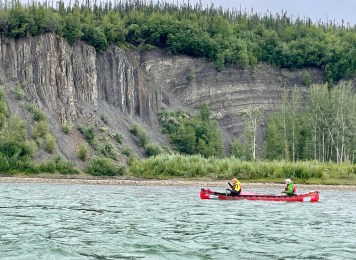
Paddling by massive rock walls formed by geological folding and faulting had us asking more questions. 

Cliff patterns betraying a history of geological rock folding.

Mike particularly grew fond of stones that resembled hard mudballs made up of small, marble and pea-sized stones cemented together. Only later, after some geologic investigating did I learn that these are glacial relics called diamictites.

A sample of a diamictites

The collection of various stones found in the conglomeration were diverse in their own origin. At one point in their history, they had been scraped up and carried for a slow ride on a glacier. Finally, after perhaps centuries of moving, the climate warmed and the glacier began to recede. At the melting terminus of the ice lobe there is usually an ocean or a large body of glacial meltwater. 

Imagine a piece of that glacier, falling into the water where it floats as an iceberg pitted with the small stones. Eventually the floating ice melts and the stone cargo sinks to the muddy bottom. Centuries pass and the plopped stones are now congealed in mudstone.  Another ice age descends and the massive moving sheet of ice breaks up the mudstone with its cemented small rocks into chunks of various sizes.

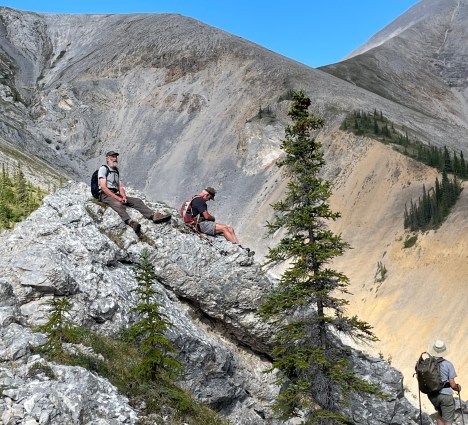
From one campsite, we were seduced by a distant peak. Several of us donned day packs with stowed lunches, water bottles and rain gear and headed uphill.

We eventually left the rocky wash and began to zigzag up through the park-like spruce anchored to the steep slope. Halfway up, a small flock of boreal chickadees flitted next to me. Their hoarse steady calls almost seemed to encourage me to keep climbing. 

Pausing and gazing at our distant route.

Finally three of us broke through the treeline into the alpine. Higher up we walked among limestone shards. Near the top we paused under the slight lean of a house-sized limestone outcropping. Dark clouds and distant thunder urged us to don our rain jackets and tuck in close to lime behemoth to avoid becoming lightening rods. We pulled up our hoods to fend off being pelted by tiny hail, called graupel.

Soon the winds carried the surly clouds away. The sunshine returned to us as we marveled at the irony of standing among the remains of ancient seabeds perched on top of this mountain peak.

After our high altitude beach combing, we began the long and slow descent back to our riverside cobbled camp.

With a deliberate descent, carefully watching each step, I would occasionally pause and look up at the landscape ravaged by water, wind and time. We purposefully avoided walking single file so as not to endanger those downhill of a runaway rock. Occasionally a step would loosen a rock and send it bouncing and clacking downhill. It is very likely that the dislodged rock would someday feel the flow of water as it begins the long slow saga of whittling a mountain to rounded cobble and eventually grains. 

Perhaps future paddlers might contemplate one of the rocks we accidentally loosened from the mountain top and sent to join a gathering of waters. Who knows, maybe that once-leaping rock just might settle along the river and uncomfortably poke a sleepy camper’s hip.

The Hart River weaving its way through rock.

Note: Thanks to author/geologist Marcia Bjornerud for introducing me to diamictites in her fine memoir Discovering the Subtle Wisdom of Rocks.

Older Men and a River

After emerging from the tent each morning, I walked across the cobble to the river’s edge. I squatted like a prospector panning gold, scooping handfuls of brisk water into my face. Whether camping near a river, lake or creek, I always bring three handfuls to my face. Then I mumbled a few words of gratitude, spoken in a hush in case one of the other guys heard me talking to myself. Mumbles and mutterings happen more frequently these days.

With my face dripping, I’m fully awake. I look up at the surrounding phalanx of silent mountains, and quietly say “thank you” several times.This was my recent practice when five other men and I paddled the Hart River, just below the Arctic Circle in the northern Yukon Territory.

Most of us had paddled remote rivers together but not all of us. Two Canadians and four Americans made up the crew. Our average age was 72.8333 years old. While hair color tends towards a hoary frost, collectively we are aged kids.

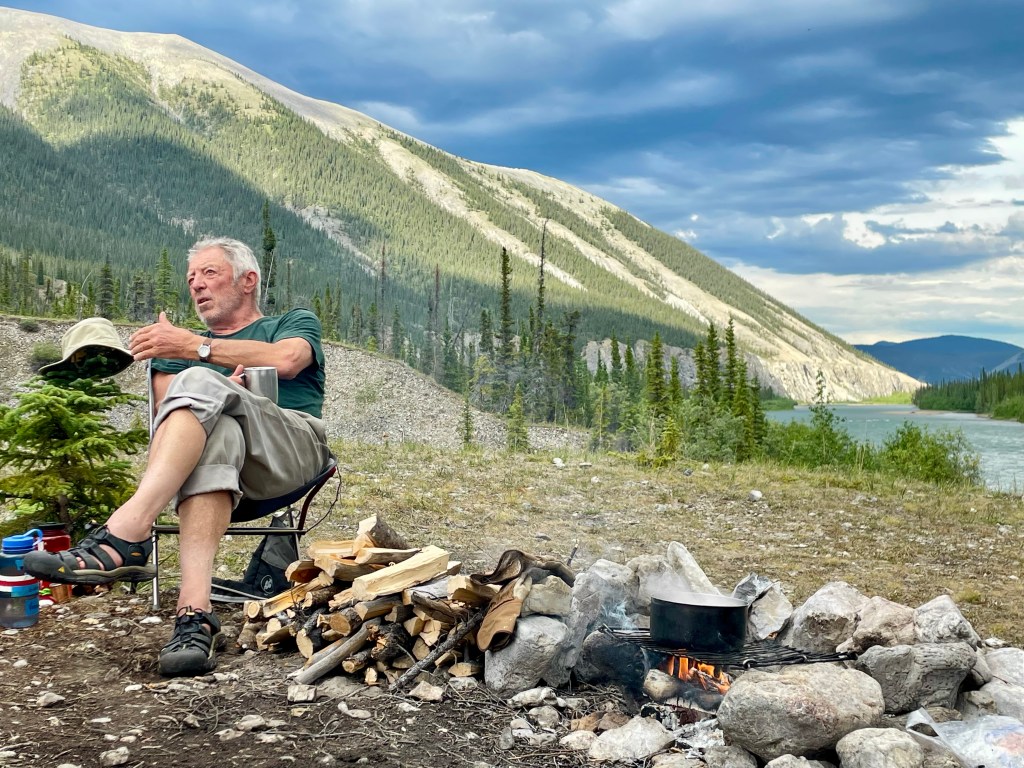
After the daily baptism, my internal compass guided me to the morning campfire where the other river worshippers were gathered in an incomplete circle of camp chairs for communal muttering and coffee. The wafting of tear-inducing campfire smoke always kept the circle broken.

After being transported on a highway for over five hours and then flown further north via a Turbo Otter on floats, we were blissfully far from the din of civilization and the cacophony of social ills, dysfunction, politics . . . oops, I’m being redundant. 

During its two-hundred mile flow, the Hart River passes beneath two mountain ranges: the Werneckes and the Ogilvies.  These steep slopes stunned us with sediments of tan, gray, maroon and black hues.  Rounding each serpentine river bend, a new peak would show itself.  I was dizzied by the height of the spires and blurted out a hearty “Wow!” From the canoe next to me I heard “Holy Smokes!” From the third canoe came a duet of “Oh my God!” and “Holy shit!”  

After a day of riding the river’s fast current, our chairs reunited in a ragged circle after the tents were set up. With a campfire calling us to order we had a  celebratory nip as we reflected on the day. 

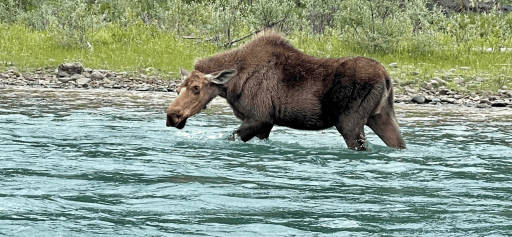
There was the cow moose standing in the river, just a few canoe lengths from us as we floated by.  With her ears laid back, hair bristling on her back and grunting displeasures she refused to run. She likely had a calf hidden in the riparian willows. 

We talked about the ease of a grizzly clambering up the steep bank as we shot through a small rapids next to the bear.  We wondered about the curious, lone buff-colored wolf that seemed as curious about us as we were about it. We were giddy as kids when we recalled the train of haystack waves in a Class III rapids that reminded us that we are never too old to be in the thick of it. 

We talked about maturing into senior citizens with the woes of hearing loss, more frequent peeing, reflecting more frequently about the days of yesteryear.  We discussed the advantages of pee bottles kept in the tent.  With such a vessel there is no need to crawl out of the tent, unsteadily stand up and ascertain where you were and then hope you were not peeing on the tent or someone’s camp chair and then crawling back into the tent and into the sleeping bag. As we shared feelings about social media and our changing bodies, we were in full agreement that out here, far from any roads, emergency support, and hospitals the real accident would be to die in bed.

We lamented the loss of wild places and critical thinking. How could we as a species be so ignorant about how our actions contribute to the whittling away of natural systems that allow us to live? 

Flickering campfire flames captured each of our gazes and carried us back decades. It was no surprise that memories were released of past cars we owned as young men. We also covered pranks of yesteryear as well as favorite old rock and roll tunes. Sadly most of us could not sing more than one or two lines. Awkward teen remembrances brought quiet, knowing chuckles. 

One of the guys asked, “Have you guys ever had sex in a canoe?” There were a few more chuckles while half of our circle confirmed that they had indeed had sex in a canoe. We moved on to football before anyone requested details of trysts in a canoe.

With happy hour completed, it was time for supper to be prepared. Each of us rose out of our camp chairs. A couple went on a wood gathering foray. One worked on supper while another fetched river water to filter for drinking. One strolled towards a willow thicket to pee. As he walked, I overheard him mumbling to himself, “Sex in a canoe?” There was a pause and he concluded, “I guess it’s never too late to explore a new frontier.”

Spring Walkers Beware

Twice this spring I have been in a position to save the lives of two pedestrians as they crossed a road. What makes it even more meaningful is that both walkers are considered “threatened” in Minnesota.

The first one I spotted was running, a weird description for a turtle, because it was more like swimming over the gravel road as fast as it could. I never pass up helping a Blanding’s turtle cross a road. 

After walking the turtle across the road, I peered into the front end of the shell where the shy turtle had pulled its head. I found myself smiling at the Blanding’s own perpetual, gentle smile on a face that reminds me of the most endearing alien of all time: E.T.  The turtle’s distinctive lemon-yellow throat is like a welcoming sunrise. 

I turned the turtle over to examine the bottom shell known as the plastron. The plastron is made up of scutes, resembling puzzle pieces put together. The slightly flat plastron told me it was a female turtle. The male’s bottom shell is slightly dished in.

I counted the growth rings on the scutes to get a rough idea of the turtle’s age. 

I could see 25-30 rings, but part of the scutes were worn smooth with age so it was  impossible to get a firm read. Blanding’s turtles can live to 70 years. The turtle I held was easily over three decades.

Given that it was early May, I suspect this turtle was making an overland trip from where it had spent the winter in hibernation to a shallow, warmer pond to mate. May and June are dangerous months for turtles. After mating this turtle will hike to a proper nesting area and then after the eggs are laid she will hike back to a wetland or lake for the summer. All this overland traveling might require road crossings.

The second turtle I helped, just last week, is a neighbor. I spotted her on the county road about half a mile from my house. She had already hiked about a quarter-mile from a shallow slough, where she had likely mated. Now she was headed east and still had a half mile to get to the deeper lake. I suspect she will lay her eggs in her excavated hole, near the intended lake, during the second week of June. 

With luck, the eggs will remain undiscovered by predators. Roughly sixty five days later they will hatch. Then the cookie-sized youngsters will scurry for the lake water where they are safer. That lake will be their primary home for a decade or more. They will not breed until they are 10-15 years old. Very little is known about young Blanding’s turtles. 

While all turtles can pull their legs, tail and head into the shell, the Blanding’s turtle has a flexible plastron that allows them to seal themselves up much better than most turtles in Minnesota. 

This turtle is threatened because it is losing its habitat: wetlands and adjacent open high ground. It is unlikely they will get off the “threatened” list with continual human residential and industrial development.

What would Dr. William Blanding, a keen naturalist from Philadelphia, think of the paucity of turtles that he first described to science back in the 1830s?

I encourage anyone who has the good fortune of coming across one of these gentle, ponderous, reptilian survivors to offer it some help in crossing the road. And if you are really lucky and find one nesting, please leave it alone. 

Coitus interruptus finalis

As the sun climbed out of the eastern horizon, I engaged in the spring ritual of attempted murder. And as of yesterday morning I am once more guilty on all counts of not manslaughter but turkey slaughter.

The big male turkey that I shot was totally innocent of any wrongdoing. I took advantage of his greatest weakness, his intense desire to breed as many hens as he can while fending off other similarly wired gobblers. 

All birds have tricks of the trade to attract a receptive mate. For many it involves songs, vocalizations, feather display, dance and even subtle signals that are unseen by us.  

Wild turkey gobblers show off their availability and “best-of-the-best” status by  boisterously gobbling and literally strutting his stuff. They draw attention to themselves by fanning their impressive banded tail. They can even slowly twist and turn the tail creating a silent, impressive exclamation point of sorts. While strutting, his almost gaudy, iridescent body feathers are erect, fluffed out, giving him the appearance of being larger than he really is. He drags the tips of his wings on the ground, giving them a truncated appearance.  His featherless head is fleshy, wrinkled and colored red, white and blue making it beautiful and ugly at the same time. 

A healthy dominant male might have a long fleshy protuberance growing out of its head between its eyes and its upper beak. Called a snood, it signals dominance in the company of other breeding males and it serves to attract the lady turkeys. Generally, the longer the snood the more relaxed and confident is the bird. If he is alarmed or not trying to impress turkeys, the snood retracts and its quite short.

An hour before killing the bird, as night melted from dark to gray, I set out a single decoy that resembled a hen turkey and scrambled in my camouflage attire to hide among the bony limbs of a downed oak. With my fingers, I raked away dried leaves and sticks to try and make the ground more comfortable to sit on. 

I listened to three different gobblers declaring their availability and superiority over all other males. Using a mouth call I attempted to give voice to the decoy in front of me. I have learned through the years of hunting that less is better when it comes to calling. 

Three gobblers, or toms, strutted their way across the field and all of them paused in their pursuits about one hundred yards from me. The largest and loudest of the three was obviously trying to get my darling hen decoy to come out and meet him. Impatient or bored he drifted north out of sight. 

Shortly after he left, the other two toms turned and headed back south and out of sight. And just like that there were no turkeys in view. 

I decided to pack up my calls and hurry south to a woods where I could put myself in a good position to call to the duo that had departed the scene. Just as I was ready to untangle myself from the limbs, I heard a gobble from the direction that the big boy had departed. He wasn’t that far away. So I settled in my nest and made a couple of soft yelping calls followed by comforting clucks and the most seductive turkey purrs I could manage. 

Less than two minutes later, through the thick brush I spied the patriotic colored head moving slowly and regally towards me.  His wings were reaching down on each side of his puffed self, like a mythical gunslinger with his hands poised above his holstered pistols. Each barred wing was etching the ground in fine scratches as if to show off his artistic path. He was dressed to the nines, body feathers all erect and percussively thrumming.  His tail fanned out like a rising sun. He promenaded ever so slowly in a parade of one, towards the faux turkey, the femmes fatale.

In a loud instant I ended the parade. The drum major went from full strut to a crumpled, stilled carcass. I was responsible for stopping his excitedly beating heart and stealing his strut.  I insisted the bird practice coitus interruptus finalis. 

Immediately after he died,the world got dead quiet.I did not pump my fist in celebration, nor did I shout “Oh yeah!” Instead I found myself saying in a hushed whisper, “I’m sorry.”

There was a time in my life when I might have been more robustly jubilant in making a killing shot. However as I age, I have come to realize that I am moving closer to my own termination date. Consequently, the preciousness of life is more immediate. 

I walked over to the dead bird, bent down and stroked its feathers and whispered “thank you.” The lousy part of hunting is that it requires the responsibility of killing. The day went from morning to mourning.

Moments like this have me wishing there was such a thing as “catch and release” hunting. An option would be to engage more fully in photography. However, I still enjoy eating a food that I have a direct relationship with. It’s imperative that lives, meat or vegetable, are sacrificed so that I might eat. 

I also believe that I am a product of evolution where more than 10,000 generations of humans survived and thrived by hunting and gathering. It’s part of my DNA.

In 1921-24, Knud Rasmussen, a Danish-Greenlander arctic explorer and anthropologist, traveled across the Canadian Arctic visiting bands of the indigenous Inuit. He took copious notes about their lifestyles, songs and practices. One shaman he interviewed told him, “Life’s greatest danger lies in the fact that man’s food consists entirely of souls.”

I love that quote. All food is life or was life. Whether we pulled a living carrot from its nursery soil, tore embryonic peas from its mothering pod or bought a package of chicken, we are responsible for the death of our food. 

And so this morning Nancy and I sat down to our ritual post-hunt breakfast of heart, liver, and gizzard mixed into scrambled eggs with sautéed freshly gathered nettles from the garden.  And like an echo, we whispered, “thank you.”

*Note: Each of these excellent photos were provided by Chuck Kartak. Chuck enjoys the balance of capturing live images of wildlife as well as gracing his dinner table with their meat.

Strive for Connecting

The nine-year old boy was keen to show me his book The Ultimate Survival Handbook. We sat in the corner of a bustling living room and chatted about knots, pocket knives and eating bugs.  He had been steered over to me because of my experience in teaching kids about the natural world and how to coexist with it. 

By the time we had to leave his house and say our good byes to the gathered families, I felt the boy and I had become friends. I promised to send him a copy of my book Foraging in North America and some other appropriate books that would feed his interest.

I honestly felt I made a wee difference in his life and in that realization our meeting had been a gift to me.

Later in reflecting on the evening,  I recalled an article I wrote for Legacy magazine, a publication of The National Association of Interpretation, nearly 25  years ago. While the article was directed towards outdoor educators and interpretive naturalists, the general message was fitting for anyone who interfaces with youngsters.

Here is an excerpt of the article. Enjoy and make a difference to someone, especially a kid. 

Moments of Epiphany

“Am I really making a difference?” That is the anguishing question that we, as outdoor educators, often ask ourselves. Each of us has had periods when we are feeling burned out, uninspired or depressed. In the meta-view, we might ask, “Is my job, one which often involves hiking in the woods or across grasslands, purely a luxury, an extraneous or superfluous occupation?” 

In our profession the stage of interpretive delivery might be a snowy landscape where we use the mystery of a wandering fox track in the snow. Or it might be next to a wetland in the twilight of early May where we ponder the peals of spring’s frog music.  Admittedly we get to lay down in a soft field of grass or on a warm rock outcropping and consider the night sky and the stories of the ancients as told in the positions of the stars. Good interpreters form strong alliances with both creativity and knowledge to develop their skills in pulling a learner into a moment of discovery.

I suspect that each of us has had moments when we were straightened up, experienced the “aha” moment that reinforced our decision to choose interpretation as a career.

We might recall basking in the positive feedback provided by a teacher, parent or a child but for me the inspiration to carry on has mostly come during unscripted moments in the field. But the priceless response is when you hear a wide-eyed kid say, “ I’ll never forget this as long as I live.” 

If that line is uttered you can be sure that down the line, a decade, or even half a century or more, that once-kid will likely share that story with someone in their life. And to have helped script that memory into an honest-to-goodness story is a legacy.

One indelible moment for me happened in early May when the colors of the woods around the quiet lake were dominated by muted shades of green. All morning a dozen sixth-grade students and I had been moving along the lake shoreline trying to get a reading on a Blandings turtle that was outfitted with a pulsing radio transmitter. It was lunchtime as we settled down near the lake’s edge. Since there was a teacher and a couple additional adults, I decided I needed to recharge so I was looking forward to a break by eating 30 or so paces from the lively group. 

Looking for a quiet place to enjoy my lunch, I spied a redheaded boy in a bright yellow rain slicker sitting alone. Respecting his privacy, I kept a short distance from him. As I was finding a place to sit down, we made eye contact and I asked if he minded that I sit here. He quietly replied, “No problem.”

We each sat at opposite ends of a long aspen log and ate looking out over the motionless lake. A pair of Canada geese and their mirror images swam into view. Other than the lively banter coming from the lunching classmates off to our left it was very still and serene.

With the air sodden with mist, I did not dally in eating. As I chewed looking out over the lake, the boy quietly said, “It sure is a beautiful day.” Though most folks might not find it beautiful to eat a lunch amidst precipitation, I agreed. However, I thought that this was a bit unusual for a sixth-grade boy to utter the idea of “beautiful” amidst a soft rain. 

A minute passed of silent eating and staring at the pair of drifting geese, before he added, “The earth is so precious.” 

I stopped eating, humbled by his statement. All I could do was choke out a stumbling “It sure is.” There was nothing I could add to his pronouncement. 

And with perfect timing, he let a few seconds pass before he delivered the coup de grace, “If we could only learn to share.”

At this point I could not utter a single response. What could I possibly add? We finished our lunch silently watching the geese and I learned the grace of listening.

 I often reflect about that spring lakeside lunch and how it moved me. I learned that given the right surroundings we can release inhibitions and feed our hearts with love for wild places and wild things.

That moment defines my career as an interpreter. It was the best performance review I have ever had, yet it had little to do with my performance. The boy was responding to a blend of circumstances. He was at the edge of a lake surrounded by fresh soft colors, watching wildlife, feeling safe to openly speak in the company of me and likely had his favorite sandwich.

In the best selling book, The Tipping Point, author Malcolm Gladwell speaks of those individuals who are natural pollinators of new ideas and truths. He calls them “Connectors.” He refers to the Law of the Few in which there are exceptional people out there who are capable of initiating epidemics.

In serving as Connectors, we can create little moments that make a big difference.

The Ecstasy of Work

I pushed the two inches of fluffy snow off our long driveway with our snow scoop. The powerful, almost-new, snowblower I inherited last summer sits in the garage, like a down-and-out pitcher relegated to the locker room. I honestly prefer the combined quiet and physical workout of shoveling snow.

Suddenly I hear an unfamiliar, yet familiar, clamor. 

It’s dogs. I can hear a pack of them chorusing in the distance. These canine exclamations are not declaring, “Who are you!” Or “I’m hungry!” 

No, I know this is a cacophony of pure joy and an example of canine cheering.  I wonder. Yes, it has to be. The high-pitched yaps, yowls and yips have got to be sled dogs.

Over forty years ago, I was introduced to the world of handling a small sled dog team.  The lead dog in my team of three was a Siberian husky christened Klondike Kate. She and her two teammates whined and hopped impatiently in anticipation of going for a run. My friend John, a veteran dog musher and owner of at least a dozen dogs, gave me brief mushing instructions while his three-dog team also voiced their displeasure at dawdling.  John told me that once he took off, I needed to release the knot that was tethering my sled to the post.

We rocketed down snow covered roads and surged up sun bright slopes. When going uphill, I jumped off and pushed while the dogs strained. An hour later we stopped. The dogs’ tongues were hanging out of their big smiles and I was a ball of sweat. 

Suddenly, John was off. I gave the rope a yank and in an instant I was splayed on my belly in the snow watching the dogs racing away with my sled. Luckily the sled had tipped on its side, providing enough resistance that I was able to catch up, flip it upright and jump clumsily onto the tails of the runners.  

Thirty years after that first ride I was living for a time in the Yukon Territory. Dog mushing there is very much alive and thriving. Even the territorial flag is graced with a proud malamute sled dog. These dogs symbolize the loyalty, stamina and historical importance of early exploration in the Yukon.

A yard full of staked dogs can make a racket. One dog yard, about a quarter mile uphill from our Yukon Outpost was mostly quiet but you could set your watch to the loud ruckus unleashed at feeding time every day.

Another Yukon neighbor, Karen, lived with her family and 34 sled dogs nearly a half-mile from our place. One winter day she called and invited me over to try skijoring. We stepped into our skis and clipped the pulling harness around our waists.  

In February of that winter I volunteered at the 1000-mile Yukon Quest dog mushing race. This race involved the big names in dog mushing in both Canada and the United States. The 10-20 day event would start in Whitehorse, Yukon and end in Fairbanks, Alaska. It is generally considered  tougher than the more popular Iditarod in Alaska.

I was helping move teams to the on-deck area where they were sent off past the cheering crowd every three minutes. Behind me a musher sank to her knees in front of her lead dog. As if kissing a blessing to the dog’s forehead, she whispered “We can do this. Together, we can do this.” Somehow in the frigid air, I managed to swallow the lump in my throat.

This time I knew what to expect when I pulled the anchor rope. I made it about ten yards with my team of three dogs before I sprawled in the snow and got snarled in the dog traces.  

Minutes later the calm demeanor of the lead dog had vanished and the team of fourteen raucously raced away through the cloud of their own steaming breaths.

Later I learned that this musher was a seasoned racer and this was her very first Yukon Quest. For several days I followed her progress online. But she was among the third of the sleds that scratch from the race. 

With those pleasant mushing memories echoing in my mind, I finished clearing the driveway. The dog yapping had quieted. I decided to drive the half mile over to the county park and see if my read on dog excitement was correct.

When I arrived, two women were directing their dog teams up to the parking lot. Two teen girls were unhooking the dogs, and leading them towards their boxes in the back of the trucks. 

The mushers let me pet a couple of dogs. I was particularly smitten with Zissou, the nine year old Alaskan-born dog. He comes from a strong line of Iditarod racing dogs. His owner, Hannah, admired him and said, “He still loves getting out to pull as much as any of my younger dogs.” 

I can relate. Though some say I am getting long in the tooth, I can still push snow off my driveway. But I will admit I don’t yip excitedly or lunge at the prospect of taking to the task.

Time to Eat

Photo courtesy of Joe Sausen

My peripheral vision caught a streak of blue shoot by outside the pantry window. The cerulean shard swooped from the treetops through the morning sunlight and pulled up to a quick stop at the bird feeder.  A blue jay. With coffee cup in hand, I rose from the small rocker in front of the kitchen wood fire to better observe the outside action on this below-zero morning.

This advance bird initiated a cascade of jays pouring in to the feeder.  In seconds, I was watching a feeding frenzy. The cold doesn’t stop them. It’s just another day of finding calories to feed their inner fires. 

They are jostling like shoppers on Black Friday, kicking and brushing sunflower seeds to the ground. The frenetic feeding helps the more demure cardinals who prefer to feed on the spilled seed on the ground. Squirrels and rabbits also enjoy the fallen spoils.

The jays have just spent the long night roosting in the black cold. I don’t know for sure where this flock roosts but I have my ideas when I think of thickets of red cedars or windbreaks of pines and spruce within a half mile of our house. And I wonder if the elder jays tell tales, like I do, of when winters were colder and had heaps of snow?

In the background of my bird feeder, I can see a jay disappear into the cavernous rib cage of the butchered deer carcass that I hung up in a bur oak back in November. Jays, chickadees, woodpeckers and even more shy crows have picked the entire skeleton nearly clean.

Winter flocks of blue jays are assemblages of all ages. Together, they are more likely to survive. More birds mean more eyes looking for food and watching for predators, like a Coopers hawk. Jays will not tolerate this kind of chumminess in the spring.

Some jays snatch seeds and in one motion angle their beaks skyward as if they were drinking them. Through the steam of my coffee, I could watch their throats swell with the baggage of seeds. 

Like their Corvid cousins, the crow and the Clark’s Nutcracker, blue jays have an expandable gular pouch for storing food like seeds and acorns in their throat.

I watched one jay pick at least a dozen sunflower seeds before flying off with its treasures. When acorns are available they can easily carry five acorns at once; two or three in the pouch, one in the back of their mouth and one in their beak.

The jay then hurries away to eat in quiet and to stash seeds in different hiding places for future eating. Corvids are known for their great memories so food storage is a good strategy.

Another means for surviving a cold and snowy winter is to migrate to more southerly regions. Based solely on my own observations, this winter seems to be a bumper blue jay winter. I don’t recall seeing such flocks lingering during a Minnesota January.

Data from bird banding records from across North America show that survival rates are higher for those blue jays that do not migrate. I’m not surprised. Migration is a dangerous business and most migratory birds born last spring do not live to be a year old.

As I watched, I tried to pick out physical differences. At this time of the year, even those jays born last spring resemble adults. Try as I might there is no way to distinguish female from male at this time of the year. 

As a former bird bander, if I captured a spring blue jay in the finely meshed nets, I would blow on its belly to ascertain if their was a brood patch, indicating a female, or cloacal protuberance found on the breeding season male. 

Only the female jay incubates the eggs. The brood patch is a featherless area of skin on the belly where her blood warmed skin comes in direct contact with the eggs. 

The breeding male’s seminal vesicles enlarge, creating a bulge at his cloacal (genital) opening.

The sun has just set, leaving an apricot sky. It’s dead still and  -11°F.  A trio of shy cardinals have the feeder to themselves. And somewhere sated jays are settling themselves into a clump of limbs for the night.

I lower the quilted window shades and step out to the wood box in the porch. Time to feed more oak chunks into the insatiable stoves and start plundering the fridge for my daily caloric intake. 

Thanks Joe Sausen for great images!

Steaming Passion

Sulfurous geyser clouds steamed over the fresh snow-covered boardwalk. With chilly high elevation winds pushing us along we discovered a small backpacking chair clipped to a stuffed day pack on the walkway. Up ahead, a couple hundred yards, we could see a bundled form standing overlooking one of Yellowstone’s many geysers. We continued on and passed him. Why the vigilance?

The next day we returned to the boardwalk. Once more we found the silent sentinel. This time he was bundled and sitting on his small chair next to a geyser titled Grand. We paused and then dared to ask what he was doing.

“We saw your pack and chair yesterday. Are you a photographer or researcher?” 

“No,” he answered.  “I love to watch geysers and have only seventeen days to sit out here and observe them.”

His name is Corbin and he is the first geyser geek I have ever met. We peppered  him with questions. He gushed about the timing, the personalities and the sequences of what he called the “gauntlet of geysers.”

At one point we apologized for asking so many questions but he shushed our guilt away and assured us that he enjoyed sharing what he knew. And he knew a lot. I really doubt than any of the staff at the National Park Service Visitor Center at Old Faithful knows as much as Corbin.

Corb the Geyser Guy

He shared that he has has harbored a 19-year passion for  geysers.  Oh, and Corbin is 18 years old. With a wry smile, he told us that his parents met as college students during a summer of working at Old Faithful Lodge in Yellowstone National Park. Corbin was conceived in the neighborhood of thermals. Sounds hot.

“I’ve been coming here from my home in Denver every year since I was eleven,” he shared. “This is the first time I have come alone to focus for over two weeks on observations and submitting data.” Nodding at a sudden burp of steam, he added, “Besides, watching the geysers in winter is far more dramatic. The steaming water hits the cold air making for an explosive looking event. And there are way, way fewer tourists out on the boardwalk.”

Staring at the roiling cauldron, Corbin calmly noted, “There, the thermal pool around the geyser is filling slightly.” 

He was amazingly dexterous with his bare thumbs typing the observations and time into his mobile phone. He also carried a radio for transmitting observations back to someone at the Visitor’s Center next to Old Faithful. 

Corbin closely watched the Grand geyser and informed us that this geyser would be erupting within the next hour and a half. “This geyser erupts every 6-8 hours.  Each eruption can last ten to twelve minutes.”

“Old Faithful is the signature glacier in the park and get all the press. But no geyser in the world can send an eruption as high as Grand. It can sometimes reach 200 feet in the sky.”

With that tease, we tugged our parkas tighter and hunkered down in the cold to wait.  Some of the smaller nearby pools looked inviting to slip into for a warming soak. Not a good idea.

In the late fall of 2016, a 23 year-old man was visiting Yellowstone with his sister. They both thought it would be fun to “hot pot” with a warm soak. They left the boardwalk and were in a prohibited area. It is against the law to vandalize or go into the hot springs. The brother stretched to test the water with his fingers and ended up falling into the thermal pool. His sister, unable to pull him out and without phone connection, had to run for help.  The rescuers hurried back but found her brother had died. It was late in the day and they could not get his body out so decided to return the following day with more resources.  The next morning all they found was his wallet and a pair of flip flops. The acidic, boiling hot water had dissolved him.

Yellowstone’s hot springs have injured or killed more people than any other natural feature, including falling and wild animal encounters such as bison or bears.

While we waited, I asked, “Are you pursuing studies that involve geysers?”

“I’m a freshman at the Colorado School of Mines, majoring in Petroleum Engineering. That way I can study seismic activity.  I want to get a job where I can make a lot of money in a few years and then kick back and pursue my real dream of seismic mapping the fractured bedrock of thermal areas.”  

“So any thoughts when the next “big one” is going to explode?” I asked. Corbin smiled and said, “Well if you believe the conspiracy theories, rather than the science, it could blow any day. But I tend to agree with the seismologists and other experts. It’s likely that the great-great grandparents of your great-great grandchildren will never see it.”

And yet, I have to admit I felt a wee bit like I was walking on broken glass knowing that super-heated molten rock or magma roiled less than two and a half miles beneath my feet.

Suddenly Corbin matter-of-factly declared, “See that vent just to the left of Grand’s steam? That’s called “Turban” and Turban is starting to show signs of erupting.”  

“How soon will Grand erupt?”I asked.

Assessing the thermal pool rising and Turban hissing, Corbin confidently answered, “Now .  . . and Now.” With his second “now,” Grand sent a loud, noisy plume of steam high into the sky. 

Corbin radioed in the eruption time and began typing observations on his phone. For several minutes we watched spellbound as the geyser surged like a steamy fountain of fireworks. And Turban, Grand’s little sidekick, shot its own thermal celebration.

Ten minutes later, the eruption subsided. Corbin folded up his small chair and donned his daypack. He wanted to catch the eruption of Daisy Geyser and Riverside Geyser before he headed to his cabin for an afternoon nap. He was planning to return to the steaming landscape to resume his vigil in the evening. 

I found myself inspired by Corbin. Rarely do I encounter such unfettered passion. I wondered what percentage of humans follow their calling? Is it a luxury to have the time to channel so much of your energy into a passion? 

Joseph Campbell was a noted 20th century thinker, mythologist and author. His advice to people is to “follow your bliss.” 

It’s safe to say that Corbin is following his bliss. . . .and hiss.

 Page 1 of 26  1  2  3  4  5 » ...  Last »