Bush Kids


I had just pulled my knife out of its worn leather sheath. It was raining and we had retreated into a picnic shelter at the camping area for the Atlin Music Festival to grab a bite to eat. I had barely cut into the banana bread when a child’s voice next to me  matter-of-factly noted, “Nice knife.” I finished the cut and looked to my right. Sitting a couple feet from me at the picnic table was a pixieish brown haired girl.

“Thanks,” I said. I was caught off guard as I had never been complimented by a young girl for the knife I carry.

“I’ve got one too,” she quickly added and in an instant she was holding up a handsome Swiss Army Knife. “My dad gave it to me last year.” I nodded. “Here take a look at it,” she added as she held it out for me.

In a few minutes I learned that she was named Emma and that her favorite of the multiple tools on her knife was the fact that it had not one, but two blades. “It’s easier to carve things with two different sized blades.”

I handed it back  and she kept up the testimonial. “The scissors attachment is pretty cool too but it’s the hardest one to open.”

I’m guessing that Emma was maybe ten or eleven years old. I thought of how astute it was that her father gave her  the gift of a knife the previous year. Seems to me that we need far more parents willing to give kids pocket knives. Oh blasmephous words! I can hear the cries of horror at the thought of giving a child, and a girl no less, a sharp-edged tool. A good, sharp knife gifted to a child is a rite of passage. It is a pronouncement of confidence that the youngster can and MUST handle and care for the knife properly . So such a bladed gift must come with a serious discussion on the proper handling and care of all knives.

Mors Kochanski, a friend and one of the top survival experts in North America, is the author of the highly regarded book, Northern Bushcraft. Last fall, Nancy and I stopped on our return trip to Minnesota to spend a couple nights with Mors at his home in northern Alberta. We got to talking about kids and bush skills. Mors said he always encouraged parents to teach knife skills and campfire building skills as early as five years old. He insists there is no better age to instill the correct and safe use of matches and knives.The real danger is having kids play with these things on their own without proper instruction.

In chatting with little Emma, I learned she liked to camp and was eager for the music to begin the following day. It was clear that her world did not revolve solely around knives. As she and I watched an impromptu music jam begin next to our table, Emma said, “I play piano and some guitar, but I really want to play a stand up bass.”

Suddenly something shifted and she got up and headed out into the drizzle. “Well Tom, I’ve got to go. . .see you later.”

I had just met an honest to goodness “bush kid!” Had I been an eleven or twelve year old boy, I would have been mightily smitten by Emma. The youth designation of “good bush kid” was a label I had never heard of until we came up to the Yukon in 2008. And right away I knew I wanted to be knighted with such a noble title. I became aware of such a designation in casual conversations.

“ Oh, Knute is a good bush kid,”  said one good friend.

And one mother declared , “My 16 year-old daughter, she’s a good bush kid.”

It’s not a title that is cast out freely; one has to earn it. I would have far preferred being known as a “good bush kid” than a good boy scout or good Lutheran.

So what are the qualifications for such an honor? There is no definition or secret order of bush kids. But here is what I have observed. A key component  of  bush status is you must be really confident. You can handle yourself well anywhere and you don’t loose your cool.

Clearly these are excellent bush skills for surviving in the wilds. But besides being super comfortable rooting around in the outdoors, these kids carry the confidence throughout their day whether they are in school or on a trip in the back country.

Emma seemed profoundly happy. And no surprise here as studies show that kids who play and explore outside are less stressed, more relaxed and tend to have greater social skills and confidence. Bingo!

Stephen Kellert, a Yale professor with the School of Forestry and Environmental Studies, has written extensively on the subject of child development and nature. In his book Building for Life: Designing and Understanding the Human-Nature Connection he argues that, not only is contact with nature important for children’s emotional, intellectual, and evaluative development, but that their “physical and mental well-being depends on the quality of their experience of the natural world.”

My guess is that if I looked closely at the lives of those “good bush kids,” I would likely find that each of them spent a lot of time outside messing around with their imaginations.

Two nights later I was in the main tent waiting for the next band to take the stage. Hundreds of people were in the tent enjoying the day’s music. I looked over to my right and sitting on the ground in the front row, about twenty feet from me, was my friend Emma. She had a bandanna wrapped around her forehead and was having a good time. She glanced my way and saw me looking towards her. She waved… and winked. Yes, she winked. Now that is confidence!

If we had a generation of optimistic and confident  bush kids on the rise, the world would be a better place. I have a “good knife,” received a wink and the band onstage was about to play a new song. Life is looking real good.

DUMP ECONOMY


“One man’s rubbish may be another’s treasure”

         – 19th century proverb

Dump:Mike 

I find it interesting that when Europeans first settled in North America they found the natives had no name for “waste.” There simply wasn’t such a thing.

America, alone, accounts for over one-third of the world’s waste and most of that trash ends up in landfills. It amounts to one ton of landfill waste per USA citizen per year.  That is shameful and we call ourselves advanced.

While living at our Yukon Outpost in the hamlet of Mt. Lorne we have discovered a virtual “gold mine” far from the rich ore strikes of the Klondike gold fields. Our weekly schedule often involves going on one or two all-day hikes, going to town for groceries, supplies and an art fix and going to the dump. All of these are highly desirable activities.

In fact, exploits of  our dump discoveries have spread far and wide.  When friends and family make the trip from the Midwest to the Yukon they expect their travel itinerary to include a visit or two to the dump.

There are three community dumps within an hours drive of us and they are the best dumps I’ve ever been to. For one thing, there is very little trash. The recycling efforts here are the best I have ever seen. You can recycle aluminum and galvanized cans, bottles, cardboard, paper and ALL plastics, but they will also take all batteries, from those tiny ones found in hearing aids to the 12 volt variety found in autos. (Note: It is estimated that ten percent of all the world’s plastics end up in the oceans.)

They also take tires, milk and juice cartons, computers, televisions, speakers and sound systems. There is a large dumpster for metal recycling and for household appliances. And there is even a shed to leave compostables.

The Mt. Lorne dump does an excellent job of  minimizing the concept of waste. By the time you throw away your actual trash here, it amounts to very little.  It only requires that you take the time to separate things. This dump is a model for the rest of North America.

Here at the dump you can enjoy a community picnic, an impromptu music jam or an athletic workout. Admittedly the Mt. Lorne dump does not appear welcoming with a four-strand electric fence surrounding the grounds. While it might keep out after hours trash dumpers it is designed to discourage black and grizzly bears.

The dump’s greatest attractions are the two “Free Shacks.”  The sign actually reads ” Reuse Area.” One is for clothing and the other is for just about anything else. The larder that accumulates in the Free Shacks increases with the spring and fall cleaning tides.  Residents in the area live back in the bush or are thinly spread in the hamlet. Garage sales are not practical with a spread out population so it is easy to simply give stuff away to someone who might need it.

One day I pulled up to the Free Shack  and in moments I was putting a a thick sheepskin winter coat and a German-made backpack in the truck. I’ve also added some nice wool sweaters to my Yukon wardrobe and secured a favorite belt, though it’s a bit long for my svelte midsection.

I always scan the books and have found some great reads like “Deep Survival” by Lawrence Gonzales and “The World is Flat” by Thomas Friedman.

For my wife Nancy, the dump is the equivalent of a rich blueberry patch. While I can often make my scan in a matter of five minutes, she wants at least triple that. On the other hand, Nancy’s plunder has far surpassed mine. She has snagged garden tools, quilts, duvet covers, cute pants, shorts, tops and even hats that look like they just came off the shelf at L. L. Bean.  She even found some of our kitchen holdings  including, plates, mugs, glasses, silverware, a nearly brand new bread machine and a sparkling, unscratched Cuisinart blender.

Over the past weekend I learned that over at the Marsh Lake dump, a 45-minute drive from our dump, a woman connected with a mink coat that was in excellent shape! I’m serious.

Loading camper

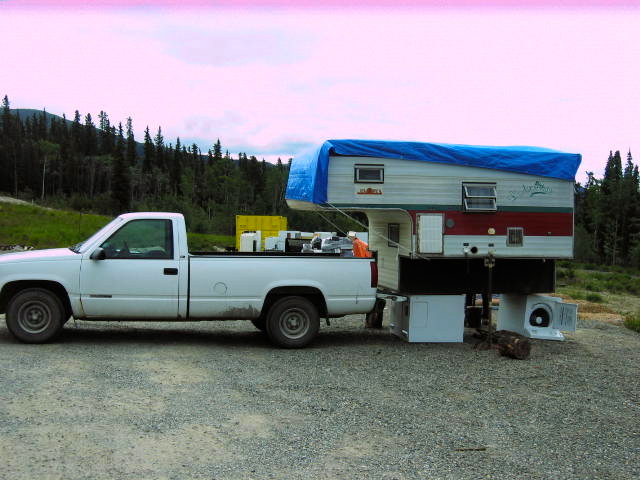
Last week I helped a local woman load a camper on the back of her pickup. Yep. . . a bonafide over-the-cab camper! Word has it that the week before the fellow who brought in the camper dropped off a boat and trailer. It disappeared very quickly. Apparently the guy who dropped off these treasures is moving south and he did not want to fuss around trying to sell any stuff.  (For clarity’s sake, “moving south” means moving anywhere south of the Yukon).

Camper loaded

Given that many folks that live in the Yukon are here for only a few years, they  often accumulate more than they need.  Consequently to make the move south more easy they often bring good quality items to the dump.

Recently, my good friend Mike stopped at the Marsh Lake dump and got himself a car.  His brother is running that dump this summer so he could have provided insider information.  The car was half-filled with gas, and an easy starter with a perky battery. There was a note on the front seat that included a phone number so the car’s title could be transferred. He called the phone number and discovered that the owner was a neighbor! She had been trying to sell the car for some time and simply gave up. Oh yeah, the glitch turned out to be a bad axle. He noticed when turning a corner that the car made some noise. Upon further inspection he discovered it had a bad axle. So he found a used one and replaced it himself.

The same day I helped the woman load up the camper, I found two gas stove knobs in the dirt outside a dumpster. I eyed them over and jammed them in my pants pocket.  Our small stove/oven is missing two knobs and we have tried several but none have fit. I am pleased to say that we now have four perfectly operating burners that are easily adjusted with a turn of the knob. Who cares if they don’t match.

In regards to social benefits, the Annual Dumpster Dining event offers grilled bison burgers and bison smokies (brats).  Combined with  live music the event attracts scores of folks. When we first arrived in the Yukon and had to make a trip to the dump we soon found other folks flocked there. Consequently, we have met some of our dearest friends after a visit to the dump.

People get a little wacky going to the dump.  During one cold winter day, I saw a bundled man hunkered over a row of computers. Suddenly he let out a steaming, triumphant cheer. I walked over to see what he was celebrating and he excitedly told me that he had just found some sort of computer component that would have cost him hundreds of dollars if he bought it off the shelf.

While shack “shopping,” the protocol is honorable and polite. Although I have seen folks anxiously wait for you to put down the wool shirt or mixing bowl that you inspected and then like a hungry raven drop in and claim it as it slides from your hands.

This dump will get you in shape. We now have a nearly new spare life jacket, a taped hockey stick and puck, cross country ski poles and a set of weights. I’ve passed on rickety looking treadmills. But a neighbor girl got a very nice mountain bike that simply needed to be cleaned up and have it’s tires pumped with air.

Mike, the Mt. Lorne dump manager, enjoys golf and basketball. So it is not unusual to see him practicing sand trap shots from the sandy landscape that sits under the dump.

mike BB shot

Mike and I both enjoy picking up the basketball and shooting hoops on the backboard and basket that came in to the dump. We can make up some very inventive shots for a wicked game of Horse when you consider dumpsters, crates of bottles and parked cars.

The dump can provides forays into the arts. One day Jeremy, dump watcher on duty, reported proudly that he had his new guitar along. He asked if Nancy had her fiddle in the truck. She did so in minutes they were jamming.  Soon neighbor Ruth pulled up to leave some things and she quickly pulled out her mandolin. I found a reasonable chair from inside the Free Shack and listened to the spontaneous concert.

And the beautiful thing is that if we don’t like something that we found, we can bring it back next week. A stack of pocket books are poised to make the trip and  I see that Nancy has put the bathroom scale by the recycling tubs. That means it’s going back to the dump as social currency.

Sad, I rather like that I only weigh 69. . . . kilograms.

Attacked!!


It had to happen sooner or later. Particularly in a land that has far more large wild mammals than humans. It’s only more ironic that as the author of four regional editions of Things that Bite, something other than invertebrates like mosquitoes and black flies should finally nail me.

But before I give you the sordid details, let me lay out the events leading up to the attack.

It was my birthday. . . 62 years old.  With the day opening with a flawless blue sky, Nancy inquired what I would like to do. Smiling at my first request, she wondered what else I would I like to do. I said, “How about hiking that unnamed peak a couple peaks south of Red Ridge by Annie Lake?” We had never climbed this peak and I was curious about it and wanted to get up to alpine to collect some flowers.

After a short drive, we parked the truck, donned our packs, adjusted our hiking poles and headed up. With no trails to follow we started up through the bush. The base of the peak rose up quickly through lodgepole pine, aspen and some clumps of hefty willow with lots of thigh-high soapberry bushes and dwarf birch in the understory.  Dwarf birch is commonly referred to as “buck brush” up here and no one likes hiking through it.

The volume and volubility of our chatter accelerated as we eased through the thicker cover. There is no need to ever surprise a bear. Let them know you are coming and they usually will vanish before you are near them. And a bear around here could be either a black or a grizz.

Our route was not direct. There were plenty of zigs and zags as we slowly slalom-trudged uphill. After half an hour of climbing we encountered our first patches of exposed bedrock.  Here and there were small clumps of sub-alpine fir and always some clumps of willow. But now most of the willow was shorter than the plants we encountered at the lower elevations.

Willow is everywhere up here. There are approximately 30 species of this woody plant in the Yukon. It can found in the lowlands, along rivers, on mountainsides and even a stunted version high in the alpine.

The grade became steeper and even with hiking poles, we found small willows and aspens as handy anchor points to pull ourselves up. About a third of the way up we found an open patch of grass and crowberry to sit down on and enjoy some water and snacks. Enjoying the view, we turned and looked up and realized that we still had some gnarly climbing ahead of us.

We resumed the ascent and soon found ourselves scrambling in more exposed areas of rock. The rock was scrabbly in spots so we proceeded cautiously, never directly below one another so as to avoid any dislodged rocks from hitting the other person. Now we were more frequently encountering pitches that required us to use our hands to grab secure rocks to help us along. Hiking was morphing into rock climbing and this is not what we really wanted.

About two thirds of the way up, we did a check with each other. “Are we bending the map?” I asked. “Bending the map” is a phrase coined by Lawrence Gonzales in his fine book, Deep Survival. In the book he explores who lives, who dies and why when confronted with an accident, catastrophe or being lost.

When one “bends the map” they are attempting to make a trail or route conform to them. In other words I was wondering if we were trying to minimize the difficulty of our route to the top. Nancy and I often check each other with that “bending the map” question when we are out on big hikes or paddles.

This time we both agreed that perhaps we were biting off too much. And besides, with a birthday supper of halibut enchiladas and rhubarb pie for dessert, we didn’t want find ourselves in a sketchy situation with the coming of evening. So we began to traverse to the north looking for an easier route down.

We had only gone about 200 hundred yards or so when we found the grizzly bear den.

The opening was large enough to easily let me walk in if I bent over at the waist. I didn’t. This was likely a den where a grizzly spends the winter. If it was a female’s den she might have birthed a pair of cubs here. Or a lone male could have claimed it. Once the warmer spring weather starts to melt the snow up this high, the bear(s) would leave the den and head downhill looking for some greening produce to eat.

We moved past the den and were celebrating the fact that we found a less steep descent but it also was a thicker garden of undergrowth. We could take bigger steps downhill and the gravity helped our momentum.

Suddenly the attack came.

As I passed through a moose-high clump of willow, one of the supple limbs I was pushing ahead of me snapped back and had its way with the orbit of my eye. I grumbled a curse and in stoic, male-stubborn fashion, I forced my way through.  No blood; just a good smack on the head.

We ultimately made it down and back in time for a wonderful birthday supper with some friends and Nancy’s sister, Jane. (Jane had wisely stayed back at the Outpost while we hiked.)

It was the next day that I discovered my tattooed left eyelid. The funny thing is the bruised eye socket didn’t hurt. In fact I had to pause to recollect how I hurt it.

Some folks up this way call willow “moose candy” because it is the most preferred moose food around. Funny how this plant, the same one that is the origin of the ubiquitous pain reliever, aspirin, got a “sweet” lick at me.


Willow Attack

More than Food for Thought

 Hydrating

Nothing makes the news with greater frequency these days then food. The stuff we ingest to motor through life is controversial and daily we are faced with reports of food recalls, the unknowns and dangers of eating genetically modified foods (GMOs) and the obesity epidemic.
Just yesterday, while listening to a report on CBC (Canadian Broadcasting Corporation), I learned that during our specie’s history on the planet,  the human brain likely grew larger with greater capacity when access to food became easier and easier.  In other words our success in growing crops, domesticating animals and creating tools supported good nutrition. The report went on to say that 1/3 of the 2,500 or so calories that the average North American male needs each day is utilized by that big calorie burner, the brain.

Two weeks ago I burned more than that many calories in a single event.  My brain seemed like it was on a timeout as it  diverted needed calories to my legs, lungs and heart that pleaded for more calories. The physical event was the annual Chilkat Kluane International Bike Relay. The race starts in the community of Haines Junction, Yukon and ends 149 miles away up and over the Coastal Mountains dropping into Haines, Alaska. The setting is stunning with snow-capped mountains in view during the whole ride. And there is a good chance of seeing a moose or bear as you pedal through their homescape.

I have participated on two previous Chilkat races but in each case I was on four-person teams where each of the riders must ride two consecutive legs of the race. This year I was riding it solo and was able to complete it because the weather cooperated, I was ready for it and mostly because of my awesome “support team.” The team was wife Nancy, daughter Maren and her college buddy, Karen. They kept my water bottles filled, varied my food and then made the delicate hand-offs as I cycled by.

The trick on such a long ride is proper hydration and consuming calories that can quickly go to work in fueling your effort.  My success was highly attributed to the following:

1) huge drafts of mountain air with hints of sub-alpine fir melded with balsam poplar oils

2) Lots and lots of water. .  . about half of it was fortified with Nuun supplements.

3) Plenty of Save Your Ass Bars. These are homemade and have been known to work wonders in North America and high in the Andes in South America.

4) Two Pearson’s Salted Nut Rolls.  Frank Lundeen, co-owner at CyclovaXC, highly recommended these.

4) Organic bananas, cut and peeled into chunks.

5) Clif Shot Blocks during the second half of the race. (About one per hour)

6) Sportsleggs supplements. Another Cyclova recommendation.

7) Cooked boiled potatoes rolled in olive oil and Parmesan cheese. I had these wrapped in foil but my support team quickly learned it was easier to simply hand one off as I pedaled by them. I really liked these and would even put leftover fragments in my bike jersey pocket. The key is not to overcook them.

And finally. .  .drum roll please. . . .

8) Nah, I can’t tell you. A photo is far better. And this ain’t no joke. . .this really staved off the bonking and fueled me with renewed energy! Plenty of fat, salts and carbs. And yes, it was another tip from Frank at Cyclova.

Race Food

And a superlative and creative support team is the top secret. They cranked up the music in the truck as they leap frogged me, stopping several miles ahead of me to supply me with water and food. Eminem’s classic hip hop hit  “Lose Yourself” was truly inspiring

Look, if you had one shot, or one opportunity
To seize everything you ever wanted. one moment
Would you capture it or just let it slip?

Each time I approached the truck pulled off the side of the highway, I was witness to sheer enthusiasm as they danced, sang and cheered. And they had an abundance of props like inflatable palm trees, wigs, crazy skirts and so on. Smiling helped me forget the task at hand.

When I pedaled across the finish line 8 hours 33 minutes and 55 seconds later, I was a happy boy. And there was my lovely support team cheering louder than ever with a full quart of organic chocolate milk for my recovery drink.


Yukonasia


 IMG_9411


My wife and I practice “Yukonasia.”

Perfectly legal, Yukonasia is the practice of terminating a sedentary life by intentionally living large in a land north of normal.

Even the controversial Jack Kevorkian, also known as Dr. Death for assisting over one hundred terminal patients in assisted suicide, would have approved at our boreal play on the word “euthanasia.”

“Normal” for the bulk of humans living in North America means living in urban environments where asphalt and concrete are the dominant groundcover.

“Normal” is being connected to Wi-Fi or broadband to computers, phones and various pads rather than connected to the natural world.

“Normal” is having multiple bathrooms with multiple showers and televisions are generally twins,  triplets or amazingly even larger litters.

“Normal” is pursuing comfort between walls and a roof overhead rather the potential discomfort of being caught outdoors in rain or snow.

For the past five years we have spent much of our time living in the Yukon Territory in northern Canada. Some call us renegades or even brave. I would call it paying attention to our hearts. Not surprisingly we have become hopelessly smitten with a land that is rough around the edges.

This is a destination where wild lands abound and large mammals like moose, Dall sheep, wolves, caribou, grizzly and black bears far outnumber humans. Somehow, living in a land where I can get lost, become bear food or lose my breathe while hiking high in the mountains makes me more alive.

Approximately one-quarter of the Yukon’s 36,000 human residents are native aborigines, or First Nation members. For thousands of years they have lived and thrived in this vast, mostly untrammeled land that we would call “wilderness.” Ironically, none of the First Nation native languages have a word that means “wilderness.” The closest description is simply “home.” Imagine moving through such a diverse landscape with the same familiarity that you maneuver through your own home . . . in the dark.

If we each followed our lineage lines, we would find we all have evolved from a past where wild places were normal rather than something that is now threatened and disappearing.

Yukonasia has nothing to do with death; it has everything to do with living.

Bird Song Dawning

As a naturalist, I’ve always wanted to instill the need to pay attention. As mentioned in earlier blog, I’ve always had a keen interest in bird song. As noted, hearing loss, has hampered my ability to identify the number of birds by songs and calls. According to one recent federal survey, bird watching is the fastest growing outdoor recreational activity in the U.S. With the surge in interest comes a corresponding interest in learning bird songs and learning why birds sing.

A trick in learning some bird songs is to use mnemonics.  According to the Oxford Dictionary, mnemonics is a device such as a pattern of letters, ideas, or associations that assists in remembering something. One of the most popular mnemonic devices has been used by generations of school kids to recall when Columbus sailed to the new world : “In 1492, Columbus sailed the ocean blue.” Bird enthusiasts often use words and phrases to help them remember bird calls/songs. For example, the spring song of a cardinal sounds like it is repeating “Cheer! Cheer! Cheer!

Through the years, I had collected various bird song mnemonics from various bird field guides and birders. Some of the phrases are downright silly and others are simply proper nouns. One day, back in 2005, I put together a sheet of the phrases as learning aids to use in a class on birding. My right brain hijacked the moment and as I looked the phrases over, I started arranging them together to create a sort-of-conversation between the bird species.

The first stanza refers to the advent of summer, going to Canada and taking it easy with some favorite brews. The second stanza is all about an enthusiastic greeting and introductions to a hard-of-hearing friend. The third section clearly addresses school bullying and the following not-so- politically-correct disciplinary actions meted out by the teacher. Each line of the poem is the mnemonic phrase of a different species of bird. And the final stanza offers a treat and a taste of tea followed by a query about the chef.

I shared the poem with some colleagues and they encouraged me to propose airing it on Minnesota Public Radio. So in the early days of spring I managed to navigate my way to the public radio Program Manager and he thought it was a fun idea.    I suggested that after each line was read that they air an actual recording of the bird. Knowing Public Radio likely did not have a collection of bird songs, I suggested they contact the Macaulay Library at the Cornell Laboratory of Ornithology to obtain the necessary recordings.  The library is the world’s largest and oldest scientific archive of biodiversity audio and video recordings.

So in honor of a most tardy spring I am going to resurrect the poem.  Accompanying each line is the identification of the songster or caller. Now get outside and bend your ear towards something really meaningful. Sit down and listen to the poem, preferably in the early morning when birds are most boisterous.

Note: When you click on A Dawn Chorus, a box will appear that says, “No Preview Available.” Click on “Download Anyway.” That will direct you to a box where you have the option of hitting”Download Anyway.” That’s your call. . . but there were no bugs when I posted it.

If you want me to send you the aired recording you will have to contact me at Tom <at> AligningwithNature [dot] com

A Dawn Chorus

Sweet, sweet, summer sweet. (Yellow Warbler)

Oh sweet Canada, Canada, Canada  (White-throated Sparrow)

I am so lazy. (Black-throated Blue Warbler)

Quick-three-beers! (Olive-sided Flycatcher)

Lazy daisey. (Golden-cheeked Warbler)


Please, please to meet you! (Chestnut sided Warbler)

Who? Who? Who?  (Great Horned Owl)

Old Man MULDOON, MULDOON, MULDOON  (Prairie Chicken)

Who? who? who?  (Great Horned Owl)

JAY! JAY! JAY!  (Blue Jay)

Who? Who? Who?  (Great Horned Owl)

PETER!, PETER!, PETER! (Tufted Titmouse)

Here I am, way up here, see me? (Red-eyed Vireo)

Here sweety!  (Black-capped Chickadee)


Creeep! Creeep! Creeep!   (Least Sandpiper)

I’ll grab you and I’ll hold you and I’ll squeeze you til you squirt!  (Warbling Vireo)

Teacher! Teacher! Teacher!   (Ovenbird)

Sweet, sweet, I’ll switch you!  (Chestnut-sided Warbler)

Whip-Poor-Will! Whip-Poor-Will!  (Whippoorwill)

Weep, Weep, Weep!  (Great Crested Flycatcher)


Plum puddin, plum puddin, plum puddin!  (American Bittern)

Potato chips……potato chips……potato chips.  (American Goldfinch)

Tea kettle, Tea kettle, Tea kettle!  (Carolina Wren)

Tea-for-two, Tea-for -two! (Ash-throated Flycatcher)

Drink-your tea!  (Rufous-sided Towhee)


Who-cooks-for-you-all?  (Barred Owl)


(Copyright 2005 Tom Anderson)


Let’s Go a Little Higher

Nan and Claire

Humans have an affinity to climb. Irresistibly we are pulled, like iron filings to a magnet, by perches, multi-branched trees, hilltops, mountain peaks, observation towers and even through the hierarchy of a job career to “reach the top.”  Many biologists and evolutionary scientists would argue that gaining elevation offered early savanna-dwelling humans a vista to watch for game or approaching threats. Such an advantage, science argues, was so desired for survival that it remains inexorably locked in our conscious. In the past castles and forts were built with commanding views. Today, prime house building sites are often sited high with grand views. Architects continue to defy limits in designing skyscrapers that stretch towards the stratosphere.

Higher and higher. . . . let’s just go a little higher.

Those six words, “Let’s just go a little higher” are powerfully seductive. Over the past few years, when Nancy and I have returned to the Yukon Territory and it’s seemingly infinite crop of peaks, we have often had our day hikes stretched into more hours than planned.   Oftentimes the beckoning siren call of an adjacent higher vista, next to the one we have just climbed, commands our attention. We confer our maps, watches, energy levels and then, more often than not, go for it. More than once we have raced darkness back to our vehicle. That means in the land of the midnight sun, we have wearily come off a hike close to midnight.

In my last blog entry, Tough Efforts, I addressed a recent trekking trip in the Peruvian Andes and the challenges of high elevations. Someone was asking me for more detail about what happens when you climb to elevations that tax the body. So here is my attempt.

First, some basic atmospheric science. In the lower realm of the atmosphere, where we live, there are roughly a dozen gases that mingle together like an invisible, but critical gaseous soup. But two, nitrogen and oxygen, make up approximately 99 percent of the mix.(Note that carbon dioxide is not in the top two, but it has been increasing at rather astonishing rates in the past two centuries, hitting 400 parts per million, for the first time in likely 2 million years. Stay tuned for  some gnarly climate change that is changing the biosphere.)

The atmosphere is an ultra-thin layer of gases that surround the earth. If the earth were the size of a basketball, the atmosphere would be the equivalent of a thin piece of tissue paper. But that thin layer of gases make life possible for us. And as that is not amazing enough, the very mix of gases is what is really critical for us. Most important for our survival is oxygen and that is possible only because of the gift of photosynthesis, the production of oxygen from green plants.

An important property of air is that it has weight. It’s weight can be measured with a barometer and is referred to as barometric pressure. Basically, as one climbs higher,  there is less air, consequently less air pressure.  Our lungs depend on that air pressure to function properly. During periods of very low air pressure, the vacuum that is normally experienced to force the breath to the lungs, barely exists and consequently the air barely seeps in. And if it doesn’t get to our lungs, it fails to get picked up by red blood cells and there is ultimately less oxygen reaching the brain. In a sense, the oxygen-starved brain sends out an alarm to the lungs and heart to work harder. So you start to breathe deeper and your heart begins to race to get oxygen to the brain. (For further, more detailed reading on the subject, I highly recommend you read Surviving the Extremes: A Doctor’s Journey to the Limits of Human Endurance by Kenneth Kamler, M.D.)

You can experience the same phenomenon of oxygen deprivation simply by exerting yourself to the max. There is no need to climb above 14,000 feet, simply try running up several flights of stairs as fast as you can and witness the heaving of your lungs as they work hard to bring oxygen comfort to your brain.

Amazingly we can climb to extremely high elevations if we do it very slowly and acclimatize ourselves gradually to low oxygen concentrations. That is why climbers who tackle Mt. Everest, must do so over a period of time that allows a slow ascent. To do otherwise will kill them.

Perhaps the euphoria, the ecstatic giddiness, I feel when I reach the top of a hilltop or peak is simply because of my oxygen depleted brain. And here I thought it was something more divine than simply biology.

Tough Efforts

Andes Mountain Glacier 


Like the local native Peruvian porters, I emulated their daily ritual of tucking coca leaves with small alkaline shavings of burnt quinoa root into my cheek. I wiped the sweat from my brow and looked ahead at the intimidating pitch to the Inca trail as it climbed even higher into the thinning Andean air.

Our local guide highly endorsed chewing coca to help assuage the pain of the climb. This is the same coca plant that has been given the evil status as it can be rendered into cocaine. For centuries the Andean people have chewed and brewed coca leaves to retard thirst, hunger, pain and fatigue. Like a cup of strong coffee, it also helps as a stimulant.

It is also the same plant that not only shares a title with one of the world’s most popular beverages, Coca Cola, but was an important ingredient to the original “real thing.” Incidentally the original brew, first produced in 1886, was described  as a ”brain tonic and intellectual beverage.” The original recipe included coca with cocaine, but the narcotic was removed just after the turn of the century.

While visiting the Museum of Sacred, Magical and Medicinal Plants in the old Inca capita of  Cusco, Peru, I learned that the uniquely familiar shape of a Coke bottle was in intentional design and was inspired by the similar shape of the coca plant seed. Peruvians will tell you  it was no accident that Coca Cola chose red and white as their brand colors.  These are the national colors of the Peruvian flag and Peru provides the bulk of coca leaves for the popular beverage.

I digress. Chewing a quid of coca leaves at least psychologically made me believe that it helps deal with exertion oneself at high elevations. Surrounded by high Andean mountains we slowly plodded in a rhythm of shuffle, rest, shuffle rest. Approximately 50 Andean peaks rise over 20,000 feet. Imagine trying to breathe while hiking up a steep gradient while breathing through a half inch diameter water line. They claim that when you climb Mt. Everest it’s like trying to breath through a drinking straw. No thanks.

The porters, with their large bulky  loads, always passed us, often with a smiling greeting. On the descent sections, some of them nearly vertical,the porters amazingly trotted down the irregular stone steps. Oh, did I mention that most of the natives wore rubber sandals or tennis shoes rather than vibram-soled hiking boots? As I trudged I attempted to sidetrack the nearly constant light hammering of a high-altitude headache with thoughts of becoming a porter when I grow up.

After four days of hiking the Inca Trail to Machu Picchu, someone in our group asked if the trek was the toughest hike they had ever done. Most of us agreed it was right up there at the top of the list of “most rigorous.”

But it got me to thinking of other outdoor efforts that have rendered me to a state of quivering jelly. So during our bus ride back to Cusco, I mentally came up with my “Top Five” list of arduous outdoor recreational efforts. Certainly running Grandma’s marathon to Duluth, skiing the infamous Birkie cross country ski race to Hayward, Wisconsin or cycling in a race in the Coastal Mountains of Alaska would easily make my  list of physical challenges. But to qualify for this list I had to consider only human-powered recreational travel that included camping.  This would include canoeing, snowshoeing, backcountry skiing or backpacking.And to really make the list, the effort had to include multiple pains or discomforts.

1)   Canoeing the Caribou River

This northern Manitoba three week trip provided days of lining canoes down shallow rapids, running leaping rapids with heavily loaded canoes and then, most tiring, unloading the canoes and bypassing major rapids by striking off across through stunted spruce and muskeg with canoes and packs on our back and no trails to follow. At times we were knee deep in muck with clouds of blood-seeking mosquitoes and black flies accompanying us in the summer heat. I have had the good fortune to paddle several Canadian sub-arctic and arctic rivers but none had more days of relentless, exceedingly hungry insects. One of our party members fractured part of his foot and we had to come up with an innovative cast constructed of tupperware and. . . you guessed it. . . duct tape. With no other options but to continue downriver, this was no trip for whiners.

2)   Backpacking the Lake Superior Hiking Trail

This outing would not make most lists, but one day I will never forget was a hot fall day two years ago when we foolishly put in nearly 20 miles on the very first day. This is not a good strategy when your packs are at their heaviest. Besides the burdens on our backs, the October day was unseasonably warm and a drought had rendered many small creeks stoney dry. Sweating profusely resulted in our quickly depleting our water. The preceding months had been dry. Consequently,  the many small creeks we crossed were stoney dry. We were foreced to go further than planned so we could find a flow of water in which to filter water. Feet, backs and muscles all protested as we stumbled to the twilight campsite.

3) Winter camping in the Boundary Waters Canoe Area Wilderness (BWCAW): Trip 1

It was early March, my preferred date to head on a winter outing in the boreal wilds. For several days, Nancy and I had enjoyed an enchanting and very quiet time on a remote lake. The daytime temperatures were pleasantly tolerable in the mid-20sF. Fishing for lake trout provided ample food and we dined for two days on a big rich pot of cheesy trout chowder. On the day we pulled out to begin the trek back to our truck, the weather had changed. The temperature dropped and we had to pull our gear into a stout headwind out of the northwest. It was a painful slog. Even with neoprene masks and scarves wrapped around our faces, we were constantly tearing up in the frigid cold. Luckily we had heated up the remaining trout chowder before breaking camp that morning and poured it into a thermos. When possible we would tuck behind a lake point or sit on the lake screened by  our “conestoga” sleds and sip the life-giving buttery chowder. For two days after finishing the trip we ached and dealt with peeling skin on our faces.

4) Winter camping in the BWCAW: Trip 2

Before I give details of this testy trip, I need to provide a disclaimer. I love winter camping in the BWCAW and have done so nearly every year for the past 20 years. As a naked ape, we are not designed to engage so fully with winter as Sasquatch or a polar bear. On this particular trip it wasn’t the cold that created problems. Instead it was a run of  unseasonable warm temperatures, in early March,  that created miles of slogging and pulling our sleds through deep slush and water that poured into our boots. The sleds plowed, rather than slide over the frozen lake surfaces. We could not consider stopping to rest for the night so we simply kept going with our wet and wrinkled feet sloshing in our boots.


5) Descending the North Branch of the Sunrise River

This was meant to be an educational, fact-finding outing. I was leading a group of local high school biology students on a three day  spring trip down a small river that is the namesake for their home community. The dozen or so students were divided into working teams. Some attended to water sampling and analysis, others helped with bird banding and others made wildlife inventory and observations. Part of the appeal of the trip was the fact that nobody paddles this stretch of river. It was to be a real adventure right in their home county. It soon became clear why no one paddles this sinuous creek.  For much of the trip we were wading and pulling the canoes over and around fallen trees that stretched across the river. In other sections, where tangles of alders grabbed at our progress, we pulled out bow saws and cut a channel through the maze. Oh and to make matters really testy was the first really gnarly mosquito hatch of the year. After a winter of dormancy, the nymphs emerged as ferociously hungry adults!  Cooking supper was an effort and no one wanted to sit around a campfire. In fact no one built a campfire. Wet and aching, we all sullenly crawled into our tents.

It’s funny how the passage of time has a way of lessening the ache of suffering. In fact you can almost count on a livelier increase of embellishments that make the trip sound worse and worse over the course of years. Consequently, I’m confident that the recent trek on the Inca trail will grow in stature and pain and will shoulder its way into my top five list.


Winter Wasps Idle Along

I stumbled groggily down the stairs in the early morning light  As I walked across the kitchen on my way to start a fire in the wood burning stove, I spied a piece of debris on the maple floor. Thinking it was a piece of firewood scrap, I bent down to pick it up. I stopped in mid bend when the piece of scrap showed life by moving a half inch on its own power. This was no skittering cockroach or shy millipede.  A closer look revealed a thin-waisted wasp, plodding  lethargically across the floor. It moved like it had had a hard Friday night of partying and was now trying to stagger to the coffee pot.

I wondered how this unseasonable wasp could have survived the winter. Obviously it had found refuge from last fall’s killing frost by crawling into some cranny of this century old house. And now, it’s biological clock or the March temperatures had beckoned its slow-moving resurrection. Unlike my constant internal furnace which runs at about 98.6°F, the inner fires of insects are roughly the same as the air temperature surrounding them. So on this late winter morning the kitchen and the wasp share a temperature of roughly 54° F. If my fire building skills prevail, the kitchen will quickly warm up much faster than the wasp’s own fires.

Was this the sole  survivor  of last summer’s extended  wasp family where scores, or more likely, hundreds of brothers and sister wasps share a colony? Normally, the only one to survive a winter is a fertilized female (queen)  who finds shelter before winter and then shuts down her bodily functions and hibernates through the long winter. When she emerges in the spring, she alone makes a small paper nest and begins the job of egg laying. These first eggs and ensuing large and wasps will be her first workers to help her expand her nest and family.

So was this glacially moving wasp a pregnant female? I will confess for a split second I considered a perfunctory stomping on the wasp. Like most humans, I have been conditioned since I was a wee larvae to step on bugs. . . especially out-of-place bugs that roam inside our dwellings.  And usually judgement is quickly dispatched if those critters have eight legs (spiders) or  wear alternating bands of yellow and black and are thin-waisted, like wasps and hornets. From an early age we are mistakenly taught that these are the enemy. When in fact they provide far more benefits than threats.

Sure a wasp sting burns painfully and for roughly two percent of the population, such a sting can initiate anaphylactic shock which is a sometimes fatal allergic reaction. What folks fail to realize that stinging insects like hornets and wasps do not go around looking for some beast to sting. They sting only when they feel threatened or when their colony is threatened. And spiders are no different. Rarely do they ever bite and when they do it is only as a defensive act.

Squishing bugs is so acceptable among our judging species, that we even use the action as a teaching tool. Just yesterday I was out cross country skiing with a chiropractor friend . It’s never a bad idea to ski with a good chiropractor; particularly when you’re over fifty years old. He had taken a lesson in trying to refine and improve his classic skiing technique. One of the tricks in climbing hills more efficiently to reduce the likelihood of slipping back is  deliver a dramatic weight shift from  one foot to the other, is to pretend you are “squishing a bug.” Yep, there it is a lesson learned that legitimizes the universal act of murdering  innocent arthropods with no questions asked.

In researching my book, Things that Bite: The Truth about Critters that Scare People, I learned, in my unofficial sampling, that over 98% of respondents never hesitated to stomp on a spider or wasp found crawling in the house. One friend, a WWII Marine vet who saw horrific close combat throughout the South Pacific has quietly shared grisly tales of close combat. Yet, he proudly  told me that for over fifty years he has never intentionally stepped on a wasp. He catches and frees all of them.

I recall many episodes of teaching kids when all attention was shaken when an autumn  hornet or wasp flew overhead, bumping into fluorescent lights. Looks of horror, escape movements, like leaning low in their chairs and scared utterances always followed the initial spotting of the frantic wasp. I always took the moment to try and calmly tell the kids that this wasp had no intention of flying down and stinging them. It was only trying to find a way out. If possible I would catch it in front of the kids and let it go outside.

Twenty minutes had passed after successfully getting a lively fire built and a cup of stout coffee in front of me.  I was sitting in a chair in front of the stove with the good company of a book and coffee, when I suddenly remembered the shapely-waisted insect company. I got up, looked around and found that even in her tortoiselike speed she had obviously left me alone. She was nowhere in sight. I looked under the table and chairs and scanned the rest of the kitchen field. No luck.

My hope is that she will find refuge in some corner of the kitchen, far away from foot traffic so there will be inadvertent defensive stings or accidental squishings.  In a few weeks, when the march of Earth’s  orbit takes us past the spring equinox and the world is clearly blooming into spring, I’ll carefully slide a piece of paper under the wasp and carry her outside and watch her crawl onto the lilac bush that is on the south side of the house so she can be witness to the swelling of green lilac buds while feeling the direct warmth of the sun.

Finding my Senses

It was the kind of May morning that inspires sonnets and songs. Blue defined by a cloudless sky and green so tender it unfurled in leaves like flags on a Sunday afternoon parade.

I remember feeling a bit nervous in the early morning hours. It was far too early for an exam. But there was no better time for the Ornithology class instructor to lead a class of yawning college students on a walk through the verdant forest.  It was by the best setting I had ever had an exam. On this morning we quietly stepped single file on a winding trail keeping our eye on the instructor. When he raised his hand and pointed towards a nearby or not-so-nearby bird singing it was our job to write down the identity of the bird on our numbered page. Twenty times he paused and we craned our necks and listened for any sign of a familiar solo. With each refrain, the instructor would raise his hand. That way we knew which bird out of the dawn chorus he wanted us to identify.

I took great pride in the fact that I identified all twenty of the birds correctly. In fact, I think I might have been the only one in the class to ID 100 percent of the birds by their songs.

Luckily for me I eventually landed a job where I could practice and hone my skills at identifying birds by their song. As a professional naturalist, I often lead bird hikes or taught some aspect of ornithology.

Then one day my world was rocked. A volunteer at the nature center paused, held up her hand, looked at me in an inquiring manner. “Tom,” she asked, “is that a blue gray gnatcatcher?”

I stopped to listen. . . and listen. . . .and listen.  I whispered, “Raise your hand when you hear it sing.” Every few seconds she raised her hand like a vertical metronome. I could not pick out the squeaky high-pitched notes of the gnatcatcher. Looking puzzled, I softly inquired, “Where?” She gave me an incredulous look and pointed directly overhead. Only then, by cupping my hand around my right ear, to create a mini-parabola to better gather the song, did I hear the whispering song. I nodded an affirmation that only felt partly satisfying. At that moment I knew I was losing some of my hearing.

The years passed and sadly the forests became quieter.  About 8 years ago I had my hearing checked by an audiologist. Sitting in the tiny, dark soundproof room with headphones on, I was instructed to click a button every time I heard any sound.

I remember the horrifying feeling when I experienced spans of silence that seemed far too long.

When I stepped out, the audiologist asked me, “Do you hunt?”

I nodded but added that I rarely shot a box or two shells during an entire hunting season. “And let me guess.” she added, “You shoot right handed.”  She was spot on. It turns out that my left ear, the one that is not tucked in tight to my right shoulder, but instead is out in the open receiving the full retort of the explosive blast. A steady diet of audio abuse has whittled away my ability to hear high frequency sounds, like the songs of a gnatcatcher or a blackpoll warbler.

The damage had likely been done when as a teen my buddies and I would numerous boxes of shotgun shells as we shot clay pigeons every weekend. To add to the breakdown, I worked ten-hour days during summers worked at a manufacturing plant. Standing between a bevy of gigantic presses that crashed and shook the building likely did not help my hearing. Sadly in those days, no hearing protection was even offered to the workers.

I asked her if I need hearing aids. She held up her hand and wobbled it, telling me that I was on the edge. I could go either way.

Eight years have passed and it should be no surprise that my hearing has not improved.  I’m overdue on catching the annual bird symphonies and I look forward to hearing the love songs of blue-gray gnatcatchers, blackpoll warblers, brown creepers and vesper sparrows.

Soon my wife, Nancy, and I will be joining my daughter and her husband in Peru. After trekking a few days to Machu Picchu, we will board a plane for a two-hour flight; take a half-day boat trip to a Peruvian research center in the Amazonian rainforest. We will be there for about a week in which I hope to reacquaint myself with a few of Peru’s roughly 1800 species of birds. It’s been about twenty years ago when I had the opportunity to spy on scarlet macaws, big beaked toucans, outrageously colored tanagers and catch the song of the musician wren.  However, if I am to discern the various bird songs, I need a hearing boost.

I can honestly say that it is the long, haunting song of the musician wren that is prodding me to bite the bullet and purchase my first pair of hearing aids.

So this past week, I had my hearing test again.  The young lady who tested me looked over the information sheets I filled out in the reception room. Upon reading of my career, she perked up. “Oh I see you were a naturist at a nature center.”

“Yes,” I responded with a smile, “and I still practice it often in the privacy of my home.” She looked a bit puzzled and I covered her by apologizing for my penmanship and informed her that I was a professional naturalist rather than a professional naturist. “Naturist is just another way to describe a nudist.”

She laughed into her hand and apologized. No problem. I’m also a naturist in the privacy of my home but I don’t get paid for it.” At any rate it was a good icebreaker for my hearing test.

Tomorrow morning I pick up the hearing aids that will be programmed for my hearing deficiencies. Vanity be damned! Who cares?  I eased into my current Baby Boomer chapter with a pair of cheater magnifying eyeglasses about half a dozen years ago so this is simply another faze of my life were cheating is totally expected.

I can’t wait to wander under giant Ceiba trees tethered by braided climbing vines. It will be Christmas morning all over again when I spy sensual orchids  and  smile at the swooping, lazy flight of a giant blue morpho butterfly. And I will find heaven on earth when I dial my hearing aids into “musician wren.”


 Page 19 of 26  « First  ... « 17  18  19  20  21 » ...  Last »