Essensual Landscapes

sensual shadowIMG_0214I love wild places.

It’s altogether too easy to say one loves anything.  I fear such idle pronouncements diminish the real authenticity and power of love. Perhaps  the descriptor “love” has become as trite as describing something as “awesome” or “epic.” Words, like footwear, can be faddish. So let me try again.

I love wild places. No, I mean really love wild places. And while I stand in awe of rugged landscapes, it is the soft, sensual landscapes that most arrest my gaze. I wonder what role the Greek god, Eros, plays in my steadfast need for wild places?  As humans we are undeniably sexual beings. Capitalists have long known the secret that sex sells. If you don’t wash your hair with “Shampoo X” then you are made to feel unattractive and even unsexy. But use “Shampoo X” and you will be awash in mate-attracting pheromones.

I often wonder how is it that the raw and naked wildness of the natural world can arouse my senses and brings me pleasure as no mortal lover can? In my heated love for the land around my home, I  confess to numerous love affairs. Some are one-time trysts and others are relationships that I have carefully nurtured for years.  Short, but heated exotic and foreign relationships serve to add fire to the passion and commitment to protect and nurture the familiar homescape.

We live in a culture that is often in dilemma about the conflict of sex and beauty. If a mutually agreeable sex act is excellent and enhances the love between two individuals it is said to be beautiful. However, the message we often receive is that sex is something that we must only whisper about, rather than celebrate. How can we find peace in our knowing if we are taught conflicting messages that one  is “dirty” and  the other is a sacred and lovely act.

I believe there is an innate tension between an honest-to-goodness feeling of arousal in wild places  and our need to suppress that nature. If we succumb to the erotic, I believe can forge an intimate relationship with it.

We are motivated to change or act when something affects us personally. It might be a health issue or the change is inspired by the girth, or lack of it, of your wallet. I would argue there is a third powerful motivator to change. That catalyst would be “heart surge”  or an actual physical uplift when in the company of a favorite person or place. There is an undeniable jolt of pleasurable arousal.

When we awaken that arousal in ourselves we are fed the sticky syrups that anchor us in relationship. Think of how many times you might have been rendered mute when confronting a magical, still moment in the outdoors.  Perhaps it was a moment when the sun dipped into west horizon and offered us one last glowing moment of the day. Or maybe it’s the first light of day that caresses your skin in a subtle warm wash. Vistas, particularly from hills and mountains, have always inspired heart surges.  These moments are best described in the words of novelist, A. B. Guthrie, “that we really ain’t such a somebody.”

It’s a good thing to be humbled by the power and affections of the natural world. Visual amazements, heady blossom perfumes, essences of cedar and spruce, the tartness of a wood sorrel leaf on the tongue or the coolness of a soft day when earthbound clouds surround us with their mist can forge unforgettable foreplay.

I want to touch, to get “dirty” with the land. There is something so honest, innocent and playful about a child or worker who is smeared and smudged with banners of dirt. I would rather engage with the banker who wears a thin crescent of dirt under their fingernails than the one wearing flawless and smoothed fingertips.

Think about it, the best sex is when one surrenders to the moment losing all control. We are a species that has a difficult time in surrendering control and letting go.  Perhaps I find a surge in sexual energy when in wild places because in such places there is no control. It is sheer wildness.   Eros is a mentor in helping me connect intimately to wild places.  The more dissociated I am with natural communities, the more I feel the wellsprings of my passions seeping away.

Just as we are genetically coded to have wild places in our lives, I believe there is an erotic calling for wildness in each and every one of us. Wide-eyed amazement at a moment of a new and astonishing discovery is unforgettable.  My creed for loving wild places is to surrender to wonder.

Certainly there are ethical and moral rules around sex, but imagine if we looked at the natural world with the same intensity as we do a remembered love?

Surrender to Wonder 2

Yoo Hoo. . . . Yeti

 Yeti Search

On our drive north the sky transitioned from blue to the murkiness of dusk. The landscape of birch, spruce, pine and alder lost its detail. Yard lights illuminated the occasional house but mostly we passed boreal black.

The smell of a cooling  pizza, bought an hour earlier in Grand Rapids, was only faint now. It was slated to be  the following day’s lunch for a snowshoe trek.

We finally approached the small community of Northome, population 199, which is located just east of the massive Upper and Lower Red Lake. Up ahead, I spotted the small, isolated motel with an infinite wild backyard. We eased into tracked  parking lot. The snow had not been plowed and by the looks of the tire marks in the snow. Easing the truck  into the nose of  a snowdrift, I was glad we had driven our four-wheel drive Toyota Tundra, known fondly in our household as “Big Ass.” It’s really not such a big truck, but compared to our 10 year-old Prius, which we fondly call “Sipper” (sips gas), the truck is a big ass.

The porch where the Office entry was located was crowded with stored bicycles of various colors, a battery charger, coils of electrical cords and a winter-retired gas grill. While the place might have looked deserted or a little ominous like the famed Bates Motel in the Hitchcock classic thriller, Psycho, its owner, Mike, dispelled any moments of creepiness. His loquacious and pleasing manner was a relief.

“My Bobcat is broken down so I can’t clean up the parking area very well,” he explained.

As he registered us to a small but tidy room we made small talk. He wondered if we were going ice fishing over on Red Lake. “No,” I answered and then hesitated to admit, “we’re going snowshoeing up into the Red Lake Peatlands.” I noted the slight raise of Mike’s eyebrows. With a polite sneer, he said, “Well we don’t see many snowshoers. . . mostly ice fishing folks and snowmobilers.” Tearing my receipt from his book and handing it to me he queried, “Are you going to look for the Sasquillions?” Momentarily puzzled , I saw the twinkle in his eye and somehow quickly deduced that he was referring to a family unit of Sasquatch or Yetis. With an equally polite sneer, I answered, “That’s my hope. And one good photo . . . and move over Bill Gates!”

“Well, have a good night’s sleep,” he said as he handed me the room key. “And good luck up in the big bog!”

This Yeti fascination is a North American phenomenon. However, I suspect every culture has their bogie man that roams the wilds and is super shy of human encounters. But the fact that it is there adds to the mystique and dread of exploring wild, dark places. While Mike might have joked about our looking for the Sasquillions, some folks shudder at the thought of such critters.

We have a burly neighbor, up at our Yukon Territory Outpost, who is generally a nice guy but he can be brusque, mean, and isolated. One night he and his family of four kids and his wife had stopped by for an impromptu visit. We were just sitting down to eat a late supper. We explained that we had been out for almost 12 hours on a mountain biking exploration on an old mining exploratory road known to locals as the Alligator Lake Road. There are no gators or for that matter no reptiles in the Yukon and only a handful of amphibians. The lake, shaped like an alligator head, is in the midst of some very remote country.

Burly Neighbor looked startled upon learning where we had gone. “You went to Alligator Lake!?  Are you f—–g nuts!” Nancy and my vacant, puzzled looks only fueled more expletives that I would be hard pressed to use in front of manly miners. “Don’t you know there is a Yeti that lives back there?!” And just to be sure we understood he heaped even more searing expletives while his family looked as calm as a Sunday picnic. I wanted to calmly respond, “Cool,” but my ancient reptilian brain would not allow such an answer. Survival was paramount.

Ten minutes later, the conversation was successfully steered towards more urban matters and my digestion resumed. Less than two weeks later, I was talking with three of Burly Neighbor’s  oldest kids and they asked, “Tom do you believe in Yetis?”

“Well,” I enthused, “I hope they exist because I thing it would be really cool to see one.” That was not the answer they expected but I like to think that hearing a positive response might give them another perspective.

So now here we were again facing the ever-elusive phantom Yeti. The next morning we left the Northome Motel with fresh snow falling in the predawn blackness. In less than an hour we would be at the edges of both the Big Bog and the imagination. With luck, we would come across the Sasquillions and get a family portrait.

A Student of Impressionism

Red fox in snow

With the long Alaskan snowshoes strapped to my feet, I shuffled in the cold air and across the fallow field towards my lesson in the slough.

I am a student of Impressionism. Though I can be entranced with other Impressionistic masterpieces,such as Monet’s serene paintings of lilypads or the simple sensuality of Degas’ bathers, I have learned  far more from the teachings of Vulpes.

Vulpes demands my complete attention. A lapse of focus always results in the loss of valuable lessons. Vulpes is tireless and teaches me the value of perserverance. For the most part Vulpes’ teachings have been offered to me through a correspondence course in which I rarely ever saw the master teacher but instead had to decipher the lessons.

 Vulpes vulpes is the scientific name that the famed Swedish scientist, Carl Linnaeus, considered the “father of classification,”  penned  for the red fox in 1758. Little did the famed Swedish scientist, “father of classificiation,” realize that red foxes are the most widespread of all carnivores in the world.

Of all the animals whose tracks, or impressions, I love to follow the most, it is the fox that tells the most interesting story. To follow the meanderings of a fox, or any other animal, is to gain silent access to their respective life story. By noting the pattern of the tracks, the distance between the impressions, the pauses and scratches, and stained snow from their prey’s blood or from their own urine, I can, with some imagination, unravel the story they leave behind. Tracking has all the elements of a good mystery in which I get the opportunity to deciphers clues.

Though foxes are in the dog family, their track is more straight-lined, like a cat. Foxes are more purposeful than most dogs who tend to frolic all over the place and leave a sloppy track. Cats, though more straight-lined in their trail are rounder in the foot and leave no claw marks because they can retract their claws. Each cat footprint tends to be more round in shape than a foxes.

The small band of French Impressionists broke away from the Romantic style of art that was popular in the mid-1800s. They believed in observing nature closely and to look with scientific interest in visual phenomena. It is no different if one wants to learn the art of reading the comings and goings of creatures over the landscape. It is simply observing their spoor.

In my early teens, I spent many winter Saturdays following fox tracks in the snow. My mother would drive me down to the “meadows,” located a couple miles northeast from town and drop me off. I carried my single shot .22 rifle and an old WWII rucksack bearing my lunch and an old white bed sheet that had been converted to a crude poncho so I might blend with the white landscape. With a wave goodbye, I left the road and set off hiking through the knee-deep snow across the meadows to find a fox track. I hiked a lot in those days. The fox tracks I followed  paid no heed to property lines. Nor did I.  In those days I don’t recall encountering “no trespassing” signs, or for that matter, many fences. Eventually, after trudging several miles and with the sun dropping to the west, I would break from tailing the fox and hike  for home. I never shot a fox on one of those winter treks, though I did see several as they glided like an October flaming leaf over the snow covered fields. They were usually at least 10 acres from me.

The meadows I hiked, no longer exist. In the span of thirty or so years, the ragged expanse of grasslands and willows that covered more than a section of land have been ditched, drained, and cleared for growing acres of carrots or potatoes. I suspect foxes might cross it but it would hardly be worthy of spending time to look for food.

In following foxes, I discovered that they were opportunistic in their diet. Mice, rabbits and even leftover cobs of field corn would provide needed calories. These solitary hunters have to maintain their weight of 10-12 pounds. Most biologists who have committed thousands of hours in following red fox find that they are not all that successful in catching birds and that in the summer months they eat a fair number of insects such as crickets and grasshoppers.

Late January and early February  is my favorite time to follow a fox because this is the time of the year that the usually solitary animal joins up with a second fox. Their tracks, born seemingly overnight on a canvas of snow, show me their tireless gait. January, to the fox, is like November to the deer and May for the scarlet tanager. It is the season to find a mate.

In following paired fox tracks, one can “see” here and there where they frolic and play with each other in the throes of courtship. At this time of the year one can almost predict where they will scent mark. In the winter, scent marking is easily found as snow grafitti where the fox urinates or defecates.   These frequent scent posts are like a Hallmark card that simply states, “Thinking of You!” or “Keep out!” Foxes typically scent mark or leave their droppings on  landscape bumps like a small hillock or even a gopher mound.

I recall snowshoeing with a small group of girl scouts and their two leaders. We came across a  fresh fox track. It was somewhat of a surprise, because in recent years with the  increase in coyotes, there has been a corresponding decrease in foxes. Coyotes consider foxes food; just as wolves consider coyotes supper.  Not many years ago, I followed a fox track crossing a frozen lake. Half way across the tracks turned into a scene of carnage. Several coyote tracks converged on the lake with the fox. All that remained was one black fox leg and tufts of orange fur scattered on the blood-stained snow.


183901635

The girl scouts and I followed the fox trail. The strand of tracks moved just offshore of the frozen lake and arced over towards the nearby shore where the fox must have inspected a dead branch sticking up through the snow. It was a perfect spot for scent marking. Sure enough, there on the tip of snow was the dribbled yellow/orange stain. I got down on my hands and knees and put my nose up close for a sniff. The girls wrinkled their noses and their leaders raised their eyebrows, but after my  coaxing about what an interesting smell it was, they each bowed to the pee. What might seem like a whisper of a smell to each of us is a loud proclamation of heated desire to a fox. The musky smell was similar to a skunk, very organic, and a welcome sensory note during a month when odors seem all locked up in winter.

The slender snout of the fox is tipped with a sharp, black nose, but encased in their long nasal passage, are approximately 200 million smell receptors. Us two-leggeds are equipped with a piddly 5-6 million olfactory receptors. But then most of us don’t have to hunt any further than our fridge for sustenance. Foxes accurately read and communicate with great selectivity through the soup of smells that make up a landscape.

I was warmed as we met the rest of the girl scout troop upon returning to the cars. The new converts to Impressionism excitedly told their comrades about their pee-sniffing session and why they did it. I hope the impression of the outing was strong enough to become a story to their children someday.

The slough is deep with snow and the cattails, hummocks and muskrat houses each are potential magnets for a fox. Now if only I can catch up the sinuous message of Vulpes, master Impressionistic.

Ruff Encounters


Over the first week of January, while weather broadcasters urged the masses to huddle indoors next to the furnace, I decided it was time to break out. I layered myself with lots of wool. This included  a favorite boiled wool sweater that I had snagged at the “free shack” at the Mt. Lorne dump in the Yukon. Finally I donned my Swedish cotton pullover anorak (a jacketlike pullover parka), strapped on my WW II surplus Alaskan snowshoes and took off with a friend for a couple hour hike.

The woodshed thermometer read a few degrees below zero. . . not so very bad. The windchill made it nippy when we plodded across a frozen lake where there was no tree cover.  Over the first hour of trudging, the left half of my nose twice turned white as a bride’s gown. I only know this because my friend noticed and warned me of the color change. I unwrapped the long tartan scarf cinched around my waist to keep out the wind and coiled it around my neck and lower face. In a matter of a couple of minutes circulation was back and the nose had returned to a healthy ruddy complexion.

The left hemisphere of my nose doesn’t do well in bitter weather. I froze it back in the winter of 1974 during a winter camping outing when temps dipped to a nippy -38°. (See last blog post.) While no serious tissue damage occurred, several days after the freezing skin turned to parchment and then peeled off. Since freezing it, the nose is subject to turning snow white when it gets too cold. It’s my habit to inform my fellow winter travelers and have them keep on eye on any color change of my schnoz.

I love my anorak. I bought it a few years ago from Don Kevilus at Four Dog Stove.  Not only because it makes me feel like an arctic explorer but it is a garment that is easy to adjust my inner fires. The long scarf belt keeps the wind from blowing up my back and can be used to cover my face. With the copious hood pulled over my stocking capped head I feel snug and cozy and my head is in its personal tent. The loose fit of the anorak allows colder air to enter the bottom. The cinching belt is generally not needed when I am exerting. Once inside the parka or anorak, the air chimneys up over my warmed torso and funnels through the neck washing over my face before flowing out the hood opening.

Even with bitter cold temperatures our bodies constantly disseminate water vapor. This is easy to witness when we momentarily pull off gloves or hat during a winter outing after exerting ourselves.  The vapor becomes visible as a drift of steam. Work too hard when overdressed and you will sweat. Then you run the danger of getting your layers of clothing wet. Wet clothes in cold weather can kill you.

My favorite feature of my anorak is the lush ruff of coyote fur that encircles the hood opening. I rarely pull the hood up but if the wind is biting, particularly if I am standing still like when I’m ice fishing for lake trout up in the border country. The thick fur ring  is a wonderful feature and is a keen feature to control humidity and temperature.

This ring of dense fur is not from a roadrunner-chasing, scrawny, Arizona coyote. This plush ruff is from a north-dwelling, British Columbia, thick-pelaged coyote.

The best fur ruffs are made from long, durable, and uneven length hairs. Coyote, wolf and dog fur all make excellent ruffs. The best of ruffs are made from wolverine or a blend of wolverine and wolf. Whereas, softer furs like fox or lynx might look more fashionable, they are not an effective clothing item for cold weather hoods. Their soft hairs absorb moisture from your breath and turns it sodden.

On the other hand, a wolverine ruff, considered the best in cold environments, will hold hoarfrost but it is easily shaken free with a brush of your hand. No fur sheds frost better than wolverine.

In 1986, I found myself in the small Inuit community of Homan Island, located on Victoria Island in the Canadian Archipelago.  On the edge of the Arctic Ocean, with floating ice chunks clogging up their harbor, it was surrealistic as I heard distant rifle shots from Inuk seal hunters and nearby barking sled dogs staked out at the stony beach. I relished the moment thinking it could have been the same sounds heard a hundred years earlier.

staticmap

It was August and I just finished a canoe trip with some friends down the Kuujjua River. I strolled into an Eskimo Cooperative to look over some of the native art that was for sale. While the soapstone carvings and the unique  silk screen prints were captivating, my eyes were riveted on the three or four full wolverine ruffs hanging over a stretched cord.

I had coveted a wolverine ruffed parka for a long time. Here was a chance to buy a strip of prime fur with a lovely span of buff colored hairs flanked by the more typical chocolate brown colors. Reverently, I approached the ruffs and leaned in to read the tiny handwritten price tags. One hundred seventy five dollars! I had no credit card then and the $30 or so cash I had would not come close to a sale. I’ve never forgotten those ruffs.

Today I am in a better fiscal position to buy one but a recent check on the internet informed me that the price has more than doubled since 1986 and I would be lucky to find a ruff, that’s just a ruff, under $375.

In the spring of 2009. Nancy and I had spent the winter in the Yukon and I was riding my road bike on the Alaska Highway with Yukon friend Gerry. It was May , warm and the days were getting long.  The ditches wore the spray of dirty snow and the adjacent woods were still white on the forest floor.

As we rode west in single file, I noticed a hunk of fur sticking out of the snow down in the ditch. My inner naturalist is always at the forefront and that means I have to check out dead things. This one was likely a road-killed something. But what?

“Hold it Gerry,” I called out as I braked, turned around and biked back to the small plume of fur.

I got off my bike and post-holed down the ditch in my cycling shoes to the tell-tale tuft of fur.  Gingerly, I gripped it and pulled it carefully out of the snow. Up out of the snow emerged a wrecked winter parka trimmed with a wolverine ruff!

I kid you not. Admittedly the parka was in really poor shape and covered in dust and gravel from winter snowplows blading debris over the parka but the ruff looked okay. We wondered how the garment ended up here as a piece of roadside flotsam. Had it blown out of the back of a pick up truck? Gerry loaned me his pocketknife and I cut the ruff off the muddy and worn parka. After shaking the sand and gravel out of it and swishing it through the wet snow, I tucked it into Gerry daypack.

Later, I repeatedly rinsed the gritty ruff off in the river that races by our Outpost. After drying, I shook it to a reasonable fluffiness.  It looked pretty good. The ruff still has not been sewn on a parka but it graces a thick caribou antler that hangs on our wall.

I could create what is called a sunburst ruff by simply sewing the wolverine ruff just inside my coyote ruff. Now that would be the ultimate.


images


Talk of your Cold


“Talk of your cold through parka’s fold it stabbed like a driven nail!”

Few lines of poetry are as memorable as that line Robert Service penned in The Cremation of Sam McGee. I recall trying to memorize that poem and I loved growling that line with a steaming hiss delivered in enunciating “sssssssstabbed like a driven nail.”

A Yukon friend recently called to wish us a good new year. While chatting, I told him that our state governor had called for the closing of schools for two days due to extreme cold.

“Really? How cold is it down there?”

I told him that temps were in the mid -20°s. “You know just another mild Yukon day.”

When Nancy and I overwintered in 2008-09 at our Yukon Territory Outpost in northern Canada, air temperatures lingered around -30°F for two solid weeks in mid December. School buses kept picking up and dropping off bundled kids every day. . . in the dark. During that spell of weather the sun wasn’t rising until nearly 10AM and then setting around 3:15PM.

I know this might be too graphic, but I have vivid memories of  finishing my morning constitution in the outhouse and standing and staring in amazement at the pronounced geyser of steam that flowed out of the one-holer. Daily I stood shivering in witness to that sub-arctic volcano.  It always filled me with gratitude for a body that was not only regular, but it managed to keep its internal thermostat at nearly 100°F while the outside world cracked and popped in the bitter cold.

Maybe that’s the problem.  As our society has become more urbanized we also isolate ourselves in altered environments and there is a cultural softening. It seems miraculous that we can create a heated environment by finger-punching a thermostat touch pad  or turning the thermostat dial. These are the conditions necessary to stare into the hypnotic dance of colorful pixels dancing across our television screens. While outdoors, quiet smoke shadows swirl over the snowy landscape and chickadees cluster in balls of fluffed feathers bent on making it through the bitter night.

Two dear friends of ours live perched on a high forested bank of the Yukon River eight hours north of our Yukon Outpost and that doesn’t include the twenty-five mile boat ride downriver.  They live contentedly in their remote, off-gid cabin. Last winter, for nearly a full week, their outdoor thermometer bottomed out at -50°.

During the cold spell, they would work on their art while sitting next to the roaring wood burning stove alternately turning their chairs 180°, like a rotisserie, so as to warm up the side that faced the cabin wall. With a robust wood pile, small flock of familiar Canada jays that visited their door step daily and an evening show of pulsating northern lights illuminating the night sky, they never felt threatened by the elements.

And so it bothers me that recently the media and for that matter, Governor Dayton, the CEO of  Minnesota, have painted the recent cold snap in apocalyptic terms. I know I’m getting older and consequently there is a feeling of smugness of accumulating scores of winters under my belt, but truly this recent cold stretch used to be fairly common over the winter. I can hardly stand the whimpering of newscasters when the temperature goes below zero. But then again, most of them are younger and have only experienced a spate of more modern, milder winters. Their definition of winter is based on what they have observed and experienced. So the menace of a polar vortex sliding in over the region, it is like spotting a yeti.  The weather people on the news are too young and their new normal for basing a cold winter day is far tamer than mine is. Over the past decade our winters have been for the most part wimpier when it comes to cold.

Bear with me as I squeak through cold snow steps of winter’s past.

“Talk of your cold through parka’s fold it stabbed like a driven nail!”

During my public school years, I don’t remember any days where the school superintendent or state governor called off school. Back in the 1980s, Governor Arne Carlson closed schools three times due to cold temperatures and stout winds. But prior to that no school closings due to cold.

Admittedly we had school closings due to snow days. There was simply too much snow for buses or any vehicles to deal with. During bitter cold days our school dress code was relaxed when temps went below zero and the girls could wear slacks under their dress. Bear in mind, girls were not allowed to wear pants, jeans or slacks.

“Talk of your cold through parka’s fold it stabbed like a driven nail!”

It was Christmas Eve in the late 1960s and the mercury dropped to about -30°. Did that stop us from driving out to my grandparents farm for the annual feast of lutefisk? Did it prevent folks from nearly filling the 11 PM Candlelight Service at Trinity Lutheran Church? Did it stop Santa from making his rounds? No! No! and No!

“Talk of your cold through parka’s fold it stabbed like a driven nail!”

January, 1977. I was housesitting a hobby farm south of the village of Sunrise. While the homeowners were in Florida, some of my duties included feeding and watering a few livestock. On two consecutive mornings, the temps hit -44° and I had to use a heavy pry bar to break open their water hole. I remember wondering what the homeowner would think if I herded his two horses and eight or so beef cattle into the house each night. Another memory was that after doing the early morning chores, I would unplug the electrical cord that connected to the block heater on my truck, and drive away each morning with the clunking sounds of squared frozen tires.

One of my most memorable winter camping nights was on Dec. 30, 1974. With packs on our backs my good friend, Glen, and I had snowshoed into the bush somewhere in Itasca State Park. Without a tent, we laid our sleeping pads and high loft down bags on a stomped bed of snow beneath a stand of tall red pines. I distinctly recall finishing our campfire cooked canned stew, standing close to the fire, surrounded by a cold black night.

“Well now what do we do?” I wondered aloud.

It was 6:30 PM. It proved to be a very long night in the sleeping bag where assuming a fully dressed fetal position was necessary. At first light, more than twelve fitful hours after crawling into the bag, we emerged to -38°F. Glen got a dose of frostbite on his fingers simply from slipping off his mitts to stuff his sleeping bag into a stuff sack. Super refrigerated nylon can burn the fingers.

Ironically, the cold winter camping incident did not stop us from future excursions.  After a long successful teaching career, including being selected as Minnesota Teacher of the Year in 2005, Glen has birthed a business, Snow Journeys in guiding folks on winter camping excursions into the Boundary Waters Canoe Area.

“Talk of your cold through parka’s fold it stabbed like a driven nail!”

The only real complaining about the cold weather should be from the emerald ash borers. This invasive insect, wintering beneath the bark of ash trees, is taking a big hit. For the more than 900 million ash trees growing in Minnesota the slowing of the beetle’s invasion is a good thing. Will the cold kill them off entirely? Not likely, but the frigid weather does buy time as forestry folks are trying to find a better way to control the destructive insect. As an ambassador for swamps full of black ash trees, I sing out a mighty “Hurrah!” for our ally, Polar Votex.

So who or what is this critter called polar vortex?

Recently, On all Things Considered, Washington Post weather editor Jason Samenow described the polar vortex this way: “We’re talking about a huge sprawling area of circulating cold air originating from the North Pole. It’s a low-pressure center, and typically during the winter months it resides up there. At times, some tentacles of it will slip southward and bring cold air outbreaks into the U.S., but this year, we’re seeing a huge chunk of it, most of it descending into the U.S.”

Before hanging up from my holiday phone chat with my Yukon friend I asked what the temperature was there. He laughed and gave me a reading that was 30° warmer than here at Basecamp in Minnesota. And if you factored in the windchill it was a full 50° warmer!

In Huck Finn’s words, “I reckon it’s time to light out for the territories.”

UPDATE:

Full disclosure is needed. I wrote this less than a week ago but forgot to post it. Today the bizarre weather continues. The air temps are well above freezing, in the low 40s, and we have swung from polar to nearly tepid.  In less than a week we have seen a swing of 60 degrees! I’m wondering if we shouldn’t close schools for just plain wackiness.

So Huck, I reckon it ain’t time to light out for the territories after all.


An Alien Christmas Tree


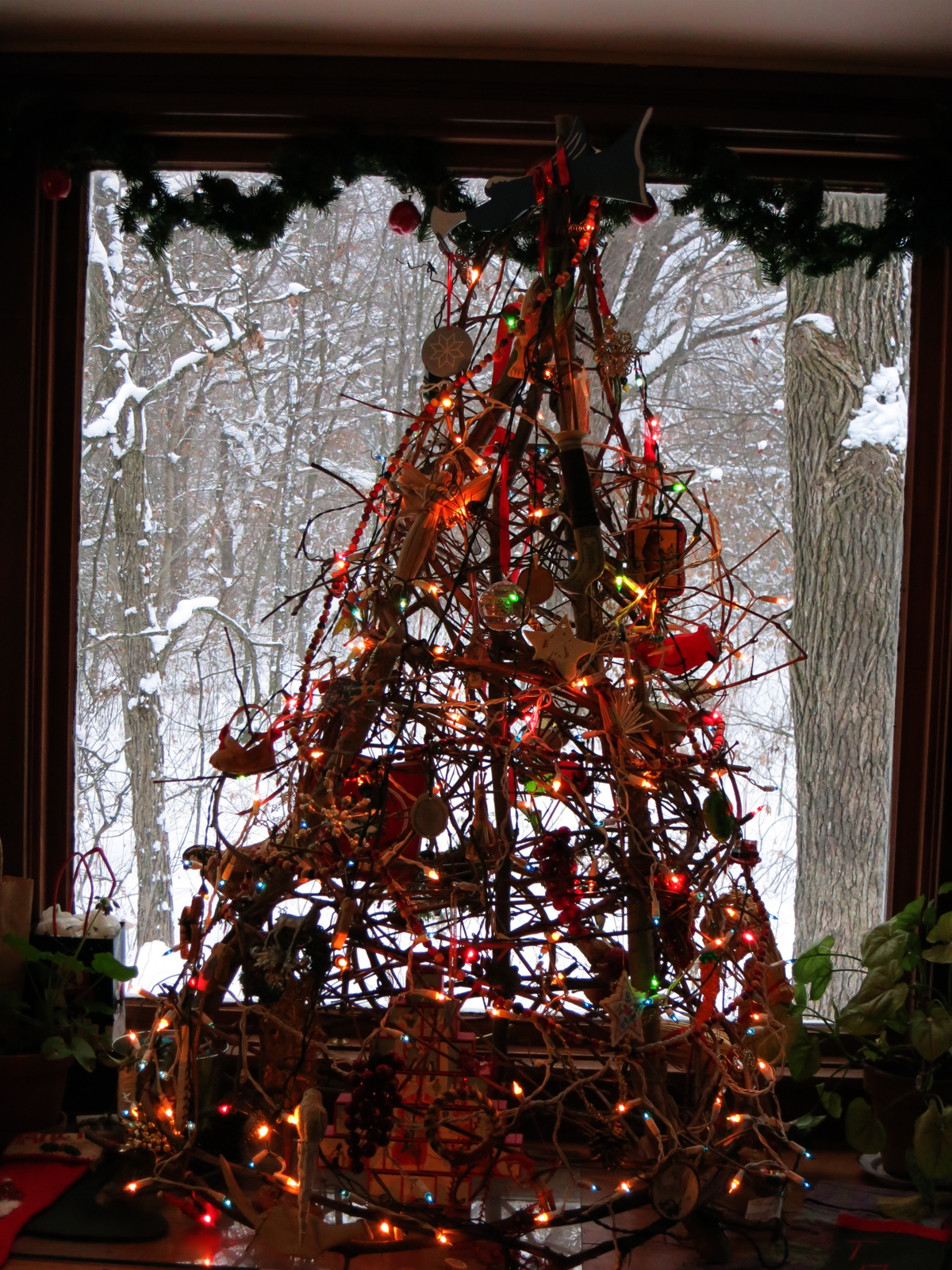
Yule tree

When I was growing up, trudging through snow to find a Christmas tree was not a family affair. The annual December fetching of the tree was their unique and special bonding period for my sister and my dad.   My brother and I didn’t mind because we got dad’s attention during the summer through Boy Scouts, by shagging fly balls after supper and going fishing and hunting with him.

Years later, I recall a similar tree-harvesting venture. My now adult daughter, Britta, was around eight years old. She followed my trail as I broke trail through the snow to a grove of young spruce trees that I had  planted years before. We finally chose one.  Before easing the sharp teeth of the buck saw into the tree’s base, I explained that we needed to properly thank this tree for giving itself to us. I told her of the practice that many native cultures practice  in leaving an offering when plants or animals were killed for their use.

In less than a minute the tree was cut. I urged Britta to put her nose close to the fresh cut and take a deep smell. She let out a hearty childlike “Ahhhhhh!” And then she stood up, standing directly over the stump and let a long trail of spittle drop from her mouth to the stump. “There,” she said, “I am giving the tree some of myself.”

“Perfect” I said through my smile.

With both daughters married and living on the West Coast, the tree gathering has changed. Now my Lovely Lady and I don’t even cut or buy a conifer any more. Instead, we stroll through the woods behind the house with our eyes scanning the underbrush for our target Tannenbaum. The Christmas tree requirements have changed as we incorporate artistic expression. Now we seek three saplings of the deciduous alien and pariah, buckthorn.

Millions of dollars have been spent in the Upper Midwest on controlling the spread of buckthorn. In Minnesota there are two species of this “noxious” outcast: Common and Glossy. Like most of us, this plant is not indigenous to North America. It was brought here from European Continent back in the mid-1800s. It was a very popular shrub for planting hedges. Not only did is shear easily but it held on to its summer green well into November when the rest of the world is moving towards shades of gray.

While buckthorn berries are not a top choice for birds to feed on, they often have no choice in food availability when other native species have a poor bearing year. Birds are effective agents for moving plants around. They eat the berries, digest the pulpy fruit and spread the hard seeds across the countryside in their droppings.

Without any native limiting factors that might impede their spread, the buckthorn has spread like a wildfire across the landscape. It has out-competed many of the native species and has changed the look of both wild and urban areas.

By elevating them to Christmas tree status, I am trying to find love for them. Sooner or later a limiting factor will likely evolve and retard their expansive  days of having their way with the landscape.

Ideally, we are looking for three similar lengths, approximately 5-6 feet in length. All branches and spines are cut off. It might not be a bad idea to treat the fresh cut stump with a buckthorn killing agent such as Garlon 4 or Pathfinder .  We are practicing a zero tolerance for any toxins on our fragile sandy soils that filter our shallow water table.

After the buckthorn is cut, we scan the naked canopy of the trees that grow at  the sunlit edge of the woods for wild grape vines that climb high into the red oaks and black cherrys. We don’t want the thick Tarzan swinging vines; instead we are looking for those that are no thicker than our little finger and then taper to a boot-lace size.  The lopping shears easily cuts them and then they are gently pulled from the upper limbs.  Once we have two or three vines, we start the actual job of fetching. The tangle of vines are far more unwieldy than the three buckthorn lengths.

Once back in our yard, we construct a simple tripod with the three rigid poles and a piece of baling twine.  Then, starting at the base, we begin wrapping the vine around and around the structure. In no time, we have a very earthy structure that is easily set in living room bay window. Strings of colorful lights are wrapped around our little Christmas tipi. These are followed by the decorations. All are easily hung by hooking them to the swirl of grape vines.

While there is no nostalgic essence of fir emanating from the non-existence boughs, there is also no need to water the tree. This is one totally organic, free range decomposable tree.  And if we are gentle with the skeletal structure, we can be assured of a number of years with this alien sitting front and center on the Yule stage.


To Sleep with the Stars

 IMG_0740

Recently I came across a small, pocket notebook that I had used as a journal on a kayaking/camping trip in the Sea of Cortez off the Baja Peninsula. Upon coming across the journal, I forgot the task at hand and sat down to read. It was a dozen or so years ago, but suddenly it all came back like yesterday.

Nancy and I paddled together in a tandem kayak.  There were eight other folks in our group. The trip was sponsored by the Science Museum of Minnesota. The intentions were to explore the Sea of Cortez, find migrating whales and hike in the adjacent Sonoran desert. I was employed with the museum as a naturalist at Warner Nature Center and one of the benefits was that I often had opportunities to help lead various eco-trips to destinations around the world.

Our flight took us from Minnesota to Los Angeles and then south to Loreto, Mexico. On the first night, as we all gathered after supper for a brief orientation by the kayaking company guides, we each were asked to share our paddling experience level and to express a goal for the trip. This was an excellent ice breaker as none of us knew each other before the trip.

Most of the clients were from Minnesota, were you are practically born with a canoe paddle in your hands.  Consequently most had either kayaked or canoed. But there was one woman, a sprite gal in her early 40s, from Greenwich Village in New York City. All eyes locked on this black belt urbanite. She wasn’t shy about sharing her experience. “I’ve never paddled. . . anything.”

In all my years leading Science Museum trips, I had never met someone like Beth; the lady who lived in the handsome Brownstone that was aired at the beginning of every Friends episode.

Beth was a highly successful businesswoman and one of the most curious people I have ever met. She had learned of this particular kayaking and camping adventure while reading a random magazine on a business flight. She thought, “Now that would be different and push me out of my comfort zone.”

How many of us deliberately choose a path that leads us away from personal contentment? This attribute of adventure seeking had steered Beth toward a highly successful business career. She had founded Code Inc., an architectural expediting firm that helps architects understand and comply with New York City building codes

Somewhere lurking in Beth’s genotype was a gene that pushes her to new experiences. What would I be willing to do to step out of my comfort zone?

Throughout the week we explored islands and coves of this unique landscape where arid desert interfaces with the Sea of Cortez. Beth exuberated a childlike wonder over almost anything.

One clear night, Nancy and I decided to forego the tent and we slept on our tent drop cloth out under the stars. Without nearby light pollution, the black sky was awash with stars and the cloudy path of the Milky Way. And when we sat up in our bags to look around, the quiet shoreline was ribbed  with a glowing ribbon of bioluminescence washed up at the edge of the beach. It was magical.

At breakfast the next morning we exclaimed about the light show of the night before. Later that day after we paddled several miles to a new campsite, Beth strolled over to us and quietly inquired, “How do you sleep under the stars?”

I was taken aback by the question. I almost blurted out, “Are you serious?” Thankfully we used better judgment. We told her about sleeping on a tarp, and shaking footwear before putting them on in case a scorpion found your shoes a perfect hideout.

Throughout the week, Beth continued to push her comfort boundaries. Her eager willingness to try new things was an inspiration to both Nancy and me. And both of would grow fonder of this bright and articulate New York City girl with the passing of each day.

At another remote campsite, there was a shallow cave in the impressive rock feature rising just off the beach. To enter it you had to scrunch over. It was only about ten feet deep from the entry but it was still pretty dark during the day. Imagine what it would be like in this narrow haunt after dark.

Beth looked closely at the rocky sanctum. She walked over to me and declared, “I’ve never slept in a cave before.”

I’m betting that no one in the group had and that no one in the group, other than Beth, had any desire to do so. We wished her a good night’s sleep as she pulled a tarp and her sleeping bag into the cave. Somewhere inside the dark abyss, we heard a cheerful “Good night all!”

Near the end of the week she reveled in the fact that she did not have to take a shower daily and that she was capable of peeing on the beach in front of others. We were witnessing a metamorphosis.

One day we discovered a dried out corpse of a kit fox. Late we came upon a dead tarantula. At each corpse Beth asked if she could touch them. And she did. She learned to identify a dozen bird species that we commonly saw over the course of our trip. And she learned a handful of constellations that prior to the trip she had only read about or seen mundane images of.

Beth was such a fearless and curious rock star that Nancy and I developed a tight friendship with her. And now having experienced kayaking, she was curious about canoes. So we casually threw out an invitation to come to Minnesota some time to join us for a canoe outing.

Less than six months later, Beth flew to Minneapolis, rented a car and found our house. We paddled the St. Croix River. She reveled in spotting eagles. On the drive back to our house, she was ecstatic upon spying roadside ditches full of wildflowers. It was delightful to have someone point out the party-colored flora, even if we see these blooms routinely. It mattered little to Beth that some of these, like yarrow, orange hawkweed and dandelions are considered invasive aliens. She was still seeing the world through new eyes.

Back at the house, we learned that Beth loved to cook. Without a recipe, she whipped up her mom’s famous apple pie. Her mom and dad lived on Nantucket Island off Cape Cod. After we did real damage to that memorable pie, she wrote down the recipe for us.

Over the course of the few days of her first-ever Minnesota visit, Beth expressed how she was going to sell her business in the next few years and move out to Nantucket Island. Repeatedly she insisted that we come out for a visit sometime.

Over the next couple of years we exchanged letters and cards but we were all too busy to have a reunion. And then I bumped into Beth in a horrifically unforgettable way.

I was waiting in line at the grocery store. I scanned the cover of People Magazine, and my gaze froze. On the cover was a lovely smiling woman who looked just like Beth. When I read the bold print on the cover “Murder in Nantucket, Every Woman’s Nightmare,” I grabbed the magazine and added it to my groceries. I was so stunned I cannot remember even paying the cashier. In the car, I flipped to the story. I was shocked and saddened upon learning of the gruesome murder of Beth Lochtefeld.

She had fulfilled her dream of selling her share of the multi-million dollar business and moving out to Nantucket Island where she was enjoying living close to her parents and involving herself in various arts related non-profit groups.

A romance-gone-bad. I could not comprehend the fear this normally fearless woman must have felt as she encountered a darkness far greater than a Baja cave and was stabbed twenty three times with a knife.

Beth, you still inspire us to step brightly in pushing boundaries towards new experiences. Thanks for giving.

Annual Tree Survey

 
Woodhenge Tamarack

Three days ago, I eased past the gilded tamarack that grows along our stretch of driveway. The tree’s brilliance prompted a lingering glance over my right shoulder. It was then that I spotted, further back beyond our house, a new dominant tree rising above all the others in our humble little woods.  As if standing on its tiptoes, trying to be noticed above the crowds of dominating, broad shouldered red and bur oaks rises a single white pine.

Upon returning home later that day, I declared to my Lovely Lady that it was time for my annual inventory stroll. This ambling walk  forces me to move as slowly as the most skilled deerstalker and to simply pay attention. The goal is only to take note about what is going on out in our woods.

I entered the portal of woods-in-transition. Indeed, our ten-plus acre woodlot is a mutt of sorts, a collection of diverse trees; some native, an alien and others introduced. Admittedly some have been transplanted or sown, but most have managed to find their way here on their own. (Note I have included the updated tree census at the end of this entry.)

As I snailed my way, zigzagging through the woods, I made a discovery that stopped me in my tracks. Tucked in the leafy duff of the back corner of our woods I found the bleached skull  peering out from under a carpet of leaves. Immediately, I knew itt was  our beloved dog, Taiga. He had died an old dog back in the winter of 2009.

With the ground frozen, his big body was sledded to his final resting place, roughly a couple hundred yards from the house. With branches piled over his stiff corpse it was our wish to share his being with the local flora and fauna. We liked to think that the local deer mouse and chipping sparrow population might find his fur perfect for nesting materials. That coyotes, crows, ravens and raccoons might find his flesh suitable for their own feasting. And eventually the very rodents, the mice and squirrels that Taiga harassed on his forays back in the woods, would whittle his bones.  After a moment of fond remembrance, I tucked his skull back under the thick comforter of dried leaves and silently moved on knowing full well that Taiga’s essence lives on here.

I thought of how this woods has morphed over my lifetime of just over sixty years. Change is always on the prowl on the landscape. Like a game of musical chairs, there is a never-ending shifting of flora and fauna waiting to jump in when conditions are right.  And just as we watch our kids strike out on their own, we need to accept that no grounds can possible remain static.

As a kid I remember coming out here to my grandparents farm and helping call the milk cows out of this very woods where they were pastured.

“Here Boss! Here Boss!”

The old dynamite shed, that my great-grandfather stored his explosives  in was properly isolated  a good distance from the house and other farm buildings. These fused tools of destruction were used to clear the land punctuated with stumps.  Slowly he cleared the land so he could plant more potatoes and other crops.

As my grandparents aged, the milking stopped and the cows were sold. Consequently, around 1970, the grazing was no longer a factor in these woods.  Another decade would have us moving the old farmhouse, built by my great-great grandfather in the 1890s, to a semi-cleared corner of this old renegade pasture.

In the nearly 40 years that have passed, many species of woody and herbaceous plants have thrived without the annual bovine grazing. It went from looking like a fairly open park to a tangled jungle.

Moving away from Taiga’s resting spot, I noticed other changes. My stroll started to involve obstacles. Recent windstorms over the past two years have torn several big oak limbs from the trees and dropped a couple others. The downed timber assures me of a winter of chain saw work.

There is some oak regeneration. Out in he more open areas, there are many scarlet red oak seedlings. Back in the woods I was surprised at the number of bur oak seedlings.

In recent years there has been an explosion of  touch-me-nots (Impatiens patiens) in parts of this woods. Could there be come correlation with the increase of oak seedlings? With climate change happening, I’m pleased to see the high percentage of young bur oak seedlings. With a likely drier future, the oaks should do just fine.

Another highlight was discovering the increase in small white pine seedlings and saplings. There are easily forty to sixty or so young trees volunteering there way into the mix.  Luckily the whitetail deer in this area have other agricultural options to feed on because in some parts of our region, deer view white pine seedlings as a dietary prize, a hot fudge sundaes so to speak.

These fast growing trees can race to the sun as well as any tree in this woods. Clearly these are the progeny of the tall mature pines that grow in my neighbors yard a quarter mile to the west. Prevailing west-northwest winds deliver an annual flight of tiny winged pine sees.

I made my way to stand beneath the “new” tallest tree on our ten plus acres. The white pine has nosed past a tall red oak. I wonder if the oak is standing tall and bold as it faces its execution by oak wilt?

I’m torn about the impending march of oak wilt; the dead oak assures me of years of exercise and many cords of hand split firewood. However, as the oak wilt moves phantomlike from root system to root system, squadrons of gray squirrels are tucking acorns into the ground. Some of these will become winter calories while others will be mislaid and have the potential to be the next round of oaks growing here.

The biggest surprise on my stroll was finding an overlooked basswood tree growing near our eastern boundary. The fifteen-foot tall tree with its fat obtuse leaves provoked a smile from me. Also known as the Linden tree, it is the namesake for the surname of the famed 18th century Swede and so-called “Father of Botany,” Carl Linneaus. It is a species that I would expect to find on richer forest soils instead of the sandy soils of the Anoka Sand Plain. So pleased to see the sneaky newcomer, I have to admit I actually greeted the tree.

Living in the woods can do that to you.

******

2013 Basecamp Tree Inventory

Introduced (Intentionally or Otherwise)

1)   White Cedar

(planted in the early 1980s)

2)   White Spruce

(transplanted around 1981 from Cook County forest, near Grand Marais.)

3)   Black Spruce

(The ten inch seedling was smuggled back to Minnesota, blanketed with moist sphagnum moss and tucked in a #3 Duluth Pack, from the Hudson Bay lowlands of northern Manitoba. This international theft occurred around 1983.)

4)   Red Pine

(planted approximately 1994)

5)   Tamarack

(4 foot sapling transplanted from bog near Twin Lake, about 2 miles distant, around 2004)

6)   Mountain Ash

(two trees transplanted around 1984; given to me by WNC volunteer Babe Allan, whose green thumb could grow a bushel of nails; she lived in northern suburbs. Birds love these berries and are responsible for a few new mtn. ash trees thriving here.)

7)   Black Walnut

(The late, Verner Dahl left two big cardboard boxes of black walnut fruits for me to plant back in the late 1980s. I neglected them but the squirrels didn’t. Their caching of the fruits resulted in several surprise black walnuts that are now approaching 25 feet tall.)

8)   Sugar Maple or the Britta Maple

(Planted in the spring of 1983 in honor of the birth of my first child, Britta. She was born the previous November amidst a snowstorm; making tree planting a delayed celebration. I dug up the man high sapling from a friend’s property near Afton, Minnesota)

9)   Apple

(Several were planted, but the most noteworthy and prolific, is a Prairie Spy (or is it a Haralson?) that I planted the spring after my Valentine daughter, Maren was born. Of course it is the Maren Apple Tree.)

10) European Buckthorn (first noted in the 1990s)

Native

10)                 Red Cedar

11)                 White Pine

12)                 Red Oak

13)                 Bur Oak*1

14)                 Paper Birch

15)                 Trembling Aspen

16)                 Large-toothed Aspen

17)                 Black Cherry

18)                 Red Maple

19)                 Box Elder

20)                 Basswood

(first noted October, 2013. Don’t know how I missed this fifteen foot tall tree before this!)

21)                 Willow

(The genus, Salix, is a confusing lot. My guess is that we have several species. Someday, I’ll challenge myself to sort them out.)

*1

I collected a handful of bur oak acorns from a mighty stand of find trees at a highway rest area along I-35 in southern Minnesota. I tucked them in gopher mounds and am pleased to say that I have three four foot tall oaks out in our open field. Without competition from other trees, and with a little luck, they should become signature landmarks another century.


The Hoarding Season


A friend of mine often tucked leftover tidbits of his breakfast, lunch or supper in scraps of napkins.  Then he slipped these caloric riches into various pockets of his clothing or even his daypack.  I remember spying such a package under his favorite reading chair!

His wife brushed off the hoarding behavior by sadly pronouncing, “He’s a child of the Depression. . .  family didn’t have much.”

It’s a common malady that folks have. I call it the “fear-of-running-out syndrome.” Folks usually hoard because they think that the collected items will someday be useful or valuable. Sometimes we hoard for purely sentimental reasons. And then there are folks stash and collect items because of afflictions of disorders such as obsessive-compulsive personality disorder, obsessive-compulsive disorder or depression.

Anthropologists often debate when this hoarding business first started. It was likely some 11,500 years ago, when humans made the leap from being strictly hunter-gatherers, to learning to poke seeds in the ground to raise crops and that tending livestock and fowl. With surpluses at hand, people could barter for foods and services and civilization as we know it, experienced a jump-start.

Just last week we laid our first, later-than-usual, morning fire in our kitchen wood burning stove. With November on the horizon, Nancy and I celebrated our annual frenzy of firewood hoarding yesterday. This week we completed filling our two wood storage sheds and packed a third of a cord of wood down in the corner of the basement, near the wood burning stove. We use that only during the  honest-to-goodness cold spells. One could argue that we are indeed hoarders. Nothing spells winter security better than stuffed woodsheds.

Given that recent winters have been pretty mousey we don’t burn as much as we used to. And usually our kitchen wood burner is enough to do the job. A few years ago we spent the money to have a professional energy audit. Using a blower door test and an infrared camera, a professional energy technician checked for leaks, inspected home insulation and heating systems in our house. The infrared camera images betrayed the telltale orange-yellow hot spots showed where our heated interior heat was escaping outdoors. Consequently, we were able to target specific spots with caulk, foam insulation, and other energy saving efforts. It has made a significant money saving difference.

Granted we spend very little on propane in the first place since we heat primarily with wood. The forced air propane furnace is our back up if we are away from the house.

It’s true we are adding some particulate into the atmosphere but we are not adding any fossil fuel carbon. The carbon released from our burning wood was not extracted as ancient carbon found in the earth’s crust. The carbon in our burned firewood has been cycling for some time in that very thin layer of earth and atmosphere that is capable of supporting life.  Known as the biosphere, the carbon is released through burning and other decomposing mechanisms and then is taken in, or sequestered, by plants for their growth. Eventually those plants die and the process begins all over again.

As long as we are confessing to autumnal hoarding, we have enjoyed picking, freezing and putting up sauce from the five gallons of wild cranberries that we have picked over the last couple of weeks.  While that might seem impressive, a neighbor lady has put up 200 quarts of cranberry juice and sauce!

Most folks don’t realize that here on the Anoka Sand Plain the underlying sand, combined with abundant wetlands provide ideal conditions for native cranberries. Minnesota has two species, the large cranberry and yes; you guessed it, the small cranberry. The large cranberries are the ones that we find dished out every Thanksgiving.

In picking cranberries you need to get out into the wetlands where the ground quakes. I wear a pair of chest waders and Nancy wear hip boots so we can kneel comfortably on the soft, wet sphagnum moss to pick the tart, grape-sized red fruits.

We were not the only hoarders in this wetland of sedges, leatherleaf and tamarack. We found small piles of half eaten fruits, etched with tiny rodent incisors. . . likely red-backed voles or meadow voles.

One day we bumped into a flock of wild turkeys that had ventured out onto the boggy site to pick ripe fruits. Being a turkey hunter, I couldn’t help but wonder how one of these cranberry-infused birds might taste.

Another day, as we approached with buckets in hand, a pair of sandhill cranes croaked out their alarm calls as they took off. And I have even picked my way around perfect round bushel basket depressions of deer beds. I can’t imagine a more comfortable bed than one of thick soft sphagnum moss.

In about three weeks, I am hoping to hoard some venison for the upcoming winter. There are few marriages as perfect as venison and cranberry sauce served in a room lit and warmed with burning oak. Now that is prosperity.

Where’s the Balance?


The Whitehorse hospital doc finally came back to the exam room carrying the x-ray. “You broke your hand,”he said far too matter-of-factly.  “The good news,” continued the doc, “is that after consulting with the surgeon, he doesn’t think it needs to be pinned since everything lines up well. . .it’s an oblique fracture. So let’s get a cast on your hand.”

Damn. . . I was really hoping for just a bad, painful bruise.

And that is why I’m pecking painfully slow at the computer keyboard. Too tough to type upper case; good thing the apple knows to use upper case at the beginning of a sentence. bear with some abbreviated wrds and mispelings.

But it all could have been so much worse. Doc didn’t think the gash on my left shin required stitches. Bummer that the gauze leaked and left a crimson, abstract version of the big island of Hawaii on our bed sheets the night before. i didn’t show the doc the hand-sized scrape on my right thigh.

So what the hell happened?

For the sake of brevity (oh this is tough to keep it brief because I like to spin a story) I fell off a little pitch of a rocky spire. Stupid.  stupid decision to climb it. The handholds and footholds looked good. And I did note the scrabbly rock near the bottom. The rock pyramid was house-sized and I was tantalized by the challenge and the higher vantage point. And I have to admit some vanity rose up as well. Being a sixty something, I like to show myself and others that i can still scramble like a mt. goat rather than an old goat.

To get to this craggy mountain bump involved a long, bushwhacking hike through some pretty scrabbly ground that has, for the most part a pretty stiff grade where you are mostly leaning into the slope. Four of us, wife, nancy, friend banjo kim and her plucky, 16 year old, stone deaf husky, named  smoke and myself were trying to get to the top of needle mt.  nancy and I had been there  before but never going this route.

We were less than ¼ mile fro the top but decided to rest, collect some alpine flowers and snack. Also decided not to risk the tough climb. All of us were fine with the call it a day.

While we rested near the seductive spire, my inner dumbness nudged the moment of repose. Perhaps the spirit of George Mallory sidled into my dulled, decision-making process. (Mallory was the famous early 20th century british mtn climber who died on mt. Everest. When a news reporter asked Mallory why he wanted to climb Everest his now famous response was “because it’s there.”

Well if it’s good enough for George it was good enough for me. Sounds rational. And besides it was only about 20-25 feet up; not 29,000 feet.

I carefully made my way up. I noted some sketchy holds close to the bottom. I remember being super intentional. Almost guiltily, I glanced back towards nan and kim. Both were watching. I remember being relieved that nancy wasn’t questioning my tiny summit attempt. She is usually far more cautious. And sometimes I get frustrated in her black belt caution. So I was clear to go.

But now with this cursed cast onmy hand, and quiet time to ponder the fall,I wonder if subconsciously I was expecting, no wanting her to check my climb?

Long after that scrabbly foothold crumbled, (luckily only four feet off the ground) and long after we made the long slow trek back down to our truck, and long after kim went home after a shared supper, did nancy light into me. Mallory’s spirit sulked away like a wisp of Everest fog.

For full effect, nancy employed tears interspersed with corrosive cursing and Olympian gesticulations. And all of it was fully justified. It wasn’t enough that I had already claimed my stupid decision. An apology wasn’t enough. I had selfishly played mt. climber without clear thought on the ramifications of a bad accident. I had put us all at risk high up on Needle, hours away from any phone or road. A bad injury would require a helicopter evacuation that could only happen hours later and even then you would be racing good light.

My finger is getting tired of this keyboard tap dance so I need to wrap this up. Besides its taken far too long to write this post.

Lesson learned: be more patient with nancy’s more cautious stance. It’s in the interest of both us. We are so lucky to have each other and to share a desre to ramble around in scrabbly, wild places.

We leave the Yukon in 3 days. Catching the ferry to Washington. I reckon 4 days of cruisin’ the inside passage will be perfect for bone repair. Then we get a few days of hanging out with daughter, maren and so-in-law, ben at their home in Tacoma.

I guess this means there will be no mt. biking with ben. but he is a doc so maybe?????

 Page 18 of 26  « First  ... « 16  17  18  19  20 » ...  Last »