

Who decides if a plant is “bad” or “good”? Is there an objective czar of plants who flips thumbs up or thumbs down?
It’s certainly not the fat bumblebee that leap frogs in its bobbing flight from pungent blossom to pungent blossom. It’s not the honeybee that is intent on gathering nectar to convert to honey. Nor is it the monarch butterflie that flits from blossom to blossom to reenergize itself after its lengthy migration.
Recent news reports are informing us of the seriousness of the downward plunge of populations of pollinating insects like bumblebees, honeybees and butterflies. These are the same pollinating insects that make it possible for you and I to enjoy one-third of all the fruits and vegetables we eat.
We have vilified plants that are far more valuable than a bland dose of Kentucky blue grass. And yet, the average homeowner spends hundreds of dollars in applying supposedly “good” poison on the same lawn that their children and pets play on.
Americans have a puzzling love relationship with manicured landscapes. In fact an area slightly larger than the state of Pennsylvania is mowed in our country! Consequently it’s no surprise that the average American spends 40 hours per summer mowing a lawn.* And I bet that most folks sit on a lawn mower that powers them through the chore so there is little-to-no exercise there.
I would rather spend those extra 40 hours fishing, riding my road bike, or laying in my hammock with a good book and a gin and tonic. Forty hours enslaved by a stinking and loud lawn mower is not only torturous but it is downright stupid.
And if you want to buy that boat or set of nice golf clubs you could easily save the money you use in buying gas for your lawnmower by mowing either less area or pushing a reel mower. More gas is consumed EACH year in the United States just for lawn maintenance than the nearly 11 million gallons of fuel spilled by Exxon Valdez in 1989.
This is beginning to sound like a nice sequel for the movie Dumb and Dumber.
Let’s assume that you mow your lawn for 25 years. That means you will spend 1000 hours or nearly a month and a half of your one wild and precious life riding or pushing a lawn mower. Crazy!!
When we think of a lawn I am guessing that the image most folks conjure is a blanket of trimmed Kentucky bluegrass. We are brainwashed that any other insurgent plants are the villains of such a bland green lawnscape.
I would like to know who decides that creeping Charlie and dandelions are “bad”?? Clearly the loudest warnings come from those who stand to gain from your purchasing power. Lawn owners apply more herbicides and pesticides per capita than farmers dump on agricultural lands.The ads for lawn care chemicals seduce folks into thinking that a yard has to attain a certain standard.
Biological diversity brings a richness to the natural community. And I would argue that ragged yards with carpets and patches of various plants brings more real value than a cosmetic perceived value.
You might wonder if I mow my lawn. I do. But over the years our lawn has shrunk and between a push gas mower and a push, non-gas, reel type mower we get the job done in 45 minutes. I have tracked our mowing and we mow our yard less than 20 times per spring-early fall.
That means we are mowing fifteen hours per summer. Looks like we better put in more flower gardens to reduce the mowing surface.
In the meantime I am going to revel in the heavy aroma and tea made from the leaves of Creeping Charlie and continue to munch salads and breakfast burritos augmented with dandelion greens while watching the bouncing bees as they loop from plant to plant.

Spinach considered one of the top ten superfoods is notably inferior in delivering nutrients than the maligned dandelion. Compared to spinach, dandelion leaves have eight times more antioxidants, two times more calcium, thee times more vitamin A, and five times more vitamin K and E.
We should be enhancing our yards with less grass. I urge you to turn your back on the manicured look to encourage the likes of such nutritious and beneficial insurgents as creeping Charlie and dandelion.
Who can possibly be against more hammock time, fishing or golf?
* According to: Barth, C. (2000). Toward a low input lawn. In T.R. Schueler & H.K. Holland (Eds.), The practice of watershed protection (Article 130). Ellicott City, MD: Center for Watershed Protection.

During the first two days of the spring turkey hunting season, I helped my 89-year old father-in-law, Dave, try and get a gobbler. I did the calling and while we managed to see a half dozen hens, only one longbearded gobbler came relatively close. He passed behind our blind some 40 or so paces away in the brush. He was intent on following a live hen, rather than be tempted to check out our faux hen decoy.
We hunted for hours and at times there was too much chuckling coming from our blind as Dave told tales and jokes that triggered our muffled outbursts. Dave is a joke savant and it only takes the mention of a subject and he will more often than not, pull a joke or limerick from his 89-year old brain to share with anyone around him.
We were whispering about the joys of eating wild game when he shared a story of a nephew who travels back to Minnesota from his Los Angeles home every November to hunt whitetail deer.
When he is lucky enough to fill his deer tag, he will ship venison home to the west coast. He enjoys cooking and entertaining his non-hunting California guests with his culinary skills. His urban friends often exclaim wonderously about his culinary skills and will ask him, “What kind of meat is this? It’s delicious.”
His answer, “Minnesota, free range, organic,” satisfies everyone with unquestioning blissful nods.
So on the morning of the third day of our turkey season, I went by myself to a neighbor’s woods. The day was clear and flirting with temperatures around freezing. After settling down in the dawning woods, I used my mouth call to try and provoke a gobbler to answer.
Nothing. Only the raucous bugling and clattering calls from nearby sandhill cranes. After twenty minutes of watching the sun climb out of the east horizon and occasional yelping on my part, I heard a distant gobble. Ahhh. . . a response! It always warms me a bit when a gobbler answers my rendition of a hen turkey’s yelps.
I called again and a closer hearty gobble erupted through the morning chill. Clearly he was on his way towards me. Sure enough, in less than two minutes I saw movement out in front of me from inside a ragged brush line beneath some tall red pines. I was pleased to see not one but two mature male turkeys or toms and no hens.
Without a hen, they would be more susceptible to my lone hen decoy. The larger tom paused to look my way and consider my decoy, but at roughly 40 yards, I was not comfortable in making a killing shot so I waited for him to move in closer. In seconds he decided to move on and my heart sank as he dipped into some brush.
I fretted momentarily that I might have missed my only opportunity but then I comforted myself in thinking that they were not alarmed and that they might be back.
The pair of gobblers moved on a short distance, slightly behind me and to my left. The continued gobbling as a duet, particularly when I gave a soft yelping call.
Suddenly I caught sight of a third turkey moving out in front of me following the same route the gobblers had taken. It was a hen. She paused to give a dismissive look at my unmoving decoy and moved steadily toward the two gobblers.
Less than a minute after she passed my set-up, the male’s gobbling intensified. Clearly the hen had been spied and now they were in full chorus with their lusty gobbles.
I realized I would have to be patient or try and attract the hen. I’ve had luck in the past calling an aggressive hen call known as cutting when I wanted to attract a hen or hens to by decoy. It always feels so out of place to rip off a loud cutting call followed by excited yelps. Hen turkeys have their own pecking order and sometimes upon hearing an aggressive cutting call, a dominant hen will make her way over to check out who the “new girl” is in her neighborhood. And with luck if she comes, she will inadvertently troll along any male suitors.
So I cut like crazy and sure enough within a couple of minutes I glimpsed the hen making her way towards me with two strutting, fan-tailed toms following her like love struck groupies.
It was 6:40AM when my shotgun erupted erasing the morning quiet and a gobbler’s life.
Less than an hour later I was dicing an onion, garlic and mincing the fresh heart, liver and gizzard from the turkey. Nancy came down the stairs from our bedroom still yawning and commenting on the blend of smells that pulled her from bed. She could hardly believe that I was already back with a bird.

In short order a couple handfuls of freshly picked nettles were sautéed and bowl of cracked eggs were stirred. Soon we were sitting down to a skillet of “Minnesota Free Range, Organic Nettles and Gobbler-Infused Scrambled Eggs.” A proper thanks and acknowledgement was made for the gifts of the turkey and nettles.
And all was good.


Eight of us, four Canadians and four Americans, paddled down the taupe- colored Green River in Utah for nearly half a dozen days before making camp at the head of Horsethief Canyon. This was said to be one of the very canyons that famed train and bank robbers, Butch Cassidy and his partner, the Sundance Kid, had found refuge with their shadowy cohorts.
Even though it was mid-April, it was hot and after the tents were put up, we sought shady shelter to eat some lunch before heading switching footwear and heading up the meandering sandy wash that snaked up a canyon.
A large boulder cracked and worn from millions of summers and winters had once tumbled and settled, like a solitary feature at the base of rocky and steep slope. It’s tapered aspect angled over us like ramp and made a perfect sun shelter for our camp kitchen area. And we were not the first to pause here.
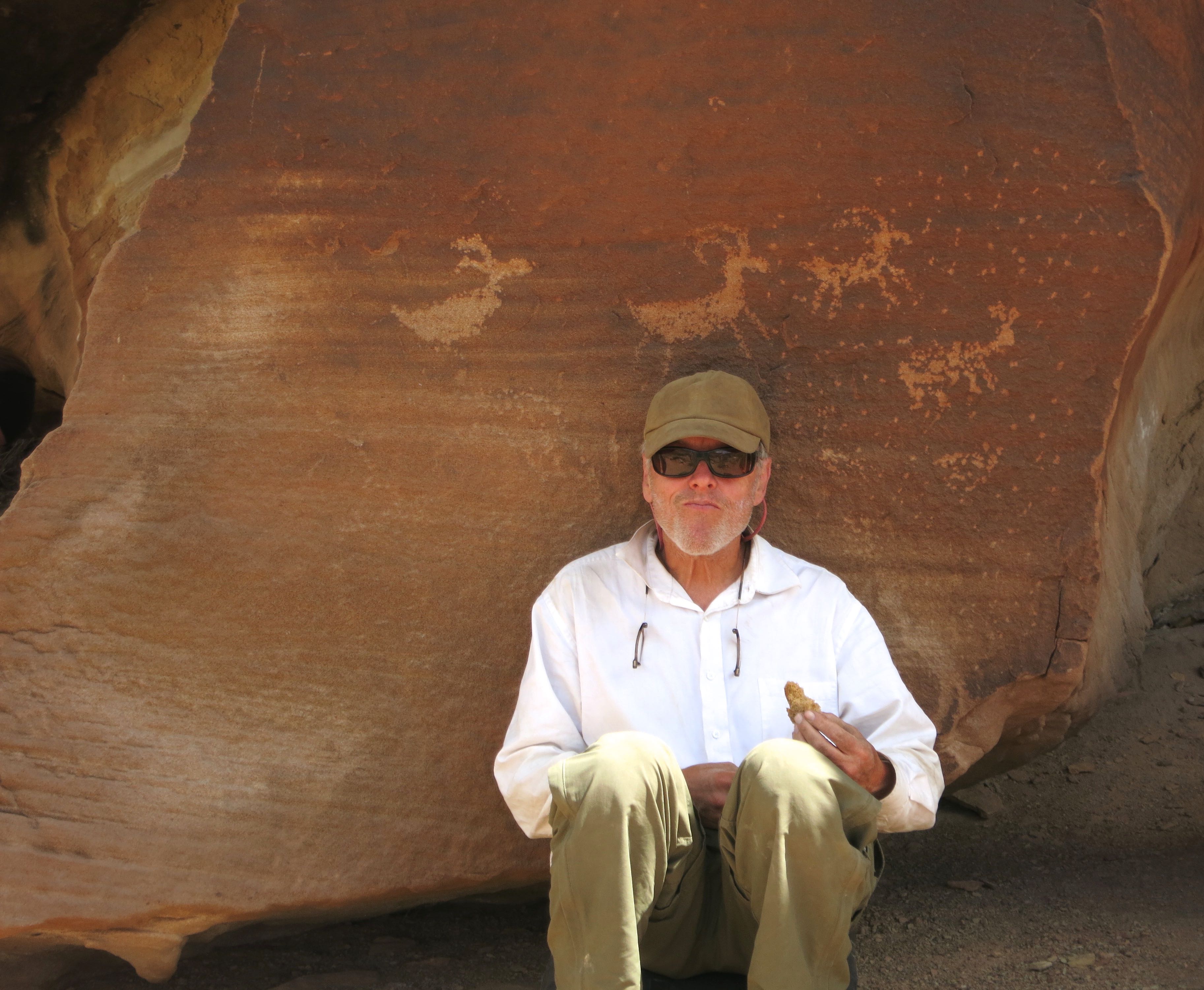
Stippled chest high is a small herd of sheep, desert bighorn I suspect. The artist had tapped the images hundreds if not thousands of years ago. Was it a Fremont culture native or Anasazi hunter who paused to create this mysterious billboard of sorts? Was the intent of the boulder art to give a message to followers? Or perhaps it was rendered out of respect for the game that nourished “the people.” I kind of like to think the native had found himself resting in the shade of the boulder and was simply expressing his creativity for no reason other than to do some stone doodling.
If the thicket of thieves had sequestered themselves in this remote canyon hideout, had they paused here to ponder the petroglyphs?
Horsethief Canyon was one of several of Butch’s favorite hideouts. While it did not have the notoriety as his remote Robbers Roost further north up in the San Rafael Swell in Utah, Horsethief Canyon is in rugged and isolated country that is mostly described as desert and sinuous canyons.
With water bottles filled and stowed in our daypacks we began hiking up canyon. The creek soon disappeared beneath the loose sand and we soon found ourselves weaving amongst impressive water-smoothed boulders. While the land wears its aspect of desert impressively, I couldn’t help but wonder how a rainstorm could turn this canyon into a mighty rapids of water rushing to merge with the Green River. With the azure sky overhead, I was confident we would not have to clamber up any canyon slopes to avoid any deadly, surging washout.
We were not alone inside the deep sandstone walls. Tracks of small desert dwellers squiggled their hieroglyphics up and down the washout banks. Small lizards were common sights and Say’s phoebes flittered ahead of us, always keeping their distance from us.

I wondered if the sandy score of footprints and tail drags came from a lineage of snakes and lizards that might have skittered from Butch and Sundance. My guess is that this canyon acts somewhat like a biological bank where species can remain undisturbed from human alterations to their homes.
An hour of hiking up canyon we delighted in finding small pools of fresh, clear water. The pools beckoned us to take a dip, but with a mysterious bend in the canyon up ahead we pushed on to explore for signs of Butch and Sundance.
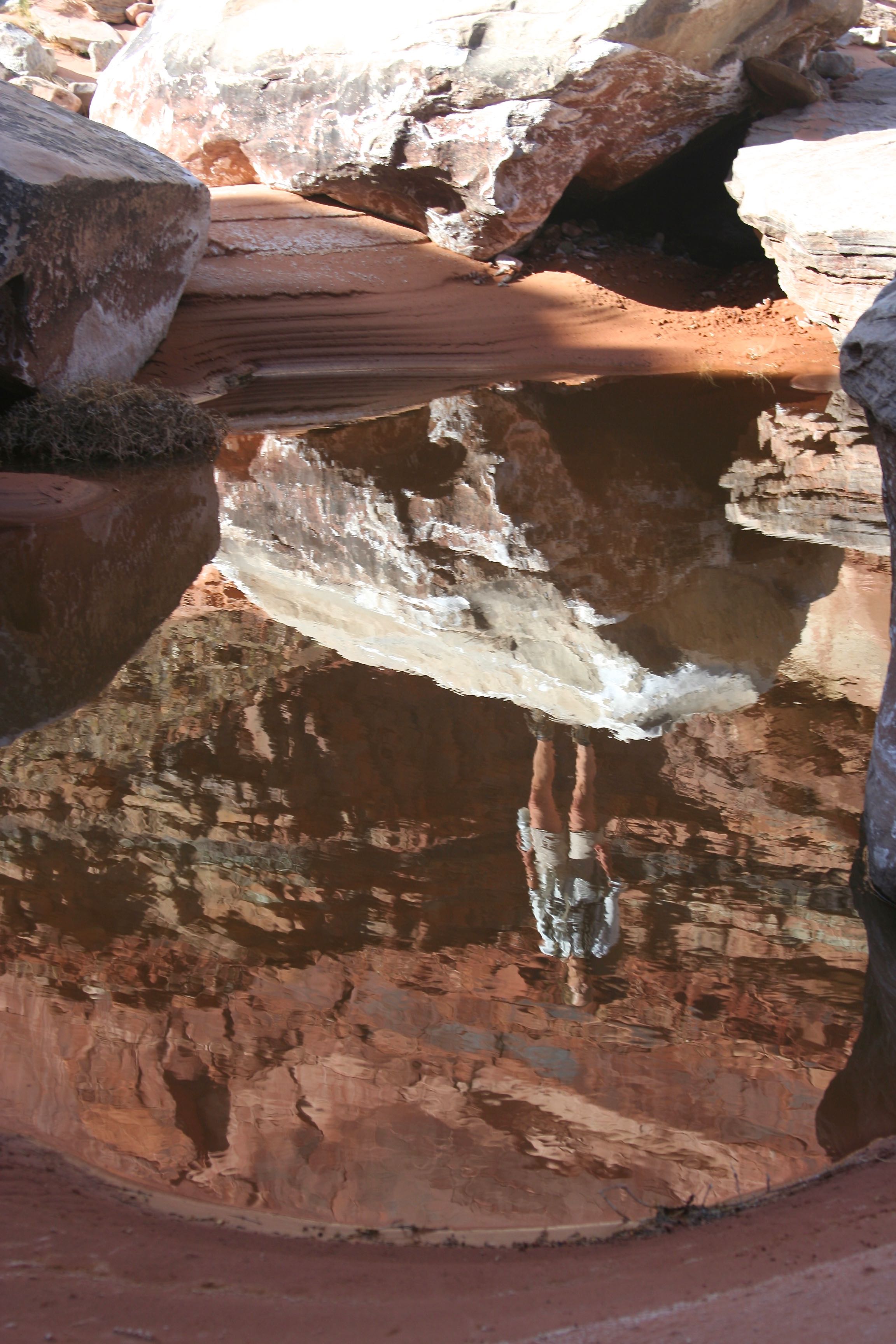
With the day waning we finally halted at an immense water-smoothed sandstone bowl. We could only imagine the torrents of water that must pour through here, rushing to join the Green River.
A raven called from up canyon. Knowing the raven’s importance in many native myths and stories, particularly as a magician or trickster, combined with Butch Cassidy’s love of tricking and disappearing from the law, I couldn’t help but wonder if Butch’s spirit now flies black and still haunts prickly, rocky, and heated hideouts.

Spring weather came swooping in and whittled the snow away in just a matter of days. Before the snow was gone, I had taken my woodcutting tools into he woods for an hour or two of putting up firewood. After cutting a large windfall oak, I turned off the growling chain saw, took off my helmet and began the maul work of splitting the oak. In a short time I was hatless and into a rhythm.
As I worked my way through the increasingly larger rounds of oak, towards what had been the base of the tree, I paused, feeling the satisfaction, of watching the oak split into two pieces. As it flew apart, the soft snow on the ground became peppered with winter dormant carpenter ants that tumbled from their upended cold weather sanctuary. I set the maul down to cool off. The maul needed no cooling but I certainly did.

I leaned close to inspect the stilled insects. Not a movement from any of them. I felt a little guilty exposing them to winter. Tumbling out of their gallery, they would either die ofexposure or from foraging small birds, like chickadees and downy woodpeckers, that sometimes are attracted to the “thunks” of my rising and falling maul. They have learned that a pile of freshly split oak oftentimes reveals calories in the form of insects.
Feeling a slight pang of hunger, I reached over and took a good pinch of ants and without hesitation popped them into my mouth. When eating insects in a society that rarely intentionally eats these arthropods, it is best to not dilly dally and just go for it. The crunch, crunch, crunch of my molarsrendering these insects to a very quick death was followed but an explosion of flavor that is not unlike a powerful Sweet Tart candy. The blended sour taste with the sweet flavor danced on my tongue and actually served as a rejuvenating break during my chores.
Carpenter ants are classified in the family of ants called Formiciidae. The origin of the family name comes from formic acid which, in my mini-dose, gave me the blast of “ultra-sweet-tartness.”
Formic acid plays an important role for the ant’s defense. It is an effective deterrent for aggressive threats to the ant. Some biologists wonder if the bird behavior known as “anting,” where the bird grasps ants in their beak and rub them all over their feathers, is an action that rubs formic acid on them to help keep parasites off the birds.

Besides the jolt of surprising and energizing taste, I was ingesting a form of food that is energy and nutrient dense. Many insects are equal if not superior to conventional livestock, eggs and even milk in delivered energy and garnered nutrients.
Intentionally consuming insects this is abhorrent to our upstanding picnic practices. At the picnic table we often flutter our hands and fingers over heaping summer bowls of potato salads and other delectables to keep curious insects away from our outdoor feasts. Perhaps we should be attracting the fresh “toppings” to enhance our cuisine. But habits are hard to break and we are products of our upbringing.
Eating insects, known formally as entomophagy, is not a common practice in Western Society but a recent UN Report entitled Edible Insects Future Prospects for Food and Feed Security estimates that two billion people on the planet regularly eat nearly 2,000 species of insects. The report’s Forward lays out the premise of the report.“It is widely accepted that by 2050 the world will host 9 billion people. To accomodate this number, current food production will need to almost double. Land is scarce and expanding the area devoted to farming is rarely a viable or sustainable option. Oceans are overfished and climate change and related water shortages could have profound implications for food production. To meet the food and nutrition challenges of today – there are nearly 1 billion chronically hungry people worldwide – and tomorrow, what we eat and how we produce it needs to be re-evaluated. Inefficiencies need to be rectified and food waste reduced. We need to find new ways of growing food.”
The word insect derives from the Latin word insectum, meaning “with a notched or divided body”, literally “cut into sections”, from the fact that insects’ bodies have three parts. (Head, Thorax and Abdomen) Given that these small livestock, are more efficient at creating protein than beef, with far less global impact on natural resources such as water and acreage required, we might do well to lean towards insectum. . . or more aptly put, “insect-Mmmmmmmm.”
According to the UN Report,the most commonly consumed insects globally are beetles (31%), caterpillars from butterflies and moths (18%), bees, wasps and ants (14%), grasshoppers, locusts and crickets (13%), cicadas, leafhoppers, planthoppers scale insects and true bugs (10%), termites (3%), dragonflies (3%), flies (2%) and all other orders (5%).
With more than 12,500 species classified and more out there, ants are the most numerous insect group in the world.
World renowned biologist and author, E. O. Wilson, has spent over 60 years at Harvard University studying ants. He is fond of reminding students that ants work together, share food and send their elders into battle to protect their young. Furthermore, these amazing insects make up more than one quarter (25%) of the world’s insect biomass. And almost unbelievably, Wilson and his colleagues estimate the world’s ant population, estimated at one million trillion at any one moment weigh roughly the same as all human beings.
In Minnesota the largest ant species are generally one of the several species of carpenter ants. Carpenter ants are so-called because of their habit of excavating wood to make their galleries and egg-laying chambers. These social insects DO NOT eat wood. They are primarily insect eaters.
We have found a few renegade carpenter ants that patrol our kitchen for bits of sweet syrup, jelly or honey. These innocent trespassers were likely carried in by us when we hauled in armloads of firewood. Once indoors, they warm up and awaken from their winter dormancy and begin to explore for food.
A couple hundred yards away from my wood cutting and ant-feasting is a wrecked birch tree that has been excavated by a pair of pileated woodpeckers all winter. Carpenter ants are essential to the survival of these largest of Minnesota woodpeckers. The long troughs carved out of standing trees are oftentimes near the base of the tree where the colony of ants tends to have their primary or parent colony. Outlying smaller colonies are called satellite nests.
For the time being the local pileated pair need not worry about the slow, two-legged anteater. He has the luxury of exercising his curiosity more than foraging for his food.


While shuffling along the potluck supper line at my cousin’s wedding I paused frequently to scoop. I found myself worrying that the surface area of my plate was not equivalent to the desires of my palate. I had to choose carefully as the choices and arrays of foods were mighty.
I came to the section of breads and there was a label that caught my eye. “Grandma Fran’s Orange and Anise Rye Bread.” The baker, a man named Duane, known to me and most others as “Whitey” is my uncle’s brother. He lives only a handful of miles northwest of our house. So given that I know the baker and I remember the late Grandma Fran as a woman easy to smile, I gently placed a slice on my heap of celebratory grub.
Half an hour after eating my small feast, I spotted Whitey so I waddled over to him to commend him on his bread baking skills. It turns out he has been baking the bread for years and has built up quite a reputation in the community. I soon learned that his offerings always disappear whenever his church has a bake sale.
“Come on over sometime and I’ll give you a lesson,” he offered. Of course I smiled and nodded.
In two weeks time, I was standing next to Whitey in his kitchen. We were surrounded with sacks of flour, bowls, measuring cups and spoons, graters, mortar and pestle, a pastry sheet to keep the mess of kneading bread off the counter.
But before we began he insisted on a ceremonial fueling. He poured us cups of coffee and what else . . .two pieces of toasted rye bread with Whitey’s rhubarb/strawberry jam.
Soon he had me grating orange peel, grinding anise seeds, preparing the yeast, mixing molasses into the blend of sugar, powdered milk and molasses before adding the rye and white flour.
He explained that as a young man he had badgered his mother into teaching him how to bake her famous bread. Whitey was the youngest of four sons, so it was likely that Fran was pleased that he showed an interest.
Whitey and I each worked on a batch of five loaves of bread. Finally it was time to let each of our batches sit in a warm place to rise for a couple hours. My rotund flour mass sat tucked in a big covered Tupperware bowl in a warm bath of water in the laundry sink.
By this time we had worked up a hunger again and so Whitey fed me another of his signature items . . .northern pike fish cakes. Excellent.
After eating, things had progressed with the flour and we began the physical part of baking bread. No machines here, Grandma Fran would never approve. We each dumped our flour in front of us, rolled up our sleeves and began the work of adding flour and kneading.
“More flour,” barked Sgt. Whitey. “You’ll know when you are there.”
I could feel the pleasant to almost painful workout my forearms were getting while I dug my fingers and kneaded the flour.
“More flour. You’ll know when you are there.”
And so I kept on. I was getting into a groove like when you are on a long arduous run or bike ride. You find a zone where you are able to displace the pain.
“More flour. You’ll know when you are there.”
My brow was breaking out in a sweat line and I wondered if the batch of bread would be tainted if I added more salt that dripped off my forehead. Luckily Whitey called a halt. We then divided our respective batches into five equal loafs. He showed me the geometrical trick in dividing a large round of bread dough into five similar bodies.
We sculpted and primped our loaves before placing them carefully in the greased round pans. Each rounded, “smooth as a baby’s butt” loaf was covered with dishtowels and placed in a slightly warm oven.
By now we needed to cool down so we bundled and booted up to head outdoors. It was on this stroll that I learned another value of baking Grandma Fran’s bread.
Whitey directed me to his evaporating cooking set-up when he boils down his maple syrup in early spring. He showed me how he built it up with cement blocks that he had procured a few miles away near Weber.
“Guess what I paid the guy for the cement blocks?”
I shrugged and Whitey smiled, “Some loaves of bread.”
Then as he showed me the welded steel door that is part of his wood burning syrup-cooking operation. It was custom done.
“Guess what I paid the welder for his work?”
Another smile, “Yep, some fresh bread.”
Strolling to his garden we noticed some deer tracks. This brought up the subject of hunting. Whitey has a yellow lab that has been his primary pheasant hunting partner. Surrounded by farmland, sloughs and woodlots, Whitey is able to secure permission to hunt on neighboring lands. He never leaves his house on a day of hunting without several loaves of bread in the back seat of his truck. He smiles when he shares that he is often urged to return for a hunt.
He has even bartered bread for other foodstuffs. At the above -mentioned church bake sale, there is a woman who makes equally legendary homemade pecan pie. They always make sure they keep one of their baked items from the sale table so they can exchange them before heading home.
We returned into the house, delicately lifted the bread shrouds away and then put them into the now-hot oven for half an hour or so of baking.
I went home with five treasured gifts of manna that night. I’m thinking of giving Whitey some . . . . No, that won’t work.
Just days ago, maybe a month after my lesson, I tried my first attempt at baking without my mentor at my side. I’m so proud of my efforts that I took photos.
Yesterday we got a fresh dumping of 3-4 inches of snow and wouldn’t you know my good neighbor had me plowed out before I could get out and shove snow around. So even though the wind-chill is a bit nippy, I’m going to take one of my loaves of bread for a one-way walk.
Thanks for the lessons on bread baking and generosity Whitey.
His mom, Frances Sundberg, moved with her family from central MN when she was 18 years old,
Didn’t take long and she was dating a native I. Falls fellow named “Swede”Clarence Sundberg.
She had four sons. So taught Whitey how to bake the bread after he badgered her on how to bake it.
She never measureded out ingredients. A bit of this a bunch of that and son on.
First time he baked he kept asking, “Isn’t that enough flour?” More flour.
“You’ll know when you’re there.”

-art by Jeanie Tigullaraq, Clyde River, Nunavut, Canada
I had been outside less than two minutes and now my naked-ape fingers were numb. Okay so at -10°F and a stout north wind, I should know better than to go out and dump ashes from the kitchen wood burning stove without wearing any gloves or mittens. Admittedly I did pause to take in rising sunshine and draw in a “good morning” deep breath of air. That inhalation was also a wake-up call that the day was nippy and not suited for an ill-clad encounter.
I hurried back to the house from the frozen compost pile, stopping to clutch a couple pieces of firewood from the wood shed. My hands that were quickly becoming rigid claws rather than flexible and tactile digits.
Back indoors, I hovered over the stove. I clutched a couple water-polished pieces of Lake Superior basalt that I keep on top of the kitchen woodburning stove. They are ideal hand and foot warmers. As warmth seeps back into my pain-riddled fingers, I grimaced as I grunted lyrics from John Cougar Mellencamp’s “Hurts so Good.”
Rolling the black silky smooth stone over in my hand I couldn’t help but marvel at how traditional Inuit hunters could tolerate existing and even thriving in Arctic conditions without a stick of wood to throw on a warming fire.
Three weeks ago I frostbit three of my fingertips while out cutting and splitting firewood. The tips on three fingers of my right glove had worn through and exposed the flesh on my fingertips. Over the past few days that damaged skin peeled away and I am equipped with new epidermal coverings on the tips.
Such a mistake in Arctic conditions could be fatal. I stand in awe of the Inuk hunter who would stand on his small swatch of polar bear fur to add both warmth to his feet and make it quieter for him to shuffle. Cold air and snow crystals combined can make for a loud squeaky ruckus. And if you are trying to remain silent above a ring seal’s breathing hole in the frozen sea ice you must remain as quiet as a falling snowflake. You need to hear the muted exhale of a seal as it pauses in its underwater excursions to catch a breath at one of its breathing holes. Shaped like upside down ice cream cones, the breathing hole on the frozen sea allowed the seal to catch a breath. With the primitive harpoon poised at the tip of the inverted cone, the patient and quiet hunter will hear the seal’s appearance in the inverted ice funnel and drive the harpoon towards the seal.
Bending over at the waist, the hunter, resembled a frozen underling bowing to the vast, desolate and frozen landscape. . . sometimes for hours. There are stories where hunters would diligently wait at the hole for the quiet exhale of a seal for over two days. No screen of trees or walls to divert windchilling winds that can easily steal your life. This was not recreational seal hunting, this was grocery shopping. Their family’s survival depended on their hunting skills and their perseverance.
Hunters were covered in layers of caribou hide, one layer, fur to the inside against the skin, and a second outer layer, the parka, with the fur exposed to the weather. The most successful hunters could deal with adversity, suffering and pain.
.How could they do it?
Developing a high tolerance of pain was a valued and necessary attribute. So it is not unusual that as children many of the games they played helped them develop skills and a mindset to hunt and deal with pain.
Sometimes, I wish we would inject only a modicum of suffering into children’s activitys. With electrical games the only suffering comes with strained thumbs as they type and peck across the keyboard. Sad.
Consider the traditional Inuk child. They learned physical games that would help them endure pain and suffering. A marshmallow might best describe modern games of our more urban society. On the other hand the piece of smooth basalt is a better symbol of the games of nomadic hunter-gatherer children. They had to be strong and tough while understanding the polished survival benefits of working together.
One Inuk game emulated two musk oxen bulls. Each child got on all fours and faced each other. Rather than ram into each other they carefully placed their foreheads together and on the signal, they simply pushed until one pushed the other away or one would give up.
Another game, called the mouth pull, would have two youngsters stand side by side. Before the game would officially commence, both participants would reach their arm around the others shoulders and then reach up to their opponent’s mouth. Each player would hook one or two of their fingers into the corner of the other player’s mouth and hook the cheek. At the signal players pulled their opponent’s cheek until one person surrendered.
To learn seal anatomy and how to do with less, children were given a leather pouch filled with the bones of a seal’s flipper. They were instructed to reach into the bag and pull out as many bones as they could grab. Once they had their hand full, the drawstring of the pouch was tightened around the child’s wrist making it impossible to pull out all the bones they wanted to pull out. With only a few bones, they had to lay their retrieved bones in the configurment of the seal’s flipper.
Nothing soothes pain like laughter. Consequently the laughing contest was an important balm. This game, my favorite, was best played during social gatherings. Participants pair up and face each other, usually holding each other’s hands. At a signal everyone begins to laugh. The person who laughs most robustly and longest is the winner. It is not unusual that soon everyone is out of control in a continual flow of laughter.
This simple game could very well be the anecdote for politicians. Imagine these hucksters paired up with a member of the opposite political party, holding hands and then laughing. Who knows where it would lead.


The gray predawn light urged me out of bed. Miss Nancy was still sleeping soundly so I quietly slipped, like an otter, into morning. The chilled bedroom air prodded me to quickly dress. I quietly plodded downstairs to practice my fire making skills and was soon feeding an armful of firewood into the maw of the kitchen stove.
A glance at the outdoor thermometer betrayed the reason the house carried a chill. Minus eighteen. I actually smiled recognizing the good old-fashioned January morning. I kind of miss those rigid Januarys of yesteryear.
The fire leaped into action trading BTUs for stout chunks of oak. I put water on to heat up for tea and sat down. As with most mornings, I glanced out the east window to assess the day. It’s a simple, but not infallible, way to forecast the weather. If I can spy the winter sun climbing out of the east, I am assured of a clear day for the time being. If there is no sun in view or if it is muddled, well the day will be overcast and perhaps that would mean some snow.
To my sleepy surprise I discovered a pair of similarly shaped mountains right outside the window. Was this a vision of what I wished for?
Minnesota has great diversity but we no longer have ranges of mountains, even though we do like to give ski hills and other notable humble rises the title of “mountain.” When we make our migratory trek to the Outpost in the Yukon, we are filled with daily mountain views outside our window.
The pair of mountains I contemplate on this January morning are of a similar shape of my Yukon morning view of Goat and Twin Mountain. They show the gentle age of roundness rather than craggy with tall spires.
Had my Minnesota address gone from its ancient post-glacial sandplain and erupted mutely overnight into towering mountains? Had I slept so hard I hadn’t heard the heaving and the tectonic thrusting of these twin mounts?
I didn’t rub my eyes to coax a clearer look. I couldn’t. I was transfixed.
High on the slopes the slopes of the white-covered range was covered with an otherworldly vegetation of unfamiliar feathery white limbs. I assessed the grade of the incline with keen attention towards the gradual shoulder. Perhaps it might offer me a route to the summit after a hearty breakfast.
That is if it were real. Well it was real. It’s just that it wasn’t a mountain. Instead it was the science of frost forming on the inside of my double-hung window. While it is a double-glazed window with an outside storm, the interior glass surface got cold last night behind our interior insulated cover. Consequently any indoor moisture that collects on the cold glass crystallizes. Clearly Jack Frost built these mountains.
The glowing heart of the mountains captured my attention. Through the translucent skim of ice, the surrealistic dawning glowed like a kitchen stove ember.
It seemed incongruous that this burning star could be entrapped deep inside a mountain of ice crystals. This closest of earth’s stars, the sun, known by astronomers as a yellow dwarf star, bears surface temperatures of over 10,000 °F and is over 93 million miles away.
Within reach of my alpine show was my camera. I wanted to catch the fireheart before it climbed out of the mountain’s core. I snapped a single shot and the phone rang.
I had been gone only minutes but whenI returned to the window, I was surprised to find droplets and an oak woods. In my absence I didn’t witness the thievery of the morning dwarf star. The mountains were both gone. Had the mountains slipped into a vaporous hideout?
The power of the rising sun had quickly burned off the ephemeral art piece. It was the perfect heist.
Perhaps the real gift had been that the glowing window art had simply been a vehicle to remind me that moments slip away. The experience shows up fully and then in the next seconds it is merely history. . .a fragment of a story. This is not unlike life. I mustn’t despair over the lost phantom image, this was not a mournful morning message as much as it is a vivacious pronouncement to live each moment fully aware and with gobs of gratitude


With yesterday’s snow settled and temps finally edging up over zero, I decided to get a dose of sunlight by going out to cut some firewood. Another reason to brave the weather is that firewood is far easier to split when the temperatures are seriously cold. If your aim is good, the wood fairly explodes.
I bundled up, but not too much since I did not want to render myself into a ball of sweat in the frigid morning air. I loaded my splitting maul and chain saw on my sled and headed into the woods.
I had been swinging my six pound splitting maul for 20 minutes so before I rendered the next chunk of oak into fractions, I took a timeout and sat down on a piece of oak remaining whole.. Alone, I enjoyed the solitude and the sense of doing good work. I leaned over and set another chunk of oak upright for the next mauling. I scooped up a handful of clean snow and snowconed it off my mitt. As I rehydrated, I leaned over the piece of oak I had set up. The concentric growth rings were interrupted by a faint crack that zig-zagged across cut surface. That meandering fissure would be the target of my next swing of the maul.
Inspecting the grain, the cracks and irregularities in the wood carried my mind back half a century when I was initiated into the chore of splitting wood. My brother and I would hike the mile or so to our great-grandparents small farm and help with lawn mowing and other tasks. On this particular day, after we finished up our usual chores, our great grandfather asked us to follow him out to the woodshed. We made our way across the yard and slightly uphill to the old woodshed that was set on the side of the hill. The back of the shed was on the uphill side and it was open in the back so that firewood could be split and tossed easily down into the shed for storage.
Grandpa handed us an axe and proceeded to instruct us how to read the grain of the wood. “Reading the grain correctly and then hitting the axe directly on your target will make the job easier,” he growled. “You’ll wear yourselves out just hitting anywhere.”
Brother Scott and I took turns flailing at the chunk of wood and we only managed to leave hack marks across the whole surface.
Nearby Grandpa sat perched on his own oak chunk. He leaned over and said, It’ll take som practice to consistently hit the spot you want. But you will get better.” We swung until our arms were weary.By taking turns we could get a minor respite to wipe the sweat from our brow.
Finally we celebrated our first split piece of hardwood. The next one went slightly better. At one point I wondered if the sun was getting to Grandpa when he lamented how much he missed hard work. For a 12 year old boy, the idea of hard work was something to be avoided if possible.
Eventually we did damage both to the pile of firewood and his axe handle and I suspect we slept well that night.
Now years later I’m still splitting wood. I’m on my third maul. Grandpa has long been buried but I bet he would be proud of the scores of winters that I have piled split firewood. I can be stubborn when I am facing a big chunk of oak is nearly two feet wide. But I have learned that if you walk your well placed blows across the oak block, you will eventually be rewarded with a new tenor in the blows. Once you hear the hollow blow rather than the solid “thunk,” you know that the next blow or two will result in a mighty crack.
For me the act of splitting wood is not onerous. It gets me outside. It gets me breathing big and loosens muscles. As one friend noted years ago, you don’t need to join a health club if you put up your own firewood.
This came home to roost a dozen or so years ago when I bumped into an urban dwelling acquaintance in St. Paul. He noted that in chatting with my wife, Nancy, he learned that we heated our home with woodburning stoves. I nodded and then he puffed up, almost to prove that he could talk the talk of a woodcutter. “What kind of splitter do you have?” he asked.
Without hesitating I responded, “You’re looking at it.” His eyes went wide and he only managed a squeaky, “Really?”
There will be a day when I will say “Enough” and then we will either buy our wood or depend solely on our propane forced air furnace. In the meantime, I simply adjust the duration of the workout. My usual routine is to run one tanks worth of gas through my Stihl chain saw and then split up what I have cut. It’s a sustainable workout and it gives me great satisfaction.
Miss Nancy will sometimes split as well. She prefers the sweet little three pound Swedish Gransfors maul. I’ll never forget her first attempt at splitting a stout piece of oak. She scowled at the oak after several inconsistent blows. Staring at it, she stopped for a moment and in between her gasps of breath, she looked at me and ordered, “Do not split this one! I’ll keep working at it. But I want to do it.” And by God, she did it. It took her several trips out to the woods to swing at it but her persistence paid off and the oak surrendered into fragments.
I mostly do all the splitting but Nancy insists on sledding all of our wood to the woodshed from our woodlot. I keep talking about buying a small tractor or a quad to pull wood, but she insists that pulling the wood is easier in the long run and it keeps her in shape. She has literally hand-pulled many cords out of the woods.
So on this sunny January day, it actually feels like an honorable January day with the air temps dipping below zero. With the old wood box full in the porch,, the same wood box that my great-grandparents used, stacked firewood filling a corner of the basement and two wood sheds nearly bursting at the seams with split wood, I I feel like a rich man.

Today, I get to enjoy the benefits of our labor and feel the heat of this wood twice. First from cutting, splitting and hauling and secondly from sitting in my small rocker, book in hand, in front of the pile of pulsing coals in the kitchen stove.
Thanks for the lessons Grandpa.


This fall has been one of firsts. And that is a good thing when you are 63 years old. And the irony is that one “first” led to a second “first” and that steered us toward a third “first.” Indeed one could say it has been a very “firsty fall.”
First. I killed a whitetail buck with my new takedown Hoyt recurve bow. I had never shot a deer with a bow and arrow.
Let’s back up a moment. Back in the late 60s I had a Shakespeare Necedah recurve bow made from laminated pieces of lovely wood. Like a wood canoe paddle, wood bows have soul.
I bow hunted for deer in high school and again after college for a few years. Marriage, two young daughters and a black lab all required my time so I chose to be a husband, dad and bird hunter. I continued to hunt deer with a firearm and managed to put venison on the table on a regular basis. Archery took too much time so my old bow was stowed on a shelf in the workshop.
Fast forward to a different marriage, daughters matured into adults and married, and three black labs later.
A year ago, Miss Nancy, my lovely lady, vented frustration when she discovered that deer were making trips into her garden sites and food forest. She is a devoted disciple of permaculture practices and at this point in the development of her food production, deer are not in the formula.
Venomously she spat, “It makes me want to hunt deer!”
Hunting is not foreign to Nancy. Her father, at age 88 just completed another fall on the deer stand. He is an ardent hunter and angler and two years ago, I had the privilege to help him bag his first mature turkey gobbler. Nancy’s mother has shot her share of deer so even though Miss Nancy has never hunted, the hunting gene has always been present. She runs on the protective side and when I first met her she would catch any spider that was scrawling across the floor and release it outside.
Over the winter, I suggested that Nancy consider buying a compound bow and take up archery. I felt she would enjoy the practice and focus of simply shooting at a target and that maybe she would even enjoy archery hunting for a deer. She agreed so last February we went to Full Draw Archery, owned by a neighbor, Willy Lines.
Not only was Willy enthusiastic and helpful in guiding Nancy towards a bow and a pink camouflage trigger release, but also I decided to upgrade and buy a new recurve.

Now I am old enough to qualify for a modern crossbow complete with a trigger and scope, but the thought of that or even using a compound with sights and a trigger release wasn’t attractive to me. I like the archery challenge of instinctive shooting without aids like scopes, sights, and triggers.
Willy, the most skillful archery shot I know, gently tried to convince me that I would likely be more successful in killing a deer if I bought a compound bow. He said, “Tom, I’ll admit I’m using training wheels (the cams on a compound bow), a sight, and a trigger. And I would really like to shoot a deer with a recurve bow, but I guarantee I’m more effective at killing and minimizing wounding a deer with the compound bow.”
I nodded, smiled and bought the takedown bow. He knew I would.
Nancy and I took our bows north to the Yukon Territory for the summer where we shot 4-5 times a week into expensive hay bales that we bought at the Whitehorse Feed Store and Pet Junction. (Three bales of hay in this boreal neck of Canada cost us forty-two dollars!)
Once Nancy became consistent in placing a good grouping of arrows, she asked, “What if I cry if I shoot a deer?
My quick response is that every hunter who kills any game animal should feel regret over the act of intentional murder. I shared that I have shed an occasional tear when I walked up to a dead buck. It’s a huge responsibility to understand that you were the murderer and thief who just stole a life.
I told her, “The day I don’t feel any remorse in killing game is the day I need to question my hunting.”
We both are keen on hunting because it is a way to provide healthy meat to our table. We spend less than $100 per year on grocery store meat. Admittedly in farm country the venison I put on the table is augmented with genetically modified corn and beans that has been sprayed with herbicides so I can’t call it organic. But it is free range, free of antibiotics, and wild meat.
So when I shot the buck in early November, it was beginning to get chillier and chillier sitting on the deer stand. The cold was hard for me, and really difficult for my lean wife. So she suggested on the morning that we were out, that we use her tag on the deer. That way I could still go out when and where I wanted to hunt in the state.
As I gutted out the deer, I set the heart and liver to the side to take home. We always have a ritual of eating heart steaks with scrambled eggs blended in with veggies the morning following the kill.
As for the liver, we usually cut the lobes into meal-sized portions and freeze them. But this year Nancy tried something different in delivering my final “first.” She rendered most of the liver into pâté.
The result was a resounding treat! I am submitting her recipe as she delivered it to our west coast kids via email.
“I just made a large mess in the kitchen trying something new: venison liver pate (imagine the little accent marks that make that word pah-tay).
It was an overnight adventure (soak liver chunks in buttermilk overnight), an olfactory adventure (mortar-and-pestle juniper berries and cardamom pods, add fresh rosemary and thyme, then cloves, cinnamon, and nutmeg), an auditory adventure (sizzling onions, garlic, and spices with the liver chunks, then run it all through the roaring food processor). But most of all, it was a WORKOUT.
Because once you have this lovely fragrant puree you need to squish it all through a sieve so that the final version has no little bits of rosemary stem or cardamom you didn’t pulverize enough. With one break, that squishing took TWO HOURS. That’s a lot of work for 4 sweet little jars of pate all labeled and in the freezer.
The last cup or so of stuff had all the little bits in it, and my arms were tired from spatula-ing it through the sieve, so I decided to have that portion be part of my dinner tonight and tomorrow. Done.
I think I’d do it again, but I’d make sure Tom was home instead of at deer camp and we could take turns pushing it through the sieve while drinking wine and reading to each other. That would be better.”
So with the late November landscape of snow and cold, I am lucky to last one to two hours in a deer stand. But with visions of additional “sweet little jars” of pate, how can I not persist?