Uncategorized Archives

Waste Made Beautiful

Nothing lasts forever. Change is the only constant.

A month ago we stood across the bay from San Francisco on what is known as the Albany Bulb, an artificially made 31-acre spit of land. Its bulb-shaped geology began when truckloads of concrete chunks and twisted rebar were landfilled here for scores of years.

The dumping stopped in 1984. Within a few years local artists began creating art among the mounds of concrete, tangled metal, washed up trash and driftwood. Like our long-ago forebears, they see a hard surface as a canvas for art.

It was ironic that as we strolled on the crude paths meandering through the eruptions of art, that only recently it had been reported that a recent discovery of “new” cave art in Indonesia had been found. The painting of a wild pig and three human-like figures is at least 51,200 years old and are now considered the oldest art known to archaeology. These etchings predate the famous paintings in the French Lascaux cave painting by at least 5,000 years.

Who knows how much earlier humans showed a capacity for creative thought and story telling through images.

Now, more than 40 years later, the art continues and the natural world is slowly reclaiming this once devastated site. Today walking trails radiate in all directions. Among the massive broken blocks of concrete there are sinuous green tangles of vine, bushes, grasses and flowers. Along this maze of trails a multitude of critters reside. Insects, birds, small lizards, mice, ground squirrels, rabbits and the occasional coyote and owl flourish here.  (Over 150 species of flora and fauna have been documented here. I suspect that the real number is substantially greater.) 

Wandering through the sinuous trails I wondered about the concept of “waste.” It occurred to me that there is no waste in the natural world; waste is a human construct and one born only in recent centuries by western cultures. Prior to contact with European settlement, North American indigenous peoples had no name for “waste.” Their shelters were made from organic materials such as animal hides, rock, mud, tree limbs or bark. The natural world would simply take these materials back when the humans were finished with them.

The indigenous understood that even their defecations were food for something else. And given that people were nomadic, there was never a foul  accumulation of feces.

We tend to refer to human feces as “waste.” However for most of the approximately 14,000 years that humans have practiced agriculture we used our feces as well as that of our domesticated animals (cattle, horse, pigs, fowl, etc) as a valuable input for our crops. 

Using chemistry, modern humans have created synthetic materials such as plastics, fiberglass, glass and more to create materials that are stubbornly resistant to natural decay. Consequently we have piled trash on acres and acres of good ground. Cities, towns and villages have departments that deal with the accumulation of our garbage. Fleets of giant garbage trucks move in and out of the thousands of acres that house our accumulated trash. We hide it behind berms and fences thereby pretending it isn’t there. 

Even a tossed cigarette butt can linger for ten years. And plastics are even worse. Plastic islands in the ocean are measured in acres. And since these are so far out in the ocean, out of sight, they are out of our minds. So who cares that sea turtles are eating filmy single use plastic bags thinking they are jellyfish?

Many of the paintings and sculptures on the Albany Bulb stopped me in my tracks. Curved pieces of driftwood melded with twisted rebar bejeweled with old loops of beads, battered phones, or even a typewriter splashed in paint made me smile, wonder, and loudly exclaim. Some were provocative and put me at unease. But that’s what good art is supposed to do. 

Here on the Bulb, the seasonal cycling of birth, death and decomposition is at work. The buildup of organic material will eventually erase all vestiges of the human landfill.  

The Bulb has become a destination for creativity where humans and the processes of the natural world pair together to transform a landscape of ruin into a softer world. A landfill evolving towards rewilding.

Headhunters

Three days after the killing I found a second victim. I had no reason to perform the autopsy I was planning to do on the first death.

I  discovered the first body as I carried a pail of wood ashes from our kitchen woodburning stove to the compost pile out near the garden. I was surprised by the curled body of a red squirrel. I scanned the snow for marks of a scuffle or blood. None. 

I picked up the rigid rodent and inspected it on all sides for telltale marks of a violent death. None. Had it been sick and just died here? Not likely. My plan was to thaw and skin it to see if I could figure out the cause of death.

Then yesterday morning, less than ten feet from where the squirrel had been found, Nancy reported a headless cottontail rabbit. I knew immediately who the killer was. I booted up and went out to retrieve the dead cottontail. I lifted it out of the slightly melted cradle of snow and given it was not frozen stiff surmised that it had been dead only a few hours.

The head was nowhere to be seen. The thin spine in the neck protruded like a textured straw with no flesh remaining on it. The lower front left leg had been torn and there was some blood smeared on the shoulders.

I carried the cottontail corpse to our basement to thaw. Later, I skinned the soft fur from the body and discovered slashes and bruises on the shoulder and upper back muscles. Clear evidence of gripping talons. 

Now I was able to reconstruct the murder scene. Directly above it stretches a dead limb from  a big red oak. This was the likely perch that the owl flew up to after it killed both animals. Given that we often see or hear barred owls in our woods, I’m deducing that that was the assassin.  

The red squirrel was probably nabbed near our woodshed where they often cavort.  The owl flew up to the snag with its prize and in the act of changing its grip to better decapitate its prey, the owl dropped the squirrel on the path below. Why the owl didn’t retrieve it, I don’t know. But they can be skittish. Perhaps Nancy or I had gone out to our porch, less than 20 steps away from the killed prey, for an armload of firewood to feed the stove for the night and had scared the owl away. 

I have come across decapitated mammals in the past. Once while canoeing I found a headless muskrat on top of a beaver lodge. Another time, I was snowshoeing and spotted a squirrel tail hanging from high in the leafless canopy of the woods. A close look with my binoculars showed it was headless.

In Minnesota, fuel is critical, especially during the winter. Some critters, like amphibians, reptiles, ground squirrels, woodchucks and some insects escape the need to gather calories by hibernating. Others, like raccoons, become dormant. 

The most calorie-rich food is fat. The heads of squirrels and rabbits are not chubby. Instead it is the brain itself that is a powerhouse of fats. Fifty nine percent of the brain is made up of fat and 30% is protein. It also contains necessary Vitamin A and calcium.

Hawks and owls can fairly easily remove the head by grasping the neck and making a quick twist to sever the spine. Then they peck with their sharp, curved tip of the beak to open up the thin-walled skull to access the treasure trove of fat.

There is evidence that humans eat the brains of their quarry or livestock for the same energetic demands. Even today, some Arctic Inuit will remove and eat the brains from harvested seals. 

I admit that I will sometimes turn to sugar, like a donut, for a blast of energy. I cannot remember the source, but it has been said that the consumption of brains is the equivalent of eating a cheesecake and a box of donuts!

Two days later I discovered another headless rabbit behind my little log cabin. Nancy is going to be tickled! Every summer she curses the garden-eating rabbits who whittle away our produce potential.

This corpse provided more clues. Laying next to its hind foot was a regurgitated owl pellet. The tight ovoid-shaped package of undigested bones, feathers and fur was 5/8 of an inch wide and two inches long. 

White and black splashes of guano stained the snow. Perhaps a crow or two visited the corpse before I found it. Or was it the owl? Two feet from where the rabbit head should have been was a lovely print in the snow of the owl’s splayed flight feathers.

Tonight we will give thanks to the owl that provided us the flesh of the rabbits, in a hearty African Rabbit Curry. There are more bunnies around. For the time being they still have their heads on.

Cold? Take a Purposeful Walk

“Give me your tired, your poor, Your huddled masses yearning to breathe free”. -Statue of Liberty

It was -26F when I got up. But it was clear and the sunrise was lovely. I figured after breakfast and a cup of coffee it would be a perfect day to grab my splitting maul and head into the woods.

Splitting wedge used by three generations of my family.

This wasn’t spontaneous, I had planned it the day before when the cold first settled in. There is no better weather for splitting some forbidding looking rounds of oak and cherry. Moisture within the wood is already creating tension in the chunk, so the descending six-pound maul head makes it easy to split. 

Tiny chunks of ice were forming on my eyelashes as my exhalations steamed up from my open mouth. I paused and took a seat on a lovely round of clear oak to wipe the tiny ice balls impeding my vision. 

I glanced back towards the house, the same house built by my Swedish immigrant ancestors in the 19th century.  I wondered if they were hassled much upon entering a new country. It was then that I decided I need to go for a walk down in Minneapolis to practice what the late US congressman, John Lewis called “good trouble.” 

I’m not comfortable with what I’ve been seeing. And I hardly recognize my own country anymore. Cutting wood turned out to be a warm up for my afternoon walk with 50,000 other hardy souls as we joined in solidarity in downtown Minneapolis in protest of the terror tactics of Immigration and Customs Enforcement (ICE), who had descended upon the city. Their actions included abducting thousands of US citizens and peaceful observers, and shooting Renee Good, a mother and US citizen. 

So why would I go down to the cities on such a cold day and subject myself to bitter windchill temps and the possibility of getting mixed up in something potentially dangerous? 

From our rural home out at the edge of a woods life can be quite serene. 

I try to stay current on news and I can no longer just depend on one source of news to be a critical thinker. The recent news of masked agents breaking down doors, grabbing US citizens for simply having an accent or for their skin color had me reflecting on the Brown Shirts in Germany in the 1930s who used the same tactics. 

I went to the house to change from wood splitting clothes to winter camping clothes and headed to the cities. I didn’t even have a sign. I just wanted to show my support. Selfishly I was hoping my support would be an antidote for my feeling helpless through such chaotic times.

I felt a warmth and pride as a Minnesotan as the crowd of demonstrators huddled like a giant mass of penguins. I was stunned after an hour of standing at the size of the gathering joining to practice our right to peacefully protest. There were people of all ages from elders to youngsters. This was a crowd that exemplified the color of America’s diverse melting pot of citizens. Surprisingly I saw zero policeman at any time during the entire march.  And I was relieved to see no masked ICE agents.

Even with this huge stream of people, there was no vandalism or violence of any nature. On the contrary I witnessed folks taking care of each other. Volunteers passed out free hot coffee, water, and hand and toe warmers. When someone slipped, a host of hands offered help. 

Most of the protester signs demanded that ICE leave Minnesota.  I cracked a smile at the sign that said, “Leave Minnesota A-Loon.” Some signs displayed bible verses and others reminded us that we all at one time were immigrants. It pleased me to even see some signs showing support for the Minneapolis Police Department who incidentally are mightily strained from the chaos inspired by the ICE agents.

Our immigration system has been broken for decades, and needs fixing. But when over 70,000 folks across our country have been detained over the past year with no criminal record, well that is just plain wrong. And the tactics used are equally monstrous and cowardly. Even the Minneapolis Chief of Police questioned the so-called training of ICE.

To use terror as a tool makes the agents terrorists themselves.

With the sun setting I was driving back north to home again. I reflected on the day and felt good about my days work. 

The next morning I was back in the woods to take advantage of the cold and easy splitting. I returned to the house to warm up and then learned of another shooting death, of Alex Pretti. Watching the videos and hearing some of the witness accounts of this shooting paints it more like an execution. And of course the government’s messaging leaped out claiming the dead nurse’s intent to inflict “maximum damage.” And yet images indicate Alex Pretti never touched his gun for which he has a permit to conceal and carry. 

This is happening an hour south of my growing woodpile. It can happen anywhere and apparently with the blessing of our own government. It saddens me to realize that America is no longer the custodian of democracy in the world.

I returned to the sanctuary of my woodpile and needed fresh air.  A pair of ravens passed overhead, almost tumbling in the cold wind. I picked up the maul and resumed work. Even though the air temps were still below zero, the methodical swinging of my maul soon had me sweating. I paused to wipe my brow and suddenly found myself wiping my cheeks. I learned that salty tears don’t freeze on the face.

In Cod We Trust

A root canal performed many years ago had likely gone bad. Consequently jaw bone issues arose beneath the roots of the upper molars  #13 and #14. And now tipped back in a dental chair, I was at the brink of losing those teeth as I faced the friendly oral surgeon. The surgical team’s banter relaxed me. I recall asking, “I suppose this might hamper my Christmas Eve dining.” The surgeon replied, “It might mean no peanut brittle but. . . .”  And just like that I slipped away to slumberland without hearing him finish the sentence.

Later, as my wife Nancy chauffeured my groggy self  back home she thought aloud of possible meals I could handle for supper.  I had forgone breakfast and coffee so fresh dental caverns be damned I was looking forward to some food.

“Hmmm maybe a bowl of hot soup?”  With a smile she added, “There’s always jello.” Luckily we have none in the house. 

But wait! “How about we pull that frozen lutefisk out of the freezer?” Now she had my full attention. Not only was this going to be an early Christmas but it would be a delicate meal on my tender mouth!

My relationship with the sacred cod goes back a long ways. My grandmother used to make it every Christmas Eve. I recall entering their big steamy farmhouse kitchen and feeling the ordinance of odor hit me. Luckily I knew beyond the kitchen was a bedecked Christmas tree with a berm of presents propping it up. So it’s no surprise that to this day the smell of lutefisk pleasantly carries me to past yuletides. 

In my boyhood, I might have put a meager forkful of the fish on my white sauce covered potatoes, but that was it. Luckily protein was abundant in the form of Swedish meatballs and sausage. Mostly it was the meal-concluding rice pudding that carried smiles from the table to the Christmas tree. 

It was somewhere in my mid-teens that my traditional fork full of fish grew to a plural nature and then there was the leap to where I relished the reconstituted cod.

After being netted in the cold water sea, cod are shipped to shore and  hung on wooden racks to dry. Fully dried they resemble leather or a piece of cardboard that has been soaked and then dried. Somewhere along the line, early Scandinavians learned that water alone cannot soften the flesh. Lye, in the form of ashes, had to be added to the water. A number of rinses were required to wash away any vestiges of lye.

These days modern techniques that include large drying kilns make the process far less smelly for the consumers. 

Far too many jokes are made of lutefisk. Most dwell on the smell of preparing it and others grimace at the gelatinous texture of the cooked fish.  As a self-proclaimed expert, I am here to tell you that if your fish becomes of that sloppy, wriggly nature, you have overcooked it. There is no greater compliment made to a church or cafe that serves lutefisk than to nod and say, “You do good fish.”

Lutefisk in the old country of Norway and Sweden was considered a simple dish, almost a survival food, and hence it was accessible to lower income folks. Recently, I saw a package of lutefisk at the grocery store selling for $18. That is a far cry from its inexpensive origins. 

Over a hundred years ago cod fisheries were abundant in the Barents Sea off the Arctic coast of Norway and in the Outer Banks off of New England and the Maritime provinces. Severe overfishing has threatened cod populations in all of their birth waters. Warming oceans are also hampering their reproduction. 

In 2007, I had the opportunity to boat among the Lofoten Islands in Norway.  We saw harvested cod split and draped to air dry on long wooden racks. But there were many empty racks.

We spoke with some residents of a small island community about the cod. They told us that the fishing industry has shifted its focus to king crab, a species which has only in recent decades established itself in these northern waters.

A 2024 story in National Fisherman reported that in 2019 Fisheries and Oceans Canada issued a warning that the cod’s extinction in the St. Lawrence was probable. “Federal Fisheries and Oceans biologist Daniel Richard claims that between 60% and 70% of cod in the southern Gulf do not survive past the age of five and are likely eaten by vast herds of gray seals in the region.”

CBC Canada reported that in the past, “when cod were abundant, large numbers of seals were not a problem. Overfishing from humans has put existing cod stocks more at risk from seal predation and preventing the recovery.”

Another threat to Barents Sea cod fisheries has been the introduction of the non-native red king crab. Introduced from Pacific waters in the 1960s by Russia, these large crabs have made their way westward to the Barents Sea. Native populations of cod began to decline as the crab populations skyrocketed. The crustaceans threaten cod fisheries by competing with cod for bottom dwelling food such as clams and worms. 

Besides competing with native species the crab’s large size can wreak havoc on fishing gill nets. 

I carefully removed the gauze compress from the tooth extraction site and sat down with my less-than-full smile and uttered a quiet, “Tack så mycket.”  (Thank you very much.)

The Well-Aged Shack

In 1940, two shacks came to the forefront. The first came to us in the newly released movie Grapes of Wrath. Henry Fonda played Tom Joad, the father of the down-and-out Joad family. With the depression and the Dust Bowl wreaking havoc on many families, the Joads leave their shack of a home in Oklahoma and head to the promise of California. 

In early July of  that same year, the bones of a new shack were driven north on a truck from east central Minnesota to the vast logged-over forest near Lake Superior. 

Some of the trucked lumber was salvaged from an old potato warehouse in Stacy, Minnesota. The rest of the building materials were purchased for $29 and some odd cents from a nearby lumberyard. 

After leaving the recently paved Highway 61 and heading inland a few miles on a gravel road the truck finally stopped. 

On July 4th the handful of workers including the family matriarch, Miranda Nelson, two of her sons, Everett and Warren and Raymond Peterson completed building a small shack that was intended to house a half a dozen or so deer hunters. Miranda’s husband Fred stayed back on their farm near North Branch, Minnesota to tend to milking and haying.

Eighty five years later four of us, three Nelsons and an Anderson made the trip up to honor the beloved deer shack’s anniversary.  Unlike the fictional Joad family retreating from their dismal shack we are drawn to the gifts of this Minnesota shanty each fall. 

Every November we relish pushing the unlocked door open and spying the same setting that the 1940 hunters saw. We crave the solitude that comes with no electricity, no plumbing and for that matter no insulation. We find comfort in using the same crude table, benches and bunks that were built 85 years ago.There is satisfaction in pulling out some of the original cookware and water kettles that were used in the shack’s first years. 

We still fetch water in buckets from the river that flows just down the hill. A doorless outhouse sits behind the shack and continues its trouble-free operation. 

In recent years, mobile phones have tarnished the experience of simplicity. Thankfully coverage is very spotty. We haven’t heard the hiss of a Coleman lantern for a few years. Now battery packs power a small nest of LED lights that hangs over the table.

There has never been a lock on the door. In the late 40’s some loggers used the shack for a while and remnants of newspaper clipping featuring Betty Grable withers away on the wall by the upper bunk.But the loggers were always out of the shack when November rolled around.

I made my first trip to the shack in the mid-1960s when I was invited by my buddy John Nelson (Nels) to join him, his dad Clifford (Tip) and his uncle Ev. We went up in mid-October to hunt grouse and the men could check out the state of the shack for the upcoming deer hunting season.  

After parking the car six miles from the shack, we stowed our gear in a small open trailer as Ev hooked up the battery to an old Model A equipped with four oversized tires.  The buggy came to be called the “Hopper.”  Stories continue to be fondly told of this unlikely chariot. 

It was my first trip this far north in Minnesota and I had never seen such wild country.  The Hopper with its oversized tires rumbled, skittered and sloshed those half dozen miles of gravel, logging roads and trails. I felt I was on the edge of a grand adventure. 

Ev was the pilot and the top mechanic of the Hopper. He wore a long red trench coat and goggles to keep the mud off of him as we traversed swamps and even forded the river. As the water rose to nearly the bed of the trailer I recall feeling quite nervous. After what seemed like a very long bouncy ride, the Hopper pulled up to the shack.

Less than ten years ago we replaced its metal roof with a new one but it  basically looks like the same shack I recall as a young teen.

I was honored to be invited to join the annual deer hunting clan in the mid 1980s and am honored to be one of the regulars since then. 

Like other old shacks, the walls of this shelter are darkened with the patina of cigarette smoke that was such a part of the 50s and even the 60s. But the real hidden treasures are the infused stories of big mythical bucks. The walls echo with tales of bears, moose, wolves, lynx, fishers, pine martens, ermine, wolverine, ravens, blizzards and hordes of shack dwelling mice. We chuckle when we reflect on especially memorable stories. 

One year, one of our non-hunting gang members painted half the ceiling white. There was some grumbling as hunters returned after sunset. Change doesn’t come easily but over time we all agreed that the candle and lantern light did reflect off the ceiling better, making it easier for cooking, performing tasks and card playing. An unintended consequence was that the white ceiling began to attract notes and signatures from folks we didn’t know.

In the 1990s, over the mid-October school break, my friend Nels was visiting the shack with his oldest daughter Emily and her friend. The girls were using a spiral bound notebook for keeping score of card games, playing Hangman and creative doodling. When they left the shack for home, the notebook was left behind.  Soon it became a guest book/journal of sorts.

We were amazed to find how many folks stumbled upon the shack or had been using it for years. It’s not easy to get to the shack. The nearest public road today is two miles distant, but there are hiking trails nearby and old logging roads.

When that first notebook was filled, I brought in a second one that included a brief introduction on the history of the shack and a request to treat it with care and carry out all garbage.  We are now on the third shack journal. 

Here is a sampling of entries:

Feb. 26, 2005

Back at the Deer shack!

Skied up the river yesterday late afternoon as snowflakes started falling and the light ebbed. Skied by once, backtracked and found it waiting dark and cold. But what a welcome sight!

Coffee is drunk, have brownies eaten, and we’re heading out.

Rick and Jane

Duluth

March 20, 2005

First day of spring! Though I am coming to learn the seasons are a bit different up here in Minnesota. Highs in the low-30’s and lows in the mid-10’s all week. Heck back down in North Carolina the college girls are all wearing their sundresses by now.

What an awesome place this is!  I am hiking sea to sea. Having started from Gaspe, Quebec last August. And this is a great treat. I wish every night I had a place to hole up in, out of the weather and off the ground. I suppose that because I do not have such places I am very appreciative of this one. 

Andy Skurka

Sea-to-Sea Route 2004-05

www.AndrewSkurka.com

A week later more visitors

22-24  de Marzo, ’05

What a magical place! We skied by moonlight on the river. I imagine we’ll be the last to do that this season as the ice is melting and open holes are getting larger – quite an adventure. 

I could hardly believe that such a shack existed and being here feels dreamlike. I’m so grateful it exists and that it is shared with all who are adventurous enough to find it. 

Kristin and Cam Dhooge

Brooklyn, IA via Spain, Chile, Brazil, Suriname, Nicaragua, Costa Rica, Vermont and Duluth, MN

And this brief entry perhaps sums it up best: “Just like the good old days. Long live this shack!”

It’s clear part of the love and attraction to the shack is that time seems to stand still here. Life is simpler here without all the static and noise of civilized living.

The shack has outlived all of the original builders and those first generations of Nelsons. And we are all very aware that not all of us current shackites will be around to celebrate the century mark of 100 years. There is no guarantee that a shack will physically exist but its silent stature will remain strong in our minds and of those strangers who called it home for a even a single night. It is clear that this four-walled, tin-roofed shelter is way more than a deer shack. It is a “dear” shack.

A Well-Aged Shack

In 1940, two shacks came to the forefront. The first came to us in the newly released movie Grapes of Wrath. Henry Fonda played Tom Joad, the father of the down-and-out Joad family. With the depression and the Dust Bowl wreaking havoc on many families, the Joads leave their shack of a home in Oklahoma and head to the promise of California. 

In early July of  that same year, the bones of a new shack were driven north on a truck from east central Minnesota to the vast logged-over forest near Lake Superior. 

Some of the trucked lumber was salvaged from an old potato warehouse in Stacy, Minnesota. The rest of the building materials were purchased for $29 and some odd cents from a nearby lumberyard. 

After leaving the recently paved Highway 61 and heading inland a few miles on a gravel road the truck finally stopped. 

On July 4th the handful of workers including the family matriarch, Miranda Nelson, two of her sons, Everett and Warren and Raymond Peterson completed building a small shack that was intended to house a half a dozen or so deer hunters. Miranda’s husband Fred stayed back on their farm near North Branch, Minnesota to tend to milking and haying.

Eighty five years later four of us, three Nelsons and an Anderson made the trip up to honor the beloved deer shack’s anniversary.  Unlike the fictional Joad family retreating from their dismal shack we are drawn to the gifts of this Minnesota shanty each fall. 

Every November we relish pushing the unlocked door open and spying the same setting that the 1940 hunters saw. We crave the solitude that comes with no electricity, no plumbing and for that matter no insulation. We find comfort in using the same crude table, benches and bunks that were built 85 years ago.There is satisfaction in pulling out some of the original cookware and water kettles that were used in the shack’s first years. 

We still fetch water in buckets from the river that flows just down the hill. A doorless outhouse sits behind the shack and continues its trouble-free operation. 

In recent years, mobile phones have tarnished the experience of simplicity. Thankfully coverage is very spotty. We haven’t heard the hiss of a Coleman lantern for a few years. Now battery packs power a small nest of LED lights that hangs over the table.

There has never been a lock on the door. In the late 40’s some loggers used the shack for a while and remnants of newspaper clipping featuring Betty Grable withers away on the wall by the upper bunk.But the loggers were always out of the shack when November rolled around.

I made my first trip to the shack in the mid-1960s when I was invited by my buddy John Nelson (Nels) to join him, his dad Clifford (Tip) and his uncle Ev. We went up in mid-October to hunt grouse and the men could check out the state of the shack for the upcoming deer hunting season.  

After parking the car six miles from the shack, we stowed our gear in a small open trailer as Ev hooked up the battery to an old Model A equipped with four oversized tires.  The buggy came to be called the “Hopper.”  Stories continue to be fondly told of this unlikely chariot. 

It was my first trip this far north in Minnesota and I had never seen such wild country.  The Hopper with its oversized tires rumbled, skittered and sloshed those half dozen miles of gravel, logging roads and trails. I felt I was on the edge of a grand adventure. 

Ev was the pilot and the top mechanic of the Hopper. He wore a long red trench coat and goggles to keep the mud off of him as we traversed swamps and even forded the river. As the water rose to nearly the bed of the trailer I recall feeling quite nervous. After what seemed like a very long bouncy ride, the Hopper pulled up to the shack.

Less than ten years ago we replaced its metal roof with a new one but it  basically looks like the same shack I recall as a young teen.

I was honored to be invited to join the annual deer hunting clan in the mid 1980s and am honored to be one of the regulars since then. 

Like other old shacks, the walls of this shelter are darkened with the patina of cigarette smoke that was such a part of the 50s and even the 60s. But the real hidden treasures are the infused stories of big mythical bucks. The walls echo with tales of bears, moose, wolves, lynx, fishers, pine martens, ermine, wolverine, ravens, blizzards and hordes of shack dwelling mice. We chuckle when we reflect on especially memorable stories. 

One year, one of our non-hunting gang members painted half the ceiling white. There was some grumbling as hunters returned after sunset. Change doesn’t come easily but over time we all agreed that the candle and lantern light did reflect off the ceiling better, making it easier for cooking, performing tasks and card playing. An unintended consequence was that the white ceiling began to attract notes and signatures from folks we didn’t know.

In the 1990s, over the mid-October school break, my friend Nels was visiting the shack with his oldest daughter Emily and her friend. The girls were using a spiral bound notebook for keeping score of card games, playing Hangman and creative doodling. When they left the shack for home, the notebook was left behind.  Soon it became a guest book/journal of sorts.

We were amazed to find how many folks stumbled upon the shack or had been using it for years. It’s not easy to get to the shack. The nearest public road today is two miles distant, but there are hiking trails nearby and old logging roads.

When that first notebook was filled, I brought in a second one that included a brief introduction on the history of the shack and a request to treat it with care and carry out all garbage.  We are now on the third shack journal. 

Here is a sampling of entries:

Feb. 26, 2005

Back at the Deer shack!

Skied up the river yesterday late afternoon as snowflakes started falling and the light ebbed. Skied by once, backtracked and found it waiting dark and cold. But what a welcome sight!

Coffee is drunk, have brownies eaten, and we’re heading out.

Rick and Jane

Duluth

March 20, 2005

First day of spring! Though I am coming to learn the seasons are a bit different up here in Minnesota. Highs in the low-30’s and lows in the mid-10’s all week. Heck back down in North Carolina the college girls are all wearing their sundresses by now.

What an awesome place this is!  I am hiking sea to sea. Having started from Gaspe, Quebec last August. And this is a great treat. I wish every night I had a place to hole up in, out of the weather and off the ground. I suppose that because I do not have such places I am very appreciative of this one. 

Andy Skurka

Sea-to-Sea Route 2004-05

www.AndrewSkurka.com

A week later more visitors

22-24  de Marzo, ’05

What a magical place! We skied by moonlight on the river. I imagine we’ll be the last to do that this season as the ice is melting and open holes are getting larger – quite an adventure. 

I could hardly believe that such a shack existed and being here feels dreamlike. I’m so grateful it exists and that it is shared with all who are adventurous enough to find it. 

Kristin and Cam Dhooge

Brooklyn, IA via Spain, Chile, Brazil, Suriname, Nicaragua, Costa Rica, Vermont and Duluth, MN

And this brief entry perhaps sums it up best: “Just like the good old days. Long live this shack!”

It’s clear part of the love and attraction to the shack is that time seems to stand still here. Life is simpler here without all the static and noise of civilized living.

The shack has outlived all of the original builders and those first generations of Nelsons. And we are all very aware that not all of us current shackites will be around to celebrate the century mark of 100 years. There is no guarantee that a shack will physically exist but its silent stature will remain strong in our minds and of those strangers who called it home for a even a single night. It is clear that this four-walled, tin-roofed shelter is way more than a deer shack. It is a “dear” shack.

Cobbled Together

Going to primal places helps me sort things out. Such as it was this past summer when six of us joined a remote Yukon river for quietude and a geology lesson. At our very first campsite we learned that the river too had sorted out things on its own. 

In looking for campsites over the sixteen days of paddling, we couldn’t be that choosy as the river banks were steep, heavily forested or stalwart cliffs. Consequently we ended up camping mostly on top of riverine rocks known as cobble. These are rocks rounded by millennia of water surging, flowing, pushing and trickling. They ranged from golf ball-shaped to almost volleyball in size. We were glad that we could push or toss enough aside to to make a reasonable tent pad. And gladder yet that we each had a fairly cushy sleeping pad to lay over the lumpy ground to serve as a bed.

In the first few days the cobble seemed almost an irritant but then as we learned to live with it we became more cognizant of the workings of a river. It is mesmerizing to think that the countless cobble we paddled over and slept on were once part of the bones of the ancient mountains surrounding high above us.

The tireless, clear river, powered by gravity combined with a continual gradient, shot our canoes over the blurry mosaic of rocks. We marveled at the speed of the current. My bowman, Mike, used his phone to determine speed and more than once he would call out, “Eight klicks!  No, ten klicks!!” (A klick is a kilometer and ten klicks converts to six miles per hour.) For the record, a recreational, flatwater paddler paddling at a fast cadence is lucky to maintain 5 mph for an extended period of time. 

We wondered about the power of spring breakup and the ensuing rush of meltwater. It would be enough to tumble these rounded boulders and rocks further and further downstream. As spring matures, the current slows and the heavier rocks would pause first. Then the lesser rocks would settle and finally the gravel and sand would settle out at the downstream end of the rocky shoals.

Surrounded by a discombobulated library of igneous, sedimentary and metamorphic rocks, Mike and I regretted our geological ignorance. As if that visible strewn puzzle wasn’t enough, we couldn’t fathom what was being blended below the crust of the earth in the tireless, roiling, mixing of minerals combined with heat and pressure. 

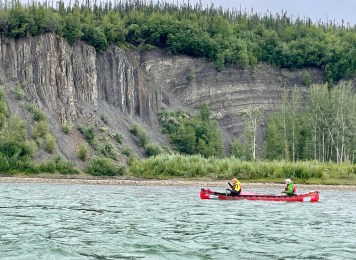
Paddling by massive rock walls formed by geological folding and faulting had us asking more questions. 

Cliff patterns betraying a history of geological rock folding.

Mike particularly grew fond of stones that resembled hard mudballs made up of small, marble and pea-sized stones cemented together. Only later, after some geologic investigating did I learn that these are glacial relics called diamictites.

A sample of a diamictites

The collection of various stones found in the conglomeration were diverse in their own origin. At one point in their history, they had been scraped up and carried for a slow ride on a glacier. Finally, after perhaps centuries of moving, the climate warmed and the glacier began to recede. At the melting terminus of the ice lobe there is usually an ocean or a large body of glacial meltwater. 

Imagine a piece of that glacier, falling into the water where it floats as an iceberg pitted with the small stones. Eventually the floating ice melts and the stone cargo sinks to the muddy bottom. Centuries pass and the plopped stones are now congealed in mudstone.  Another ice age descends and the massive moving sheet of ice breaks up the mudstone with its cemented small rocks into chunks of various sizes.

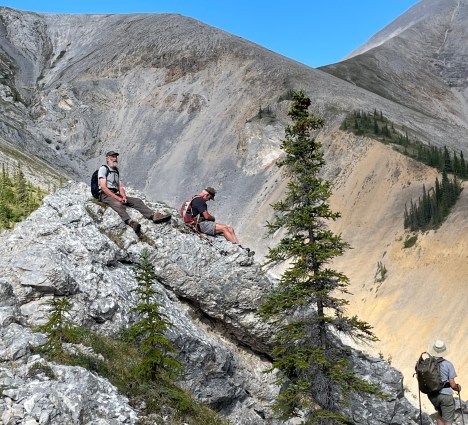
From one campsite, we were seduced by a distant peak. Several of us donned day packs with stowed lunches, water bottles and rain gear and headed uphill.

We eventually left the rocky wash and began to zigzag up through the park-like spruce anchored to the steep slope. Halfway up, a small flock of boreal chickadees flitted next to me. Their hoarse steady calls almost seemed to encourage me to keep climbing. 

Pausing and gazing at our distant route.

Finally three of us broke through the treeline into the alpine. Higher up we walked among limestone shards. Near the top we paused under the slight lean of a house-sized limestone outcropping. Dark clouds and distant thunder urged us to don our rain jackets and tuck in close to lime behemoth to avoid becoming lightening rods. We pulled up our hoods to fend off being pelted by tiny hail, called graupel.

Soon the winds carried the surly clouds away. The sunshine returned to us as we marveled at the irony of standing among the remains of ancient seabeds perched on top of this mountain peak.

After our high altitude beach combing, we began the long and slow descent back to our riverside cobbled camp.

With a deliberate descent, carefully watching each step, I would occasionally pause and look up at the landscape ravaged by water, wind and time. We purposefully avoided walking single file so as not to endanger those downhill of a runaway rock. Occasionally a step would loosen a rock and send it bouncing and clacking downhill. It is very likely that the dislodged rock would someday feel the flow of water as it begins the long slow saga of whittling a mountain to rounded cobble and eventually grains. 

Perhaps future paddlers might contemplate one of the rocks we accidentally loosened from the mountain top and sent to join a gathering of waters. Who knows, maybe that once-leaping rock just might settle along the river and uncomfortably poke a sleepy camper’s hip.

The Hart River weaving its way through rock.

Note: Thanks to author/geologist Marcia Bjornerud for introducing me to diamictites in her fine memoir Discovering the Subtle Wisdom of Rocks.

Older Men and a River

After emerging from the tent each morning, I walked across the cobble to the river’s edge. I squatted like a prospector panning gold, scooping handfuls of brisk water into my face. Whether camping near a river, lake or creek, I always bring three handfuls to my face. Then I mumbled a few words of gratitude, spoken in a hush in case one of the other guys heard me talking to myself. Mumbles and mutterings happen more frequently these days.

With my face dripping, I’m fully awake. I look up at the surrounding phalanx of silent mountains, and quietly say “thank you” several times.This was my recent practice when five other men and I paddled the Hart River, just below the Arctic Circle in the northern Yukon Territory.

Most of us had paddled remote rivers together but not all of us. Two Canadians and four Americans made up the crew. Our average age was 72.8333 years old. While hair color tends towards a hoary frost, collectively we are aged kids.

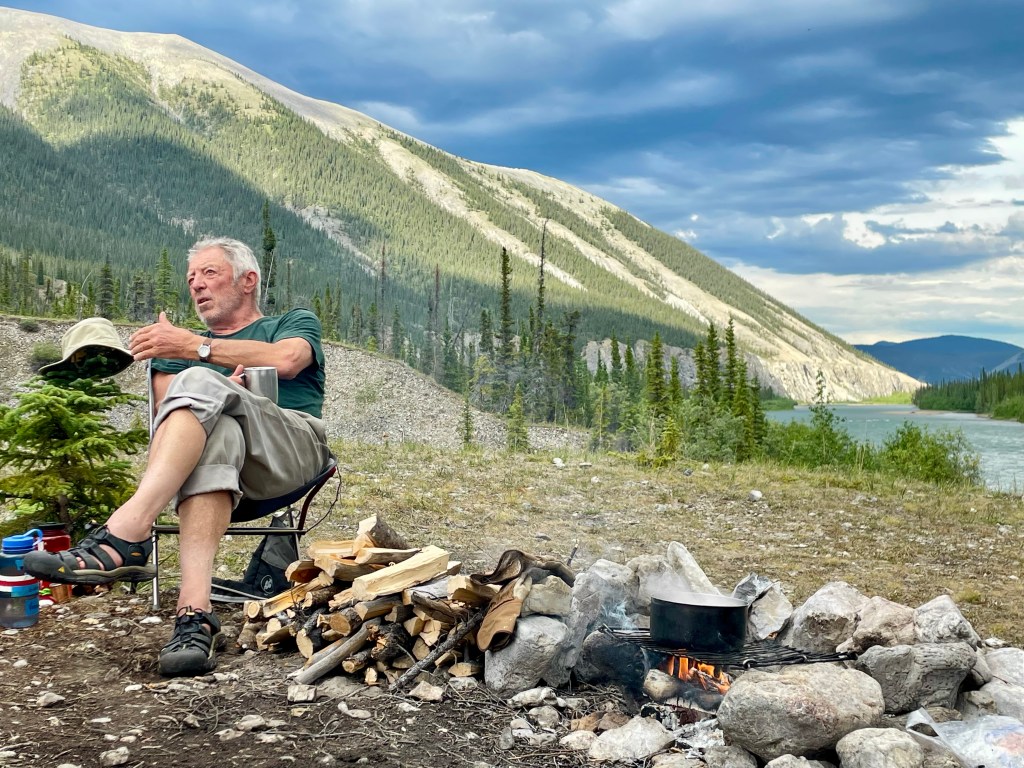
After the daily baptism, my internal compass guided me to the morning campfire where the other river worshippers were gathered in an incomplete circle of camp chairs for communal muttering and coffee. The wafting of tear-inducing campfire smoke always kept the circle broken.

After being transported on a highway for over five hours and then flown further north via a Turbo Otter on floats, we were blissfully far from the din of civilization and the cacophony of social ills, dysfunction, politics . . . oops, I’m being redundant. 

During its two-hundred mile flow, the Hart River passes beneath two mountain ranges: the Werneckes and the Ogilvies.  These steep slopes stunned us with sediments of tan, gray, maroon and black hues.  Rounding each serpentine river bend, a new peak would show itself.  I was dizzied by the height of the spires and blurted out a hearty “Wow!” From the canoe next to me I heard “Holy Smokes!” From the third canoe came a duet of “Oh my God!” and “Holy shit!”  

After a day of riding the river’s fast current, our chairs reunited in a ragged circle after the tents were set up. With a campfire calling us to order we had a  celebratory nip as we reflected on the day. 

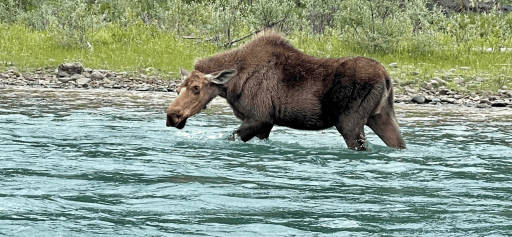
There was the cow moose standing in the river, just a few canoe lengths from us as we floated by.  With her ears laid back, hair bristling on her back and grunting displeasures she refused to run. She likely had a calf hidden in the riparian willows. 

We talked about the ease of a grizzly clambering up the steep bank as we shot through a small rapids next to the bear.  We wondered about the curious, lone buff-colored wolf that seemed as curious about us as we were about it. We were giddy as kids when we recalled the train of haystack waves in a Class III rapids that reminded us that we are never too old to be in the thick of it. 

We talked about maturing into senior citizens with the woes of hearing loss, more frequent peeing, reflecting more frequently about the days of yesteryear.  We discussed the advantages of pee bottles kept in the tent.  With such a vessel there is no need to crawl out of the tent, unsteadily stand up and ascertain where you were and then hope you were not peeing on the tent or someone’s camp chair and then crawling back into the tent and into the sleeping bag. As we shared feelings about social media and our changing bodies, we were in full agreement that out here, far from any roads, emergency support, and hospitals the real accident would be to die in bed.

We lamented the loss of wild places and critical thinking. How could we as a species be so ignorant about how our actions contribute to the whittling away of natural systems that allow us to live? 

Flickering campfire flames captured each of our gazes and carried us back decades. It was no surprise that memories were released of past cars we owned as young men. We also covered pranks of yesteryear as well as favorite old rock and roll tunes. Sadly most of us could not sing more than one or two lines. Awkward teen remembrances brought quiet, knowing chuckles. 

One of the guys asked, “Have you guys ever had sex in a canoe?” There were a few more chuckles while half of our circle confirmed that they had indeed had sex in a canoe. We moved on to football before anyone requested details of trysts in a canoe.

With happy hour completed, it was time for supper to be prepared. Each of us rose out of our camp chairs. A couple went on a wood gathering foray. One worked on supper while another fetched river water to filter for drinking. One strolled towards a willow thicket to pee. As he walked, I overheard him mumbling to himself, “Sex in a canoe?” There was a pause and he concluded, “I guess it’s never too late to explore a new frontier.”

Spring Walkers Beware

Twice this spring I have been in a position to save the lives of two pedestrians as they crossed a road. What makes it even more meaningful is that both walkers are considered “threatened” in Minnesota.

The first one I spotted was running, a weird description for a turtle, because it was more like swimming over the gravel road as fast as it could. I never pass up helping a Blanding’s turtle cross a road. 

After walking the turtle across the road, I peered into the front end of the shell where the shy turtle had pulled its head. I found myself smiling at the Blanding’s own perpetual, gentle smile on a face that reminds me of the most endearing alien of all time: E.T.  The turtle’s distinctive lemon-yellow throat is like a welcoming sunrise. 

I turned the turtle over to examine the bottom shell known as the plastron. The plastron is made up of scutes, resembling puzzle pieces put together. The slightly flat plastron told me it was a female turtle. The male’s bottom shell is slightly dished in.

I counted the growth rings on the scutes to get a rough idea of the turtle’s age. 

I could see 25-30 rings, but part of the scutes were worn smooth with age so it was  impossible to get a firm read. Blanding’s turtles can live to 70 years. The turtle I held was easily over three decades.

Given that it was early May, I suspect this turtle was making an overland trip from where it had spent the winter in hibernation to a shallow, warmer pond to mate. May and June are dangerous months for turtles. After mating this turtle will hike to a proper nesting area and then after the eggs are laid she will hike back to a wetland or lake for the summer. All this overland traveling might require road crossings.

The second turtle I helped, just last week, is a neighbor. I spotted her on the county road about half a mile from my house. She had already hiked about a quarter-mile from a shallow slough, where she had likely mated. Now she was headed east and still had a half mile to get to the deeper lake. I suspect she will lay her eggs in her excavated hole, near the intended lake, during the second week of June. 

With luck, the eggs will remain undiscovered by predators. Roughly sixty five days later they will hatch. Then the cookie-sized youngsters will scurry for the lake water where they are safer. That lake will be their primary home for a decade or more. They will not breed until they are 10-15 years old. Very little is known about young Blanding’s turtles. 

While all turtles can pull their legs, tail and head into the shell, the Blanding’s turtle has a flexible plastron that allows them to seal themselves up much better than most turtles in Minnesota. 

This turtle is threatened because it is losing its habitat: wetlands and adjacent open high ground. It is unlikely they will get off the “threatened” list with continual human residential and industrial development.

What would Dr. William Blanding, a keen naturalist from Philadelphia, think of the paucity of turtles that he first described to science back in the 1830s?

I encourage anyone who has the good fortune of coming across one of these gentle, ponderous, reptilian survivors to offer it some help in crossing the road. And if you are really lucky and find one nesting, please leave it alone. 

Coitus interruptus finalis

As the sun climbed out of the eastern horizon, I engaged in the spring ritual of attempted murder. And as of yesterday morning I am once more guilty on all counts of not manslaughter but turkey slaughter.

The big male turkey that I shot was totally innocent of any wrongdoing. I took advantage of his greatest weakness, his intense desire to breed as many hens as he can while fending off other similarly wired gobblers. 

All birds have tricks of the trade to attract a receptive mate. For many it involves songs, vocalizations, feather display, dance and even subtle signals that are unseen by us.  

Wild turkey gobblers show off their availability and “best-of-the-best” status by  boisterously gobbling and literally strutting his stuff. They draw attention to themselves by fanning their impressive banded tail. They can even slowly twist and turn the tail creating a silent, impressive exclamation point of sorts. While strutting, his almost gaudy, iridescent body feathers are erect, fluffed out, giving him the appearance of being larger than he really is. He drags the tips of his wings on the ground, giving them a truncated appearance.  His featherless head is fleshy, wrinkled and colored red, white and blue making it beautiful and ugly at the same time. 

A healthy dominant male might have a long fleshy protuberance growing out of its head between its eyes and its upper beak. Called a snood, it signals dominance in the company of other breeding males and it serves to attract the lady turkeys. Generally, the longer the snood the more relaxed and confident is the bird. If he is alarmed or not trying to impress turkeys, the snood retracts and its quite short.

An hour before killing the bird, as night melted from dark to gray, I set out a single decoy that resembled a hen turkey and scrambled in my camouflage attire to hide among the bony limbs of a downed oak. With my fingers, I raked away dried leaves and sticks to try and make the ground more comfortable to sit on. 

I listened to three different gobblers declaring their availability and superiority over all other males. Using a mouth call I attempted to give voice to the decoy in front of me. I have learned through the years of hunting that less is better when it comes to calling. 

Three gobblers, or toms, strutted their way across the field and all of them paused in their pursuits about one hundred yards from me. The largest and loudest of the three was obviously trying to get my darling hen decoy to come out and meet him. Impatient or bored he drifted north out of sight. 

Shortly after he left, the other two toms turned and headed back south and out of sight. And just like that there were no turkeys in view. 

I decided to pack up my calls and hurry south to a woods where I could put myself in a good position to call to the duo that had departed the scene. Just as I was ready to untangle myself from the limbs, I heard a gobble from the direction that the big boy had departed. He wasn’t that far away. So I settled in my nest and made a couple of soft yelping calls followed by comforting clucks and the most seductive turkey purrs I could manage. 

Less than two minutes later, through the thick brush I spied the patriotic colored head moving slowly and regally towards me.  His wings were reaching down on each side of his puffed self, like a mythical gunslinger with his hands poised above his holstered pistols. Each barred wing was etching the ground in fine scratches as if to show off his artistic path. He was dressed to the nines, body feathers all erect and percussively thrumming.  His tail fanned out like a rising sun. He promenaded ever so slowly in a parade of one, towards the faux turkey, the femmes fatale.

In a loud instant I ended the parade. The drum major went from full strut to a crumpled, stilled carcass. I was responsible for stopping his excitedly beating heart and stealing his strut.  I insisted the bird practice coitus interruptus finalis. 

Immediately after he died,the world got dead quiet.I did not pump my fist in celebration, nor did I shout “Oh yeah!” Instead I found myself saying in a hushed whisper, “I’m sorry.”

There was a time in my life when I might have been more robustly jubilant in making a killing shot. However as I age, I have come to realize that I am moving closer to my own termination date. Consequently, the preciousness of life is more immediate. 

I walked over to the dead bird, bent down and stroked its feathers and whispered “thank you.” The lousy part of hunting is that it requires the responsibility of killing. The day went from morning to mourning.

Moments like this have me wishing there was such a thing as “catch and release” hunting. An option would be to engage more fully in photography. However, I still enjoy eating a food that I have a direct relationship with. It’s imperative that lives, meat or vegetable, are sacrificed so that I might eat. 

I also believe that I am a product of evolution where more than 10,000 generations of humans survived and thrived by hunting and gathering. It’s part of my DNA.

In 1921-24, Knud Rasmussen, a Danish-Greenlander arctic explorer and anthropologist, traveled across the Canadian Arctic visiting bands of the indigenous Inuit. He took copious notes about their lifestyles, songs and practices. One shaman he interviewed told him, “Life’s greatest danger lies in the fact that man’s food consists entirely of souls.”

I love that quote. All food is life or was life. Whether we pulled a living carrot from its nursery soil, tore embryonic peas from its mothering pod or bought a package of chicken, we are responsible for the death of our food. 

And so this morning Nancy and I sat down to our ritual post-hunt breakfast of heart, liver, and gizzard mixed into scrambled eggs with sautéed freshly gathered nettles from the garden.  And like an echo, we whispered, “thank you.”

*Note: Each of these excellent photos were provided by Chuck Kartak. Chuck enjoys the balance of capturing live images of wildlife as well as gracing his dinner table with their meat.

 Page 1 of 26  1  2  3  4  5 » ...  Last »